ES90 Volvo Electric Cars ECO Review
Behind the wheel of the Volvo ES90: real-world range, ultra-fast charging and benchmark comfort
 Antonio Roncero @roncero_antonio
28 March 2026
14 min.
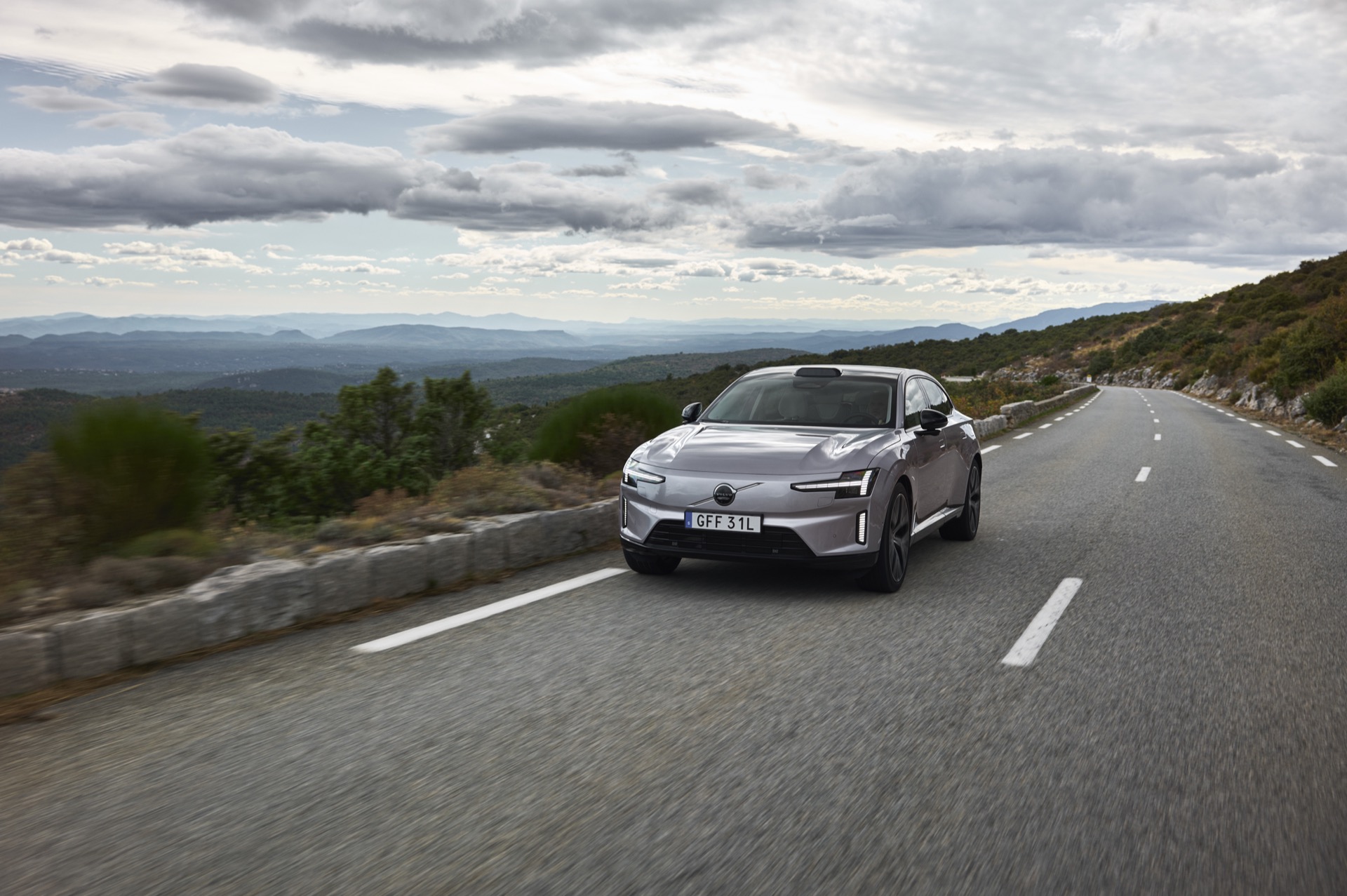
Silence and space for superb comfort, ultra-fast charging, a record-breaking drag coefficient… When you step out of the Volvo ES90 after a day behind the wheel, the only thing on your mind is when you’ll get to climb back in.
Some cars need a label, and others simply reject one. Among the latter is the Volvo ES90, an electric saloon that plays in the big leagues, able to go up against the likes of the Audi A6 e-tron, Mercedes-Benz EQE or BMW i5 without any complexes. This Volvo has nothing to envy in the German trio when it comes to technology, refinement or ride comfort.
At five metres long, with a 3.1-metre wheelbase – even longer than that of the EX90 – and a fastback silhouette that conveys elegance and sportiness, the ES90 pushes the wheels out to the corners of the bodywork, leaving overhangs trimmed to a minimum. This makes the most of every centimetre inside. But the ES90 is not only elegant, it is also efficient by design: its Cx drag coefficient of 0.25 is the best Cx for a model from the Swedish brand.
A design that conveys calm
Seen in profile, the ES90 projects authority at first glance, without resorting to aggressive lines. The roofline slopes gently towards the rear, creating a striking silhouette that will appeal even to those who only understand saloons with a clearly defined third box for the boot. Continuing with design details, the headlights with the unmistakable hammer-shaped light signature of Thor that characterise Volvo create a familial continuity that gives personality to a front end in which there is no clearly defined, recognisable grille. At the rear, the split C-shaped LED lamps have a signature of their own and a striking welcome and farewell light sequence.
Seven elegant exterior colours – I personally favour Vapour Grey and Aurora Silver – and wheels from 20 to 22 inches complete an exterior that, while not revolutionary, conveys modernity and that sense of Scandinavian design in which nothing is superfluous or missing. Well, to be purist about it, there is one thing I think is superfluous: the protrusion on the front edge of the roof, above the windscreen, which houses the LiDAR sensor. All in the name of safety. To sum up some recognisable details:
- “Thor’s hammer” light signature at the front
- Rear LED lamps with split C-design
- Up to 7 exterior colours and 20- to 22-inch wheels
The interior: a Scandinavian ode to well-being
If the exterior could pass unnoticed depending on the bodywork colour chosen, the interior is downright seductive. The quality of the materials, the feel of the surfaces and the coherence of the whole place the ES90 at the level of the best in the premium segment, and in some respects even above rivals with a longer tradition in this area. This is nothing new for Volvo, which in recent times has got us used to cars that score top marks for finish. Colours and textures inspired by Nordic nature, a carefully curated selection of materials – many of them recycled – and six-ambience lighting all contribute to making life on board a very pleasant and relaxing experience.
The seats play a big part here. The front ones are magnificent: enveloping without “squeezing”, with heating, ventilation, massage and multiple adjustments, including cushion extension. Setting the seat up exactly how you like it and enjoying a massage on the journey is not an exotic luxury; it is something many cars priced well below this Volvo already offer. But as with everything, there are categories. And the ES90 sits at the “top”.
The large wheelbase suggests generous space in the rear seats, and it delivers: passengers travel here as if they owned the car. It is worth pointing out, however, a nuance that should not be ignored: the floor sits high relative to the seat base, which is very common in electric cars with the battery under the floor. In an SUV this is not a problem, but in a saloon like the ES60 it means the knees are positioned somewhat higher than the hips, which on very long journeys can cause some discomfort.
The electrochromic panoramic roof also deserves special mention. It is not merely an aesthetic element: the ability to adjust its transparency makes it functional in any season, and it works really well. It comes as standard on the top Ultra trim, and costs around €1,200 on the intermediate Plus.
Technology: zero buttons and everything on the screen
At a time when debate about the digitalisation of the cabin has resurfaced, Volvo appears to have made its choice and is betting everything on the screen. The only notable physical button on the centre console is the volume one. Even steering wheel adjustment, mirror settings or roof transparency are controlled from the touch menu, although it is also true that many of the main functions can be activated via the voice control system. The visual result is a clean dashboard with extraordinary tidiness, but I still think it would not be too complicated to fit some physical controls for direct access to certain functions without breaking that design.
The 14.5-inch central screen in portrait orientation has high resolution and runs with remarkable fluidity: well-organised menus, quick response… and the Android Automotive operating system with integrated Google guarantees a solid ecosystem. Google Maps, Google Assistant and access to Google Play make day-to-day use very comfortable. The 9-inch instrument display does the job, although personally I find it a little small; this is not a problem from the Plus trim onwards, which includes head-up display as standard, projecting information onto the windscreen. 5G connectivity ensures updates and transfers at maximum speed wherever coverage allows, and the system supports wireless Apple CarPlay and Android Auto.
The more tech-savvy users will also appreciate the digital key: the ES90 lets you use your iPhone, Apple Watch or a compatible Android smartwatch as a key, with the option of sharing it with other people. Practical and well implemented.
The sound of silence… and of the B&W audio system
Let it be said upfront that what surprised me most when driving the ES90 was the soundproofing and insulation work, the atmosphere of calm that pervades the cabin. Especially considering that the unit I was able to drive was fitted with enormous 22-inch wheels, which, as you can imagine, were not exactly shod with narrow tyres. Even so, the level of cabin insulation is superb. Rolling noise reaches you filtered almost to nothing, wind is barely noticeable, and the electric motor, naturally, remains “mute”. If we accept the cliché that “silence is a luxury”, the ES90 is clearly a very luxurious vehicle.
In that context, the sound system has an ideal stage on which to shine. The standard equipment is a BOSE system with 14 speakers and 940 watts, which more than suffices. But the Bowers & Wilkins option with 25 speakers, a subwoofer, 1,610 watts and Dolby Atmos spatial sound is simply extraordinary. Playing music in a car where rolling and wind noise barely intrude, and being able to choose exclusive modes or settings such as “Abbey Road Studios”, is an absolute treat for the ears. Not so much for the wallet, as its price exceeds €3,500.
Boot and practicality: good, with caveats
The driving position, slightly higher than that of a conventional saloon, gives the driver a genuinely good view of the road. Rearward visibility is another matter when it comes to looking in the interior mirror, as it is considerably compromised by the steep angle of the tailgate and rear window. If you want to see anything behind you, you will need to travel with the centre seat folded down.
The main boot offers 424 litres, a figure that for the size of the car may seem modest. However, access is excellent thanks to the large tailgate, and the 40/20/40 split-folding rear seat configuration, an increasingly rare feature that many users nevertheless need, allows the space to be adapted flexibly. Being able to carry skis or golf bags without sacrificing all the rear seats, for example, is no small detail. At the front there is another 22 litres in a frunk under the bonnet, more than enough to stow the charging cables conveniently.
800 V technology: ultra-fast charging as a real advantage
For the Spanish market, Volvo has decided to bring only the rear-wheel-drive variant with a single motor. Its main specifications are:
- 333 CV motor
- 92 kWh battery
- Homologated range of up to 650 km
In other markets the S90 steps up with two all-wheel-drive Twin Motor versions producing 450 CV and up to 680 CV in the performance variant, with a 106 kWh gross-capacity battery. Not being able to choose the more powerful versions is not a problem in itself, because the ES90 Single Motor, with its 333 CV and 480 Nm of peak torque, is well equipped when it comes to performance. The acceleration figure confirms it: 0 to 100 km/h in 6.9 seconds. It is not the best figure in its class, largely because the ES90 is heavy, very heavy: more than 2,440 kg. Whether the sensations match the real dynamics is another matter, but we will come back to that later.
The best part is that, regardless of version, all ES90s have 800-volt technology. And this is not just a marketing point: it means charging at higher power with less heat generated, which speeds up the charging process and improves battery life. In the case of the ES90 Single Motor, we are talking about a maximum DC charging power of up to 310 kW, higher even than any of its German rivals. The Twin Motor versions reach up to 350 kW, and in either case the power drops to 120 kW at higher states of charge.
Translated into charging times, this theoretically means recovering around 260 km of range in 10 minutes. I say theoretically because ideal conditions are needed, which are hard to find, starting with the fact that there are not many charging points capable of delivering such high power. In any case, the important thing is that in ten well-spent minutes, with the battery preconditioned – the system takes care of this automatically if you programme the destination – you can recover enough range to travel by combining short charging stops with the occasional longer one, always under half an hour, to set off again with the battery at 80%, even if you had almost run it right down.
This high charging power largely compensates for the fact that real-world motorway range falls short of the 650 km homologated figure. The best approach if you want to travel calmly, without range anxiety and without having to drive efficiently all the time, is to plan stops every 300 km.
Safety and driver assistance: among the best on the market
The ES90 carries a true arsenal of sensors: 8 cameras, 5 radars, 12 external ultrasonic sensors, interior infrared sensors, a 360-degree camera and, crowning it all, the aforementioned LiDAR sensor on the roof, which enables genuinely impressive assistance functions and prepares the car for future improvements via over-the-air updates.
Processing is handled by two NVIDIA DRIVE AGX Orin processors in a dual configuration, with a capacity of more than 500 trillion operations per second. Combined with the sensors, this enables advanced driver-assistance functions that exist not only on paper: they work, and they work very well. The driver monitoring system – which detects whether attention is drifting from the road – and the door-opening alert that protects cyclists are details that show how Volvo understands safety: active, proactive and based on decades of real research. Travelling while trusting the route planner to schedule charging stops and arrive at the destination with the desired battery level, and letting the adaptive driving assistant guide you, is an absolute delight.
Behind the wheel: maximum comfort, some dynamism still to come
The chassis is up to the task. The twin-chamber air suspension with semi-active dampers is one of the best possible combinations for a car of this type: it absorbs imperfections with astonishing naturalness and keeps the car flat through corners, while generating a “magic carpet” sensation that rear passengers especially appreciate. Note, however, that it is not available on the entry-level version, it is optional on the intermediate one and only comes as standard on the top trim. The electrically assisted steering is well calibrated, with enough feedback without becoming heavy.
Yet there is one point where the ES90 does not fully win me over. Volvo has optimised the car for absolute comfort, and that is a legitimate decision: but the result is that the ES90 always responds as if permanently set to a softened ECO mode. There are no selectable driving modes, nor paddles on the steering wheel to manage regeneration. I think a system with driving modes that at least gave the option of selecting a sportier programme at will, with a more forceful motor response, and paddles that gave the driver a bit more say, would suit the ES90 wonderfully.
As it stands, it is excellent for anyone seeking that enveloping comfort; less so for those who occasionally want to feel they are driving a 333 CV car… and nor is there the option of a more powerful ES90.
Range, prices and equipment details
The Volvo ES90 Single Motor has a starting price of €71,252 for the entry-level Core trim. I won’t go into detail about everything it includes as standard; the equipment is genuinely very complete.
What is worth knowing is that there are two more trims. The ES90 Plus costs €75,307, and adds to the Core versions front seats with electric lumbar adjustment, head-up display, air purifier with advanced filter, specific upholstery and interior trim details, electric steering column adjustment and BOSE Premium sound system.
At the top of the range, the ES90 Ultra requires an outlay of €83,473, and here the equipment reaches a higher level of luxury and sophistication, with features such as the electrochromic roof, 21-inch wheels, 360-degree camera, front seats with massage function, heated and electrically reclining rear seats, high-definition pixel headlights, or the magnificent air suspension with the four-C chassis, which can only be fitted as an option on the intermediate trim and costs €2,120.
Conclusion: a benchmark that earns its place
The Volvo ES90 does not compete on price with the most affordable cars in the segment, nor does it aim to. It competes on concept, execution, technology and quality, and it is one of the best electric saloons in the premium segment. The only thing it lacks is that touch of dynamic soul that would turn it from excellent into irresistible.
Volvo ES90 – Image gallery
Technical specifications of this car

 Peugeot E-208 GTi: a battery-powered toy that revives the spirit of the 1980s sports cars
 New Lexus ES: luxury grows and goes electric
 First contact with the Dacia Sandero Hybrid 155: power and efficiency from €19,890
Deja un comentario