BMW M5, more than 30 years as the benchmark sports saloon
 Victor Alós Yus @sepelaci
17 October 2017
4 min.
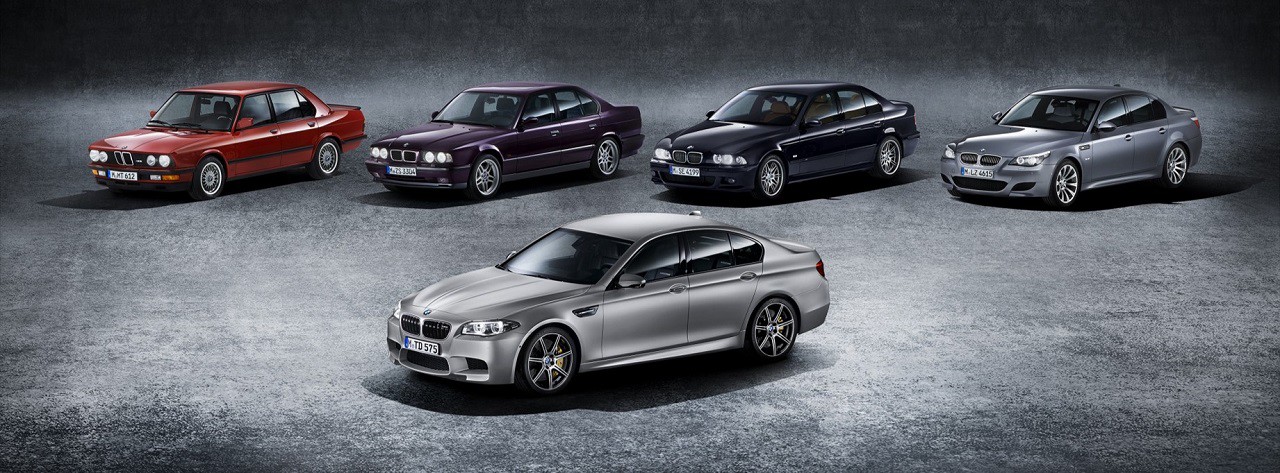
This year sees the sixth generation of the popular German sports saloon, and to celebrate, we look back at the previous generations and the model’s key features
Since it was launched on the market in 1984, the BMW M5 has been one of the sports saloons that has stood out remarkably both on the racetrack and on the road. A model that has improved generation after generation and has reached its sixth version, which is presented this year. The characteristics of this saloon allow it to deliver sporting performance while also being perfectly suitable for everyday driving on the city and country roads.
The first generation arrived after two earlier models, called M535i and M535i, which were the predecessors of the first-generation M5. This arrived in 1984 under the name M5 E28S and surprised everyone with its four-valve, six-cylinder inline engine with a displacement of 3.5 litres and 286 CV. A sporty version of a car from the brand that was capable of reaching 100 km/h in 6.8 seconds and a top speed of 245 km/h. It immediately became the fastest four-door saloon ever built up to that point.
1988: BMW M5 E34S/E34/5S
Four years after that first generation came the M5 E34S. This variant brought changes to the engine, which grew to 3.6 litres, and its power increased to 315 CV, which allowed it to reach a top speed of 250 km/h. In 1992 it benefited from an update that took the engine to 3.8 litres and power of 340 CV, and it also offered a Touring version, of which only 900 units were built and which has become a classic that many would love to have in their garages.
1998: BMW M5 E39S
The BMW M5 E39S arrived as the third generation and, although it kept the look of its predecessors, it swapped the engine for a 5.0-litre, four-valve V8. Power rose to 400 CV and peak torque to 500 Nm, which reached the rear axle thanks to a six-speed manual gearbox. Although the top speed stayed at 250 km/h, the 0 to 100 km/h acceleration time dropped to 5.3 seconds.
2005: BMW M5 E60/E61
The BMW M5 E10 hid under its bonnet a newly designed V10 engine that kept a displacement of 5.0 litres. The power of this fourth generation rose to 507 CV, and acceleration times dropped again, to 4.7 seconds. The speed limiter could be deactivated thanks to the M Driver package, which took the model up to 305 km/h. The seven-speed automatic gearbox and the Launch Control system helped to further reduce acceleration times and give it a more sporty character. As with the second generation, several units of the Touring version were built from 2007 onwards.
2011: BMW M5 F10M
The fifth generation arrived in 2011 and replaced the V10 engine with a 4.4-litre twin-turbo V8 which, despite being smaller, delivered better performance. Power climbed to 560 CV and peak torque reached 680 Nm. With the M TwinPower Turbo technology, the new M5 was equipped with a seven-speed automatic gearbox that took the model from 0 to 100 km/h in 4.3 seconds and up to 315 km/h.
In 2015 a competition package arrived that raised output to 570 CV, while also paying tribute to the original M5. Indeed, with a power output of 600 CV, which was considerably more than that first version offered.
2017: BMW M5 F90
And so we arrive at the sixth generation of the BMW M5, codenamed F90, which will produce 600 CV thanks to its new twin-turbo V8, which has had its turbochargers and injectors renewed. Peak torque has been set at 750 Nm from 1,800 rpm, and you can find all the information about this sixth generation of a car that makes a difference in this comprehensive article.


 Peugeot E-208 GTi: a battery-powered toy that revives the spirit of the 1980s sports cars
 New Lexus ES: luxury grows and goes electric
 First contact with the Dacia Sandero Hybrid 155: power and efficiency from €19,890
Deja un comentario