Mercedes-Benz Aims to Improve the Charging Experience with Its ELF Test Van
 Javier Cantagalli
14 October 2025
3 min.
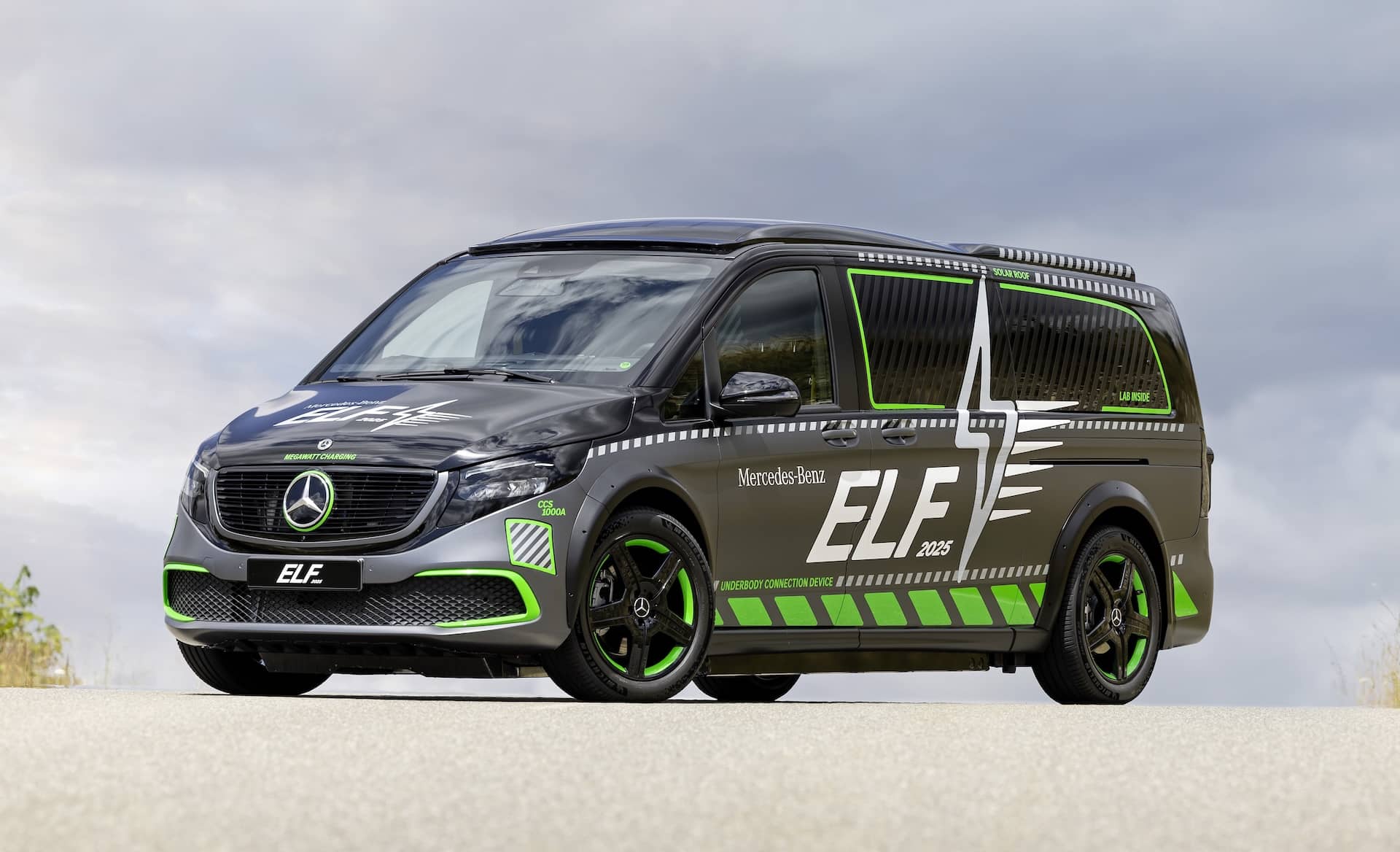
With the ELF, Mercedes-Benz is testing cutting-edge technologies that promise to transform electric mobility and bring about a more sustainable, connected future.
Mercedes-Benz aims to go one step further than its competitors with its new experimental ELF van, an electric-powered vehicle designed to explore advanced charging technologies. This mobile laboratory integrates multiple innovations related to ultra-rapid charging, as well as bidirectional, solar, inductive and conductive solutions, with the ultimate aim of evaluating and redefining the limits of smart charging.
As we have already mentioned, the ELF stands out for its ultra-rapid charging capability and, to this end, incorporates the CCS system, common to any electric vehicle, but optimized in this case to reach a maximum charging power of up to 900 kW, which theoretically should allow a 100 kWh battery to be charged in just ten minutes. Something unthinkable today in any series-production electric vehicle intended for the European market.
Getting Ahead of the Future
As we already told you here at HighMotor, Mercedes-Benz already demonstrated with the AMG GT XX prototype, developed in collaboration with Alpitronic, that ultra-rapid charging of an electric vehicle approaching one megawatt is possible, achieving on that occasion an average charging power of 850 kW. The ELF van is also, however, compatible with the MCS standard, designed primarily for electric trucks and buses, with which reaching one megawatt of charging power is indeed possible.
The ELF van’s compatibility with the MCS standard aims to evaluate the thermal resistance and performance of high-voltage batteries and cables under extreme conditions, with a view to optimizing the performance of vehicles designed for long-distance routes with minimal downtime.
Beyond ultra-rapid charging, the ELF van is also used by Mercedes-Benz engineers as a test bench for bidirectional charging solutions, which allow the energy stored in the vehicle’s battery to be returned to the home -V2H- or to the electricity grid itself -V2G-. This van from the German manufacturer also supports bidirectional charging in both direct and alternating current. Current Mercedes-Benz models such as the new electric CLA or GLC already support bidirectional charging, and the company plans to launch services using this technology in Germany, France and the United Kingdom this same year.
Arrive, Park and Forget About Everything
Finally, it should be noted that the ELF van also explores inductive charging, which transfers energy without cables through a system integrated into the ground. With a power of 11 kW in alternating current, this technology is ideal for homes, fleets and robotaxis, offering convenience and discretion. Automated conductive charging, on the other hand, uses floor plates that facilitate precise parking, starting charging through a connector on the vehicle with the same 11 kW AC power. Both solutions eliminate the need to connect cables, improving the user experience.


 Peugeot E-208 GTi: a battery-powered toy that revives the spirit of the 1980s sports cars
 New Lexus ES: luxury grows and goes electric
 First contact with the Dacia Sandero Hybrid 155: power and efficiency from €19,890
Deja un comentario