Mercedes-Benz crosses Europe with the eActros 600 to test MCS charging at one megawatt
 Javier Cantagalli
25 January 2026
3 min.
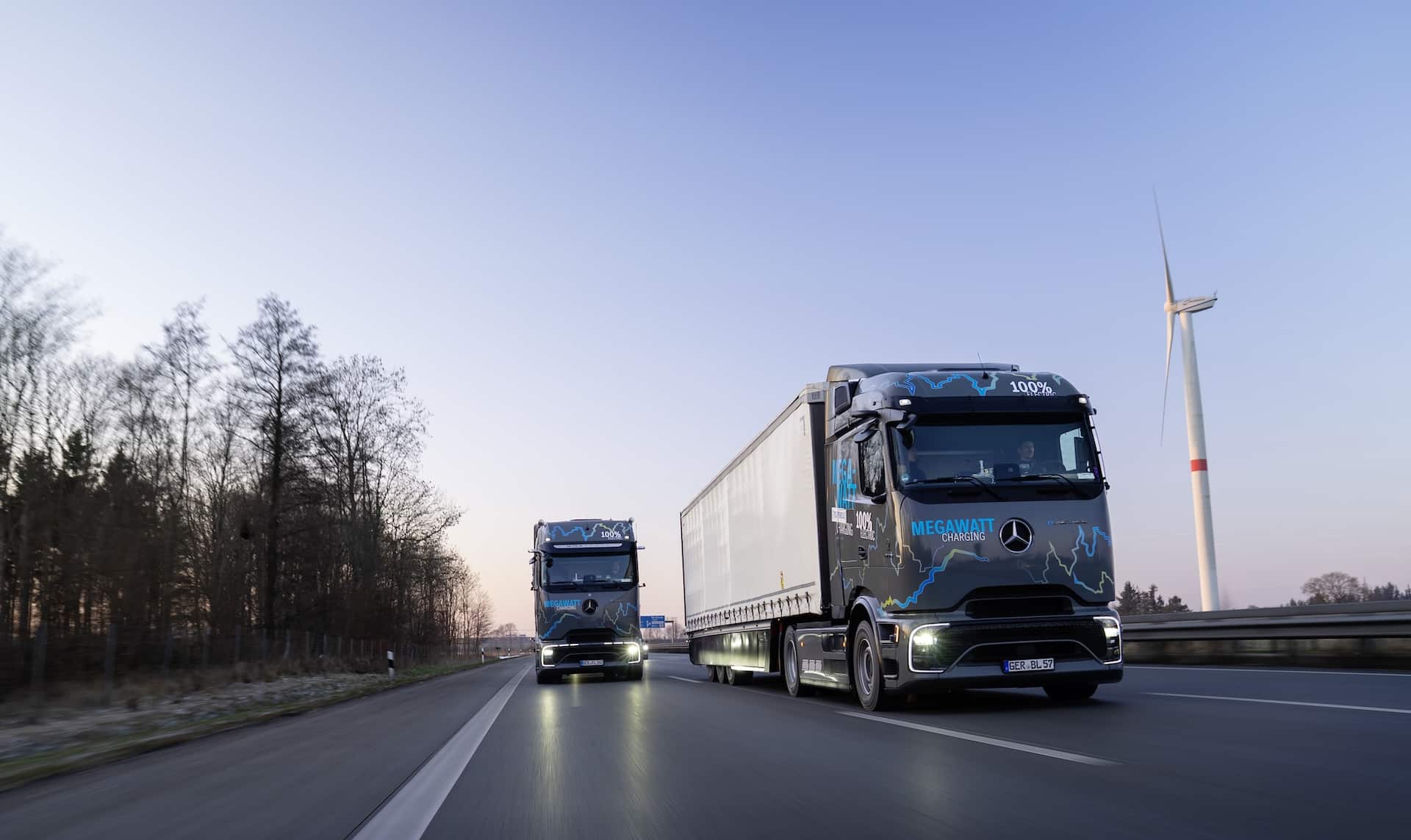
The MCS standard will make it possible to run transport routes that were previously not viable, by considerably reducing the time spent at each stop to recharge.
Mercedes-Benz’s heavy-duty truck division is driving the development of the one-megawatt charging system (MCS) through a demanding on-road test. The company has sent two test units of the eActros 600, driven by development engineers, on a journey of about 2,400 kilometres, starting from the Wörth am Rhein plant in Germany and ending in the town of Linköping in southern Sweden.
The route crosses the Netherlands, Belgium and Denmark, with recharging carried out mainly at MCS charging stations, both public and private, specially prepared for heavy vehicles. The main objective of this initiative is to verify the perfect compatibility between the truck and chargers from different manufacturers, as well as to collect valuable data on the practical behaviour of the system in real conditions, taking into account the low temperatures recorded at this time of year in northern Europe.
Once the route is completed, Mercedes-Benz engineers will analyse in depth the charging curve, the average effective power and the overall performance of the MCS infrastructure along the route.
The Mercedes-Benz engineering team considers that one of the greatest challenges they will have to face lies in harmonising the vehicle with the different charging systems available. The extremely high current of the MCS standard requires very demanding thermal management, so a road test like this offers a unique opportunity to evaluate these aspects in everyday operating situations.
What advantages does the new MCS charging standard offer?
The MCS standard allows power of up to 1,000 kW, a significant improvement over the current CCS standard, which is limited to 400 kW. In the case of the eActros 600, the MCS standard makes it possible to increase the battery charge from 20 to 80 per cent in about 30 minutes, compared with roughly an hour needed under the CCS standard. This drastic reduction in charging times represents a completely disruptive change in long-haul logistics, enabling routes to be completed within a single working day that were previously not viable.
The main obstacle, however, that logistics companies will face is the limited public MCS infrastructure currently available in Europe. The small number of MCS charging points found on major logistics routes is explained by the fact that very few trucks compatible with this standard are on the road and because the international standardisation process has not yet been concluded. Although this should change in the coming years.
As we already told you here at HighMotor, Mercedes-Benz achieved in 2024 the first charge of a prototype eActros 600 at one megawatt at its development and test centre in Wörth am Rhein.
Finally, it should be noted that the MCS port will be offered as an option on the series production version of the eActros 600, allowing customers to prepare for the future of electrification in long-distance transport.


 Kia offers an electric range of 10 models, 50 versions and 400 possible combinations
 The seven finalists for the 2027 European Car of the Year (COTY) are exclusively electric
 Peugeot E-208 GTi: a battery-powered toy that revives the spirit of the 1980s sports cars
Deja un comentario