Michelin Pilot Sport 4, review and wet-weather test
 Diego G. Moreira
5 May 2017
4 min.
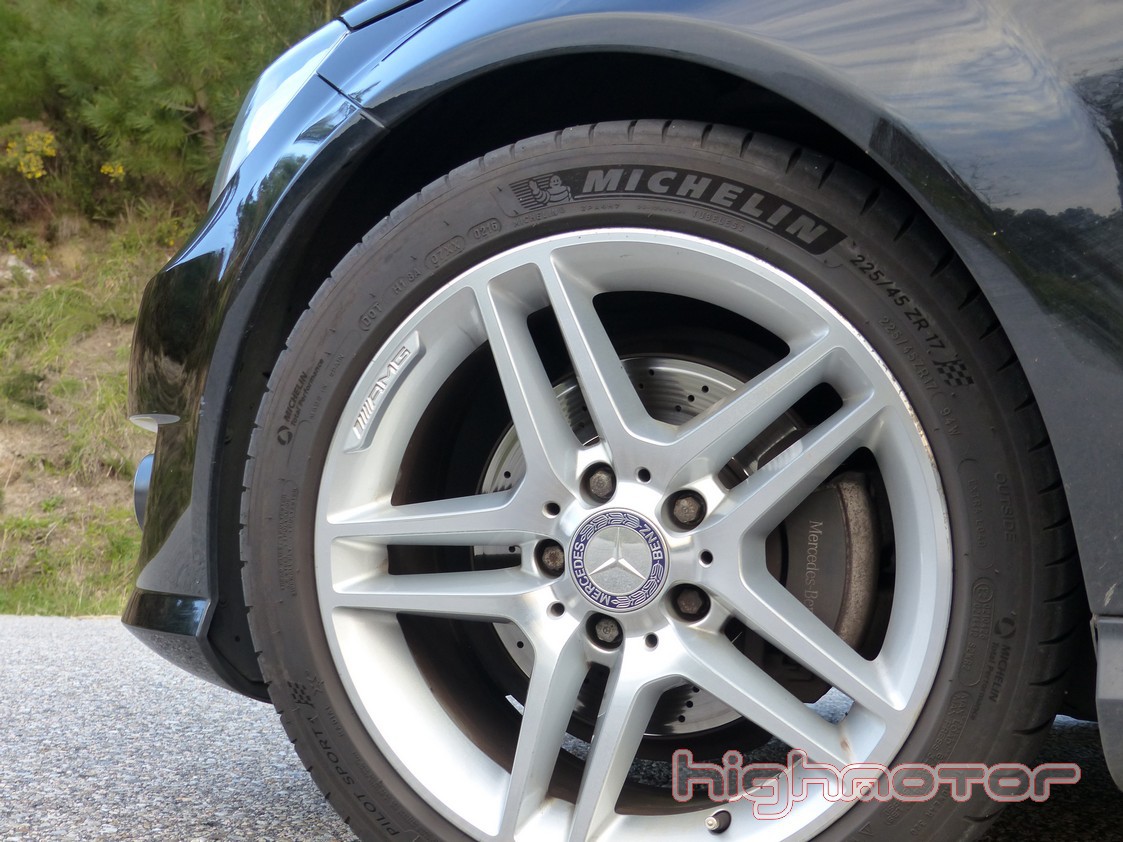
Long-term tyre test where we analyse the behaviour of the Michelin Pilot Sport 4, in this case their wet-weather response and wear.
For over a year we have been testing the Michelin Pilot Sport 4, tyres designed for sporty vehicles, though not reaching supercar territory, where the new Michelin Pilot Sport 4 S take that spot. We have already shared our first impressions of the Michelin SP4, but we still needed to talk about their wet-weather behaviour, something we have had many chances to check in our day-to-day driving in Galicia, where rain (though a little late this year) is usually plentiful.
We recall that we fitted the Michelin SP4 to a Mercedes C-Class in AMG trim, with a front tyre size of 225/45 R17 and rear tyre size of 245/40 R17. The C-Class we are testing the tyres on is a diesel, with some sporty touches (such as firmer suspension and the wheels) but which ultimately aims for onboard comfort, so the challenge of seeing whether we could improve certain dynamic aspects was an interesting one.
14,000 km – 12 months – Wet-weather test
A few months ago we analysed their dry behaviour over the first 5,000 km, highlighting a characteristic that defines the Michelin Pilot Sport 4 very well: the response to steering inputs is more precise and quicker than with other tyres, improving the car’s response at high speeds. Another detail we already noted at the time is a slight reduction in consumption. I usually drive certain routes regularly, so it has been easy to make consumption comparisons on country roads. Specifically, there is an 80 km stretch I drive several times a month on a country road, and there I have noticed, compared with the previous tyres, a slight reduction of 0.2 l/100 km in the car’s consumption (where it used to hover around 5.0 or 4.9 litres per 100 km, I have now managed to reach 4.7 litres per 100 km). It is a very flat route with hardly any traffic, which makes it easy to compare these figures.
Focusing on wet-weather behaviour, we are testing these tyres in Galicia (a land of winter rain), so on our regular routes we have been able to check the grip of the Michelin Pilot Sport 4 on wet asphalt.
The average temperature on rainy days is around 13-15 ºC. There is a regular country road route, with a double-lane overtaking section on an uphill, and at the end of that lane there is a fairly demanding bend, especially at high speed, where it is easy to safely test the tyres’ grip. It is surprising that, even with wet asphalt, you can enter that bend faster than with other tyres. For reference, I had the previous tyres fitted to the car, which on wet roads did not allow me to take the bend at more than 90 km/h (safely), whereas with the Michelin Pilot Sport 4 I manage to reach 100 km/h with complete confidence on that stretch.
Another critical point when driving on wet asphalt, or in Galicia’s case, depending on the day, flooded roads, is the typical motorway sections where the car can easily lose grip when it slightly enters aquaplaning. These are areas where the asphalt does not drain properly, and with fairly wide tyres it is easier to notice the loss of grip. Again, compared with the tyres I had before, the feeling is one of greater control: water evacuation is faster from the tyre (you can feel its new silica-based rubber compound) and more effective, which lets us pass through these areas at the wheel with more confidence, sometimes even without needing to lift off the accelerator.
Finally, there is braking on wet roads. Here we go straight to the official figures. In fact, the tyre label gives it a class A for wet braking, and according to a study carried out by TÜV SÜD, the Michelin Pilot Sport 4 was the best in its category for wet braking (a study performed at 80 km/h) compared with the main tyre brands on the market.
Durability and wear after more than 14,000 km
To finish, we need to talk about the wear the tyre is suffering, now that we have passed the 10,000 km barrier (specifically, at 14,000 km). In our measurements, the tread on the front tyres is at 5 mm and on the rear (rear-wheel-drive vehicle) at 4 mm. It is on track for the expected durability of 29,000 km according to the various tests carried out by Dekra for Michelin.


 Peugeot E-208 GTi: a battery-powered toy that revives the spirit of the 1980s sports cars
 New Lexus ES: luxury grows and goes electric
 First contact with the Dacia Sandero Hybrid 155: power and efficiency from €19,890
Deja un comentario