Audi Q4 e-tron Electric Cars ECO Review SUV
New Audi Q4 e-tron: more range and technology to remain one of the reference electric cars
 Antonio Roncero @roncero_antonio
10 August 2026
15 min.
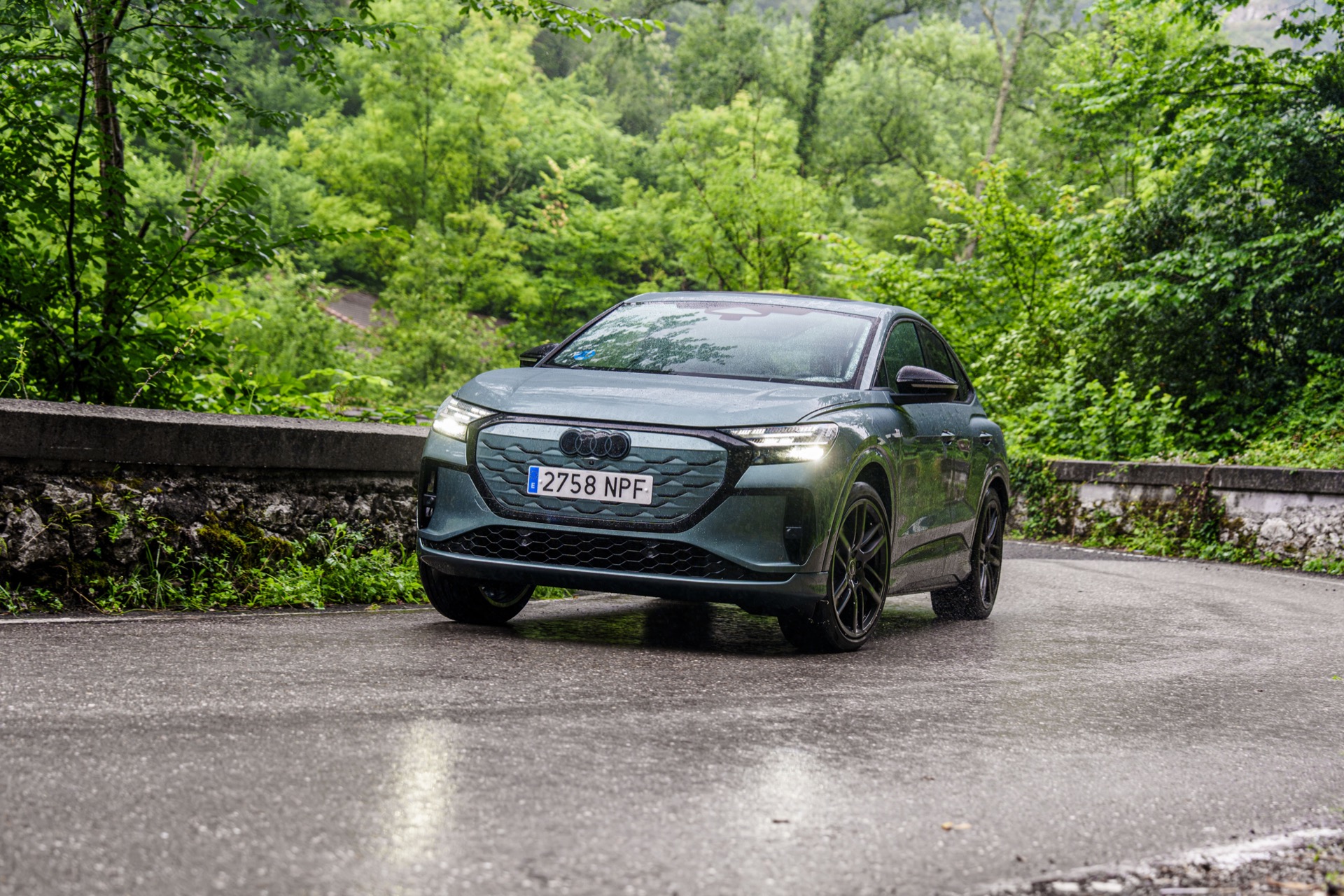
We test the revamped Audi Q4 e-tron, which improves efficiency, range, quality and technology without changing a formula that already worked very well. In my opinion, the performance version is once again the most balanced in the range.
Five years have passed since I first got behind the wheel of the Audi Q4 e-tron. Back then I titled that road test saying it was “the electric SUV I would buy”, because the Q4 offered practically everything I could ask of a family electric car at the time. It was spacious, well built, had magnificent handling and, with the large battery, already made it possible to plan long trips with a certain peace of mind, which was not so easy back then. But five years in the car world is always a long time. And with the evolution we are seeing in electric cars, in this case they almost seem like an eternity.
That is why I was particularly interested in checking how the Q4 has aged and, above all, whether the improvements Audi now introduces are enough to keep it competitive. The answer is yes. The new Audi Q4 e-tron 2026 is not a profound overhaul. Audi has focused precisely on those areas where the car was starting to show the passage of time the most: range and efficiency, multimedia system, interior presentation and driver assistance systems. And the changes have really suited it well.
The “problem” faced by the model that, until the arrival of the future A2 e-tron at the end of the year, remains the entry point to Audi’s electric range is that while the Q4 has evolved, its rivals have not stood still. In 2021 the Audi stood out quite clearly among premium electric SUVs of its size. Now it has to compete not only with models such as the BMW iX1 and iX2, Mercedes EQA, Volvo EX40 and EC40, but also with cars like the Tesla Model Y, the renewed Skoda Enyaq, the Volkswagen ID.4, the Cupra Tavascan, the Ford Explorer or many other Asian electric SUVs that offer a great deal of technology, range and equipment at very competitive prices.
A design that needed few changes
Audi has not complicated things much with the exterior either. The Q4 still looks like a Q4, and there was no need to go crazy. The main changes affect the front, with a new interpretation of the Singleframe grille now painted in body colour, slightly redesigned bumpers and some elements modified to improve aerodynamics. There are also new wheel designs, colours and additional lighting options. The headlights can feature different selectable digital light signatures via the MMI, while at the rear there are second-generation digital OLED tail lights capable even of displaying certain graphics to warn other road users of potentially dangerous situations.
As I said, these are not revolutionary changes, but they modernise the image sufficiently. And personally I still think the same as when the Q4 first appeared: its proportions are very well achieved. At a length of 4.6 metres, it has a reasonable exterior size for everyday driving without giving up a truly practical interior. And this remains one of its main virtues.
Here too, it is worth highlighting how well Audi’s Sportback formula works in the Spanish market. Normally, when talking about a coupé-style SUV, you have to accept some practical sacrifice in exchange for a sportier body, but in this case the compromise is minimal. The more pronounced roofline drop greatly improves the car’s silhouette and also clearly benefits aerodynamics: the drag coefficient is approximately 0.26 compared with 0.28 for the SUV, a difference that helps explain why the Sportback homologates a few additional kilometres of range, though not enough for this figure to be particularly significant.
Things get interesting when you open the tailgate. The Sportback offers 527 litres of boot space, even slightly more capacity under the parcel shelf than the SUV, and it still has a huge tailgate and a very usable loading aperture. The shape of the body does not mean any meaningful loss of rear legroom. There is somewhat less headroom available — around four centimetres according to measurements — but in practice it remains perfectly usable by average-sized adults, although access to the rear seats is a little more comfortable in the SUV due to the sloping line of the roof.
Inside is where the new Audi Q4 e-tron changes the most
While you have to look a little harder on the outside to discover the novelties, once you open the door the evolution becomes much more evident. The dashboard has been redesigned around what Audi calls the digital stage, following the philosophy we have been seeing in the brand’s latest models. The instrumentation uses an 11.9-inch screen, while the new central MMI grows to 12.8 inches. A third 12-inch screen for the front passenger can optionally be added. But more important than the size of the screens is how they work. The previous Q4 was never technologically poor, far from it. In fact, in our 2021 test we already highlighted the clarity of the instrumentation and multimedia system. But just using the latest Audi models shows that the brand’s digital experience has advanced enormously.
The new One Connected Infotainment system is faster, more intuitive and visually much more modern. The organisation of the menus makes it easy to find the main functions, and the voice assistant Audi assistant allows various functions to be controlled using natural language. It even integrates ChatGPT for certain queries. All of this may seem secondary when buying a car, but it stops being so when you have to live with it every day. A fast screen, with well-organised menus where you can reach a function without four or five taps, is far more important than having twenty apps you will use twice during the vehicle’s entire life. The only thing I still don’t entirely like is the car’s navigation system, whose directions are not always easy to follow. In this respect I prefer to use the wireless connection, Apple CarPlay and my favourite app, which is Waze.
The centre console is also improved, with two 15 W cooled wireless chargers, and Audi has worked on materials and trims. The so-called Softwrap extends from the doors along the dashboard and helps create a visual sensation of higher quality. And here the Q4 also seems to make progress. One of the few criticisms that could be levelled at the previous model was that, although it was a perfectly well-assembled car, some surfaces and certain plastics did not convey the premium feel one might expect given its price and the fact that it is a Audi. Now the presentation is more refined and the cabin is much more in line with the latest-generation Audi models. In fact, in its press kit the brand announces an improvement in the quality of the materials used as one of the novelties.
More range without fitting a bigger battery
Audi keeps the two known batteries, with 63 kWh gross and 59 kWh usable in the entry version, and 82 kWh gross and 77 kWh usable in the higher versions. What changes to deliver greater range is efficiency. The new rear electric motor, APP350, is combined with updated power electronics whose inverter uses silicon carbide semiconductors. Software improvements have also been introduced, along with changes as seemingly small as using a lower-viscosity lubricant in the transmission. Adding all these measures together, Audi speaks of an efficiency improvement of close to 10% compared with the previous model.
It may seem like a mere technical detail, but in an electric car this is precisely the kind of evolution I find most interesting. The solution to increasing range should not always consist of fitting ever larger, heavier and more expensive batteries. Covering more kilometres using practically the same energy is a far more intelligent development. Combined with the improved aerodynamics, the result is that the Q4 Sportback e-tron can now reach up to 592 km WLTP, while the SUV reaches 578 km in its most efficient configurations. And those roughly 600 homologated kilometres raise the bar over the previous model by around 70 additional kilometres, which is no bad thing.
Q4 e-tron performance: the version I would choose
The entry Q4 e-tron uses the small battery and offers 150 kW (204 CV) with rear-wheel drive. Above it sits the Q4 e-tron performance, which combines the 82 kWh battery with a rear motor producing 210 kW (286 CV) and 545 Nm. Finally, the Q4 e-tron quattro adds a second motor for all-wheel drive and offers 220 kW (299 CV). The most balanced choice seems clear: the smaller variant may make a lot of sense for those who mainly use the car in town or on interurban routes and charge regularly at home. It offers more than enough performance and considerably reduces the entry price. But for a car that will also be used for long journeys, the performance is once again the most recommended version, exactly as with other Audi electric models.
For 5,600 euros more than the base model you not only get more power, but also the 77 kWh usable battery and greater range. The 286 CV also provide more than enough performance for any situation, without having to carry the extra weight, consumption and price of the quattro version if you really don’t need all-wheel drive. The quattro makes sense for those who particularly value that traction capability, regularly drive in areas with difficult weather or simply want the best performance. But for most users, the performance seems to me the most logical purchase.
Charging is also improved. Versions with the large battery accept up to 165 kW on DC, enough to go from roughly 10 to 80% in about 28 minutes and recover up to 185 km of range in ten minutes under the right conditions. The battery can be preconditioned automatically via the route planner or manually from the multimedia system. And this is where the Q4 e-tron falls behind its rivals. 800-volt electric platforms already allow well over 200 kW and even approach or exceed 300 kW in some cars. Although, mind you, you should not focus only on peak power, as we explained at the time in this article on fast charging.
On a journey, the real time needed to recover range is what matters, and here the combination of modest consumption, almost 600 km WLTP and a 10-to-80% charge clearly under half an hour makes the Q4 perfectly usable for long trips. It also features Plug & Charge, so at compatible chargers you simply connect the cable and the car identifies itself automatically, starts charging and then handles payment. A small detail that, when you use the public network a lot, ends up being quite valuable.
The first Audi with V2L and V2H
There is also a novelty that is not so new if we look at its competitors, but of which Audi is proud: the Q4 is the first model from the brand prepared for bidirectional charging. Using the V2L function it can supply up to 2.3 kW at 230 volts to power external devices through a socket in the boot or an adapter connected to the charging port. You can connect tools, small appliances, charge electric bicycles or use the car as a power source during an outdoor activity. As I said, it is nothing to boast about, since some electric city cars have had it as standard for some time.
It is also prepared for Vehicle-to-Home (V2H), so that, using a compatible installation, the vehicle’s battery can act as energy storage for a home. For now it is not offered in Spain. But if you have solar panels at home and the V2H ecosystem eventually spreads, having a mobile 77 kWh battery in the garage opens up very interesting possibilities for the future.
It still drives like a Audi
The Q4 has always been one of those electric cars that manage to disguise their weight quite well. The driving position feels very natural, the steering is precise and the car maintains a very well-achieved balance between comfort and control of body movements. On winding roads it feels more agile than its dimensions and weight would suggest. It does not aim to become a sporty SUV, but it inspires confidence when you raise the pace, with steering that is sufficiently direct and a front axle that enters corners with precision. This is one of the areas where it continues to set itself apart from some electric rivals that may have better figures on paper but offer a much more artificial driving feel.
Add to that the acoustic insulation, especially good on the motorway, and the instant power delivery typical of an electric car. With 286 CV, the performance version is particularly pleasant because it has more than enough power to overtake or merge onto a motorway quickly, without chasing that rather absurd supercar-style acceleration that some manufacturers seem to consider essential in any electric vehicle.
Audi has also updated its assistance systems. Among the new features, the adaptive driving assistant plus stands out, capable of helping with acceleration, braking, distance keeping and lane centring. Above 90 km/h it can also assist with lane changes on the motorway when the driver activates the indicator. Another interesting function is the use of online information to keep the vehicle correctly positioned even when lane markings are hard to recognise. It can also be fitted with a parking assistant capable of memorising usual manoeuvres.
These improvements may not be decisive when configuring the car, but they fit precisely with the philosophy of this update: making everyday life easier without trying to impress with features that are then barely used.
Five years on, it is still a very good car; the problem is the rivals
The Q4 we tested in 2021 arrived at a time when there were still not many truly convincing premium electric SUVs. Now the situation is completely different. BMW has the iX1 and iX2, Mercedes offers the EQA and EQB, Volvo has the EX40 and EC40, and Tesla continues to put on the table a combination of space, efficiency, performance and price that is very hard to match with the Model Y. They are joined by alternatives such as the Skoda Enyaq and Enyaq Coupé, the Volkswagen ID.4 and ID.5, the Cupra Tavascan, the Ford Explorer, the Hyundai Ioniq 5, the Kia EV5 and a growing list of Asian models. Many offer more standard equipment and some charge considerably faster.
The Audi must therefore justify its price in a different way. And it still does so mainly through driving quality, set-up, ergonomics, interior space, presentation, technology and the feeling of a well-resolved product. There is no single feature that makes the new Q4 extraordinary. Its strength lies precisely in the sum of all of them.
Price of the 2026 Audi Q4 e-tron
The Audi Q4 SUV e-tron with a 63 kWh battery starts from 49,970 euros, while the Sportback starts at 52,070 euros. The Q4 e-tron performance, which is the version I would particularly recommend, costs from 55,570 euros with SUV bodywork and 57,670 euros as a Sportback. Finally, the Q4 e-tron quattro starts at 58,570 euros, or 60,670 euros in Sportback form. The difference between the SUV and Sportback is therefore 2,100 euros.
And here too I would be quite clear: if the budget allows, the Sportback seems particularly interesting to me. Not only for the extra kilometres of range provided by its better aerodynamics, but because its coupé design really suits it and the practical penalty compared with the SUV is minimal.
In summary, the new Audi Q4 e-tron is still a very good electric car. It has more range without resorting to a bigger battery, consumes less, offers a much more modern digital experience, improves the perceived quality of the interior, charges slightly faster and adds features that can genuinely be useful, such as Plug & Charge or bidirectional charging. And if I had to spec one, I would apply practically the same logic I used in 2021: I would avoid both the base version if I am going to travel frequently and the most powerful one unless I really need quattro traction. I would go for the Q4 e-tron performance with 286 CV and a 77 kWh usable battery, and with the Sportback body style.
Audi Q4 e-tron | Image gallery
 Peugeot E-208 GTi: a battery-powered toy that revives the spirit of the 1980s sports cars
 New Lexus ES: luxury grows and goes electric
 First contact with the Dacia Sandero Hybrid 155: power and efficiency from €19,890
Deja un comentario