Model 3 Tesla Sedans Electric Cars Tests
Tesla Model 3 Premium Long Range Rear-Wheel Drive: the version that puts efficiency ahead of everything else, with 750 km of range
 Óscar Sanz
14 September 2026
8 min.
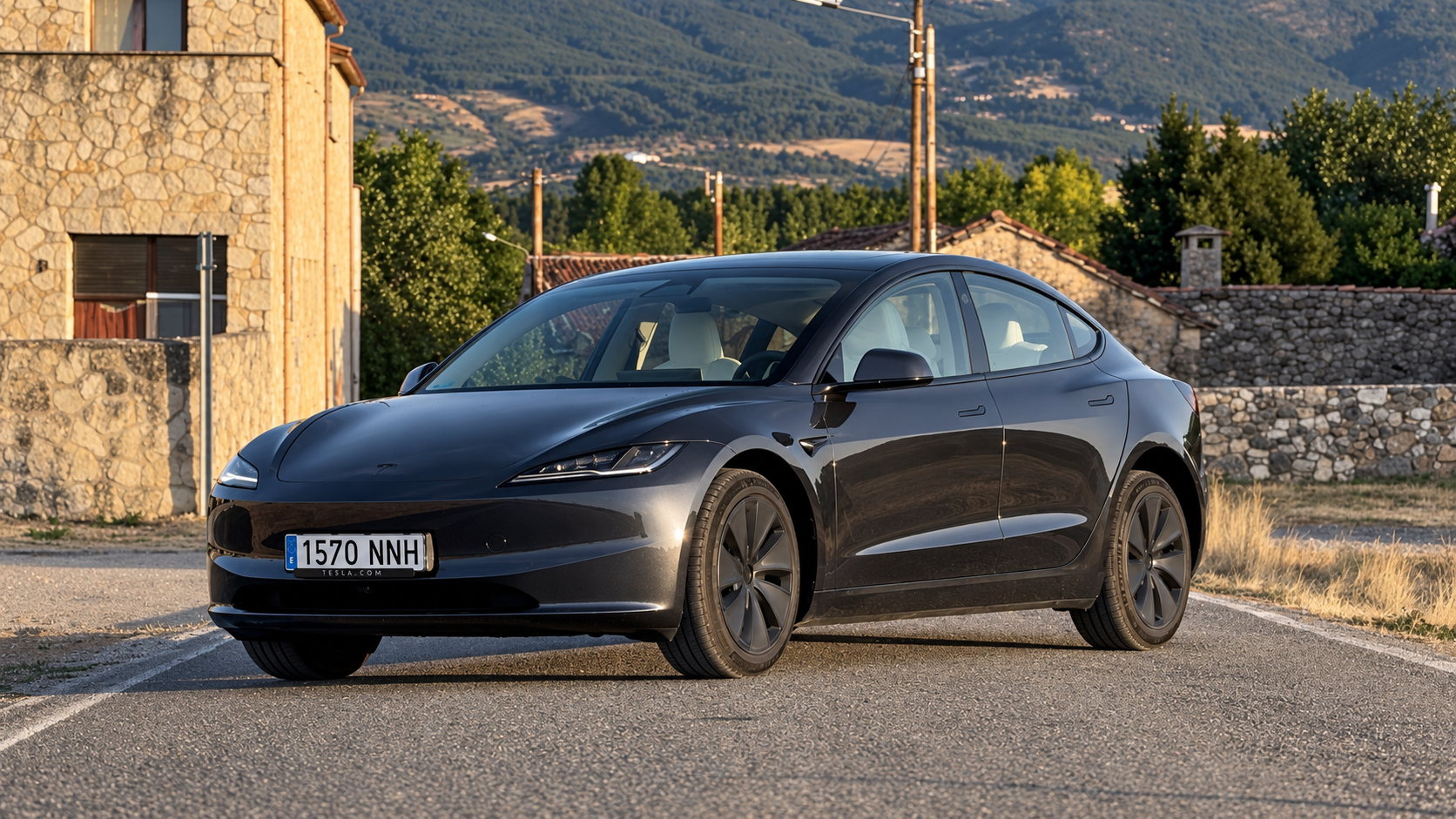
Electric cars have advanced so much in recent years that talking only about power is starting to make less and less sense. The real battle now is efficiency: achieving more range not necessarily by fitting ever-larger batteries, but by making better use of every kilowatt-hour available. And that is precisely where this Tesla Model 3 Premium Long Range Rear-Wheel Drive wants to make a difference.
The recipe seems simple: a single motor, rear-wheel drive, very refined aerodynamics and energy management that makes it possible to homologate 750 kilometres of WLTP range. To this it adds performance that is more than sufficient for any situation, along with the most complete equipment associated with the Premium versions of the Model 3.
And after driving it, you quickly understand the point of this version. It does not need outlandish acceleration figures to feel quick, nor does it give the impression of sacrificing performance in favour of range. It simply seems to have found a particularly interesting balance point.
320 CV and rear-wheel drive: nothing more is needed
Rather than the usual temptation to associate a high-performance electric car with two motors and all-wheel drive, Tesla opts here for a far more rational configuration. The Model 3 Premium Long Range Rear-Wheel Drive uses a single electric motor on the rear axle that delivers 235 kW, equivalent to 320 CV.
The absence of a second motor simplifies the propulsion system and keeps weight under control. Tesla declares a mass of 1,822 kg for this variant. The result is precisely one of the car’s strongest points: a homologated combined consumption of 13.6 kWh/100 km.
But efficiency does not mean giving up performance. The Model 3 accelerates from 0 to 100 km/h in 5.2 seconds and reaches a top speed of 201 km/h. These are figures that not many years ago would have belonged to a petrol sports saloon, and here they arrive together with the instant response characteristic of an electric motor.
In our test, that acceleration figure almost takes a back seat. What convinces most is how easily it delivers its power: a single press of the accelerator is enough to gain speed forcefully and without interruption. For joining a fast road or tackling an overtake, the 320 CV seem more than enough.
Up to 750 kilometres: the main argument
The figure that inevitably takes centre stage is 750 kilometres WLTP. It is the homologated range of this configuration and, above all, a figure that places the focus of this version on something very different from acceleration.
It is worth remembering that WLTP is a homologation cycle and not a promise of real-world range. Tesla expressly warns that the distance available depends on factors such as speed, weather conditions or the gradients of the route.
Even so, the figure helps to understand how far Tesla has focused the development of this version on efficiency. The 13.6 kWh/100 km homologated are especially low for a saloon 4.72 metres long, with five seats and more than 300 CV.
And it is precisely at the wheel that range stops looking like just a catalogue figure. Having such a margin changes the relationship with an electric car: you can concentrate more on driving and less on constantly checking how many kilometres remain in the battery.
That is probably its greatest appeal compared with more powerful or all-wheel-drive versions. For a driver who covers many kilometres on country roads and motorways, having a single motor is not a significant sacrifice in performance, but it does allow the stored energy to be used to the greatest possible extent.
A much more mature Model 3
The current Model 3 keeps proportions very similar to those of the model that revolutionised the electric saloon market, although the profound evolution introduced by Tesla has refined much of the whole.
It measures 4.72 metres in length, 1.85 metres in width and 1.44 metres in height, with a wheelbase of 2.875 metres. These dimensions place it squarely among mid-size saloons and make it possible to combine a relatively low, aerodynamic body with space for five occupants.
The silhouette is clearly shaped by aerodynamics: a low nose, a clean frontal area, a steeply raked windscreen and a progressive drop of the roofline towards the rear. There are no unnecessary decorative elements, because much of the Model 3’s efficiency comes precisely from reducing drag.
From the driver’s seat, that low body also helps the car feel very planted on the road. It is not the radical approach of the Performance, but the quick steering and low centre of gravity make the Model 3 respond very naturally when the road begins to wind through bends.
It is also practical. km77 puts the rear boot at 425 litres and adds another 88 litres under the front bonnet, a space that is especially useful for storing charging cables or items you want to keep separate from the main luggage.
Minimalism taken to its ultimate consequences
If on the outside Tesla has evolved the Model 3 without altering its concept, inside it maintains a very particular interpretation of the car. There are hardly any physical buttons, and practically all functions are concentrated on the large central screen.
And here the user experience is still very Tesla. During the first kilometres you have to get used to searching the screen for functions that other cars still have a dedicated control for. Once that logic is absorbed, operation is quick, although the decision to eliminate physical controls remains a matter of taste.
The cabin also plays heavily on a sense of spaciousness. The extremely clean dashboard, the large glazed surfaces and the panoramic roof create an atmosphere very different from that of a traditional saloon.
On the road, moreover, the silence inherent in electric drive makes any aerodynamic or rolling noise especially noticeable. And this is where one of the advances of the current Model 3 shows: the car conveys a sense of insulation and refinement clearly in keeping with that Premium designation.
Fast charging of up to 250 kW
Range is only part of the equation when using an electric car for travel. The other is how long it needs to recover energy.
This version accepts a maximum DC charging power of 250 kW, while on AC it reaches 11 kW.
As with any electric car, reaching maximum power depends on many variables, including the state of charge and battery temperature. Tesla also reminds that both real range and charging performance can vary depending on the type of Supercharger, the vehicle configuration, the temperature or the weather conditions.
Added to this is one of the brand’s traditional advantages: the integration between the vehicle, the navigation system and the charging infrastructure. It is one of those aspects that is especially appreciated when actually using the car, not just when analysing a specification sheet, because it removes much of the planning associated with long journeys in an electric car.
The Model 3 for covering kilometres
After years in which the electric car has used blistering acceleration as one of its main commercial arguments, this Model 3 offers something far more interesting: demonstrating how far an electric car can go when efficiency is the priority.
The 320 CV allow it to still be described as a quick car, but they are not the centre of the proposal. What matters are the 13.6 kWh/100 km homologated, the 750 WLTP kilometres and the 250 kW maximum charging power.
And after trying it, that is probably also the best way to understand this version. You do not leave the car thinking about its 320 CV, even though it has them. You leave thinking about how easy it is to have that performance while, on paper, it still offers one of the most outstanding ranges in its line-up.
That makes the Tesla Model 3 Premium Long Range Rear-Wheel Drive one of the most coherent configurations of the Model 3. Anyone looking for extreme acceleration will still find a far more spectacular proposal in the Performance. Anyone who needs all-wheel drive can turn to a Dual Motor version. But for travelling, covering many kilometres and making the most of every charge, the combination of a single motor, rear-wheel drive and maximum range makes a great deal of sense.
Technical specifications of this car

 Peugeot E-208 GTi: a battery-powered toy that revives the spirit of the 1980s sports cars
 New Lexus ES: luxury grows and goes electric
 First contact with the Dacia Sandero Hybrid 155: power and efficiency from €19,890
Deja un comentario