Tony Dodgins: "With the right car, Fernando Alonso would have four or five world titles"
 Redacción
11 September 2026
6 min.
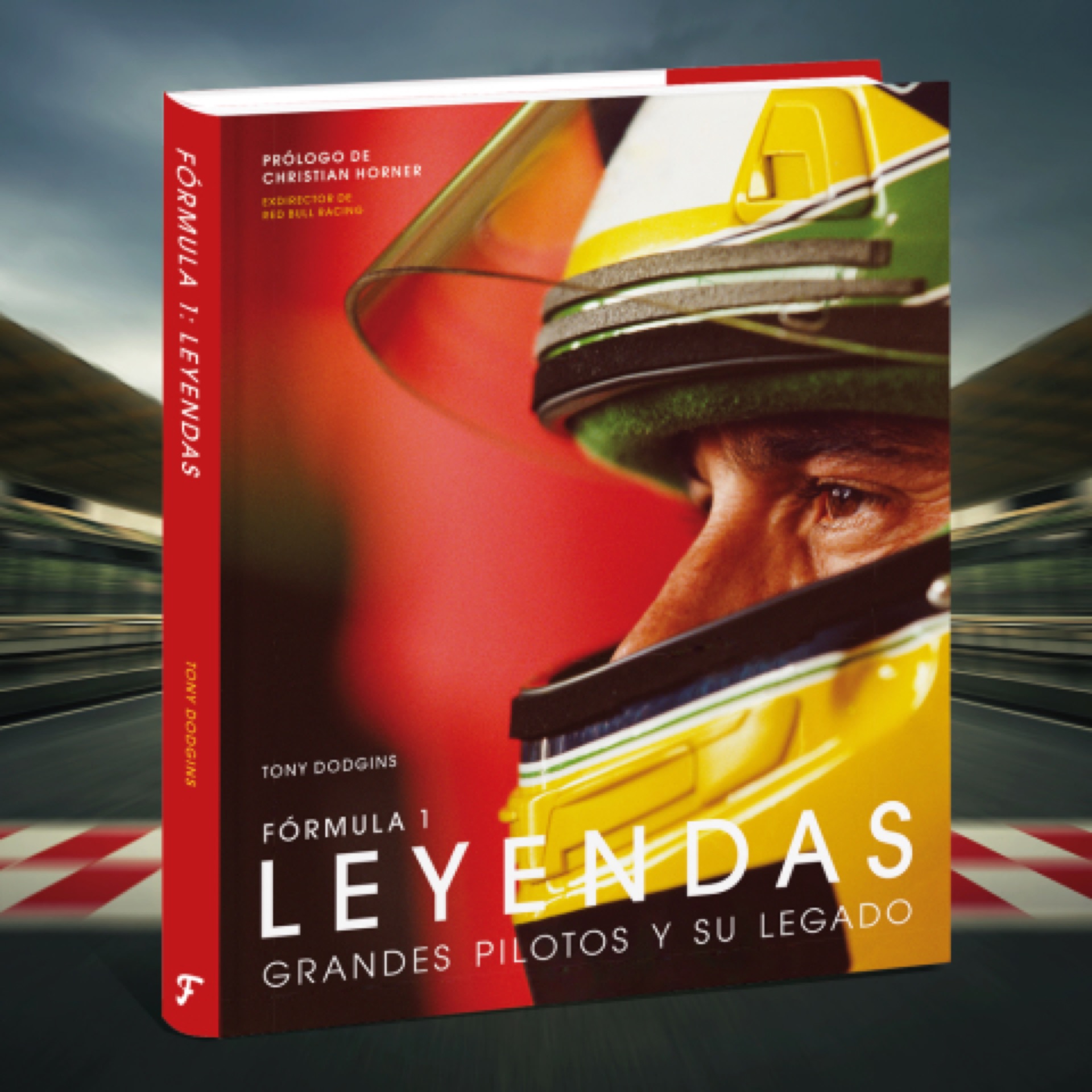
Tony Dodgins, author of Leyendas, analyses the place of Fernando Alonso and Carlos Sainz in F1 history and the major challenges facing the championship.
Formula 1 is going through a new period of popularity in Spain, driven by Fernando Alonso’s continued presence, Carlos Sainz’s career and the arrival of the Madrid Grand Prix. In this context, Leyendas, a book by Tony Dodgins published by Familiam Editorial, is now available in Spanish. The British journalist reviews in the book some of the most important drivers and episodes of the World Championship, from its beginnings in 1950 to the present day. We took the opportunity of its publication to talk with Dodgins about the qualities that turn a driver into a legend, the historical position of Spanish drivers and the changes Formula 1 is currently undergoing.
“The greats combine natural talent and intelligence”
Highmotor: What will the Formula 1 fan find in Leyendas?
Tony Dodgins: I would like to think the book offers a snapshot of some of the greatest drivers and their feats, from the early days of the World Championship in 1950 to today’s stars.
HM: After decades analysing grands prix and champions, what makes a very fast driver a true legend?
T. D.: Legends get results: wins and championships. Romantics talk about courage and bravery when referring to drivers, but I think intelligence must also be taken into account. The truly great ones seem to combine natural talent with an enormous mental capacity, and Fernando Alonso is a clear example. Then there are the great characters, such as James Hunt, and the especially spectacular drivers, such as Gilles Villeneuve.
The return of Formula 1 passion in Spain
HM: How is the renewed enthusiasm for Formula 1 currently being experienced in Spain perceived from abroad?
T. D.: I love seeing a country embrace a sport this big. I remember the magnificent images of Ayrton Senna and Nigel Mansell with their wheels separated by just a few centimetres on the Barcelona straight, when Formula 1 first went there in the early nineties. Afterwards there seemed to be a somewhat quieter period in terms of attendance, during which motorcycling attracted more spectators. But then Fernando Alonso arrived and, suddenly, getting in and out of the circuit became something completely different. For Spanish fans it would be fantastic to see Fernando in a car capable of fighting for the title, if he decides to continue, and Carlos Sainz at the wheel of a competitive Williams.
Historic circuits versus big urban spectacles
HM: Formula 1 is increasingly heading towards street circuits and big events. Is it managing to preserve its history and its essence?
T. D.: It’s a good question and I’m not sure it is. You can understand Formula 1’s desire to race in the centre of major cities and offer shows, concerts and other activities, besides the on-track action. But it is also necessary to keep classic circuits like Silverstone and Spa. Time moves on, although I believe it is vital to preserve the links with the past and with Formula 1’s history. Monaco is a good example. It would never meet today’s criteria and, moreover, it usually produces a rather poor race because overtaking is very difficult. However, its qualifying session is one of the most impressive of the entire season and its setting is incomparable.
“Alonso’s two titles do not reflect his talent”
HM: What position do Fernando Alonso and Carlos Sainz hold among the great drivers in history?
T. D.: For me, Alonso is one of the best of all time. His two world championships do not faithfully reflect his talent: he should have four or five. Since 2007, his career has been characterised by being in the wrong place at the wrong time. Some of his performances with Ferrari during the 2012 season were of an extraordinary level, but the Red Bull was superior.
His physical fitness, dedication and motivation must also be admired. Today he would still be winning races if he had the right car. In some quarters he is accused of creating tension within teams, as happened at McLaren in 2007, but all the great drivers know they must look after their own interests. I think Carlos is a step below, but there is nothing to be ashamed of. His contribution to the team, his technical ability and his work ethic are qualities as admired as his speed.
Leclerc and Hamilton, a rivalry with potential
HM: Is there a rivalry in today’s grid that could reach the intensity of clashes like Senna and Prost or Hunt and Lauda?
T. D.: I think the relationship between Charles Leclerc and Lewis Hamilton has the potential for that. Rivalries between team-mates are always the most intense, because the driver on the other side of the garage is the only one with the same car and therefore the one you must beat. If someone with the same equipment beats you, it damages both your reputation and your market value. In 2025, Leclerc comfortably outpaced Hamilton, but in 2026 Lewis is closer and Charles has suffered too many incidents.
There is a current of opinion that Ferrari should prioritise Hamilton because he has more points. I find that absurd because, firstly, he is not the faster driver and, secondly, Ferrari is not realistically fighting for the championship. Nevertheless, that narrative is gaining strength on social media, even though it makes no sense. It could end up getting into Charles’s head and generating tension within the team.
The driver will remain the protagonist
HM: Regulations and cars change constantly. How will the figure of the driver as a Formula 1 hero evolve?
T. D.: I think drivers will always have passionate followers, even in periods when elements such as electrical energy management or races with constant changes of pace make the competition harder to understand for those unfamiliar with its subtleties. I hope the rule-makers manage to let drivers show their skills more easily at the limit. But the key is that, whatever the rules, they continue doing something that a great many people would love to do and cannot.

 Peugeot E-208 GTi: a battery-powered toy that revives the spirit of the 1980s sports cars
 New Lexus ES: luxury grows and goes electric
 First contact with the Dacia Sandero Hybrid 155: power and efficiency from €19,890
Deja un comentario