Test drive: the keys to choosing the right Jaguar F-PACE Diesel
 Antonio Roncero @roncero_antonio
1 August 2023
10 min.
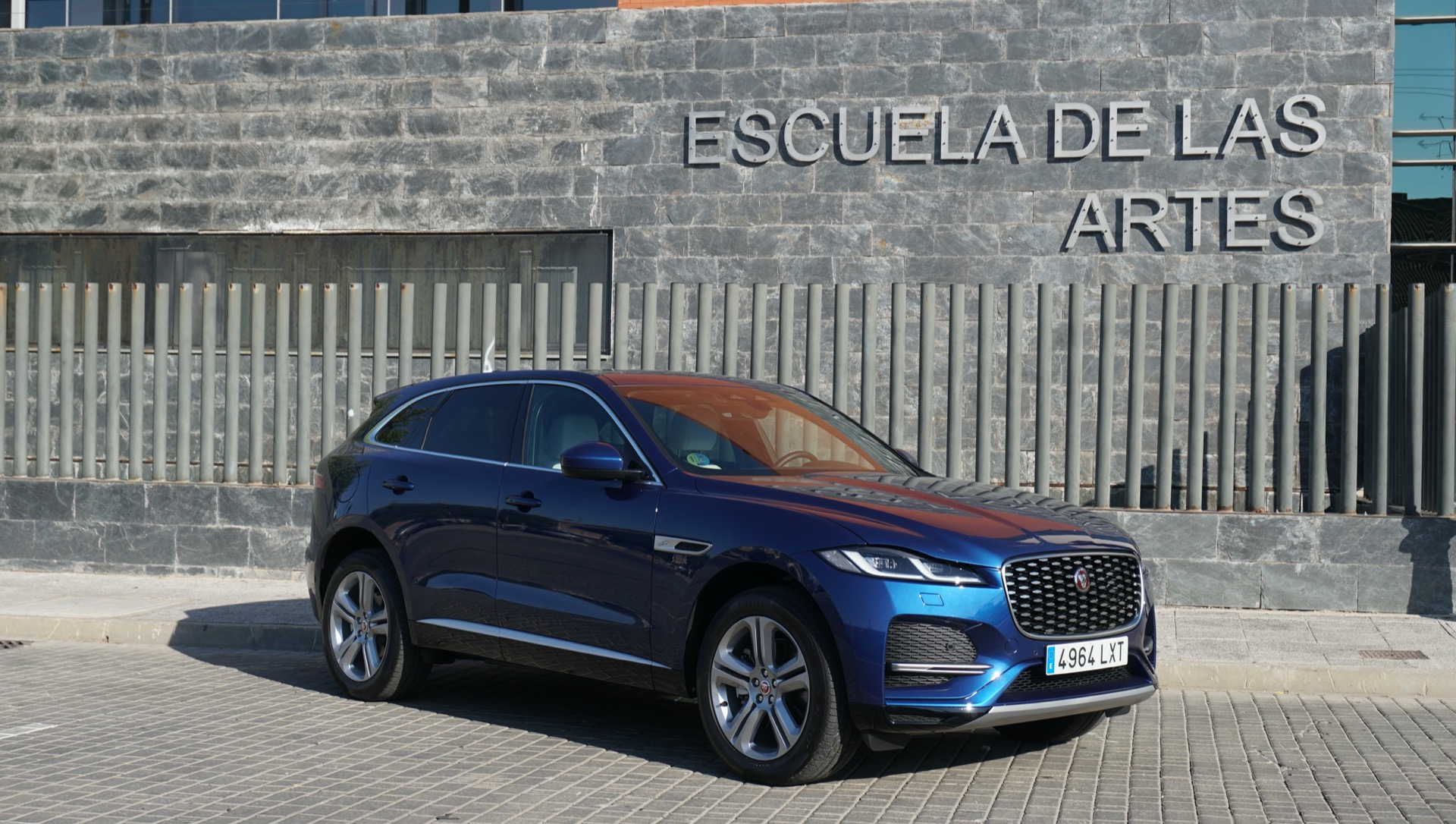
Following its last update at the end of 2022, the Jaguar F-PACE holds its own among luxury SUVs in its category, with more technology and more comfort than ever, and with three turbodiesel options to choose from.
The Jaguar F-PACE has been on the market since 2016. A few years, by the pace at which this industry moves, though over its life the English SUV has gone through successive updates. The model currently on sale is the one that replaced the first generation in 2020, and in 2022 it received some equipment improvements.
The main新 features following the last update in December 2022 included improved range for the F-PACE P400e plug-in hybrid variant, the return to the range of the entry-level F-PACE Diesel with 163 CV that had been discontinued earlier that year, and further equipment upgrades. Among the latter, the most important is the standard TFT display for the instrumentation and the 19-inch alloy wheels.
In this way, the Jaguar F-PACE range currently offers the following engine options, with starting prices from:
- F-PACE 2.0 D (163 CV): €72,550
- F-PACE 2.0 D (204 CV): €75,700
- F-PACE 3.0 D (300 CV): €90,750
- F-PACE PHEV (404 CV): €85,750
- F-PACE 5.0 V8 (550 CV): €130,650
All versions come standard with all-wheel drive AWD and an automatic gearbox. The three diesels and the V8 feature MHEV mild-hybrid technology, which allows them to display the ECO environmental label from the DGT.
On this occasion I’m going to focus on the two entry versions of the range with the 2.0 four-cylinder turbodiesel engine, because for me there’s no doubt when deciding whether it’s worth making the jump to the six-cylinder 3.0 D. The explanation is very simple: yes, the six-cylinder 3.0 is a fantastic engine, smoother and with better performance than the 204 CV four-cylinder. But the difference isn’t big enough to justify investing the 15,000 euros the six-cylinder costs more (10,000 euros if we match equipment).
Furthermore, if you particularly value that greater refinement and sportier performance, the 3.0 D has another drawback: at equal equipment it costs the same as the F-PACE PHEV, which has 404 CV, now homologates 65 km of electric-mode range and enjoys all the advantages of the CERO label. In summary: if we’re looking at the upper part of the range in terms of price and power, seeking luxury and sophistication, the PHEV is better than the most powerful diesel. If you want an F-PACE you can spend a lot of time on the motorway with, with a long range and low cost per kilometre, then your attention should turn to the 4-cylinder turbodiesels.
The best F-PACE for balance between performance and consumption
With that first point made, things get simpler. With the return of the 163 CV version as the entry engine to the F-PACE range by power and price, the next question is whether it will be sufficient or whether it’s worth paying the roughly 3,000 euros that the 204 CV version of this same engine costs. And here I’ll tell you not to skimp.
In many driving situations the less powerful engine is enough, and its performance is adequate, with a top speed of 195 km/h and 10.1 seconds to accelerate from 0 to 100 km/h. But the 204 CV version has more “punch”, and that shows not only when accelerating—almost two seconds quicker, stopping the clock at 8.2 seconds—but also when recovering from long gears without the automatic gearbox having to downshift. And although the homologated consumption is the same in both cases, 6.3 l/100 km, I’d venture that in real-world use the more powerful one will end up gaining some advantage, even if it’s small.
Since we’re on the subject of consumption, during our test with the 204 CV diesel F-PACE I found it not at all difficult to achieve real averages of 7 l/100 km and even drop below that figure on motorway journeys at a steady cruising speed. In these conditions, the long transmission ratios allow you to cruise at 120 km/h in eighth gear with the engine turning at just 1,800 rpm, with very subdued noise levels and very low consumption using the “Eco” or “Comfort” modes on the rotary dial.
If you want to make more of the power and switch to “Sport” mode, for example for driving on winding roads, you clearly notice a greater responsiveness from the accelerator… and also that average consumption then moves around 8 l/100 km, and climbs from there. In any case, consumption is one of the virtues of this 204 CV engine, which moves the F-PACE with great ease, although it falls slightly short in refinement when compared with the best in its class, namely the four-cylinder turbodiesel of the BMW, which is one of my favourites.
Behind the wheel of the Jaguar F-PACE 2.0 D: geared towards comfort
Continuing with the F-PACE’s dynamic qualities, I had to dig out notes and test files from earlier tests of this model in its first generation to confirm the impressions it gave me behind the wheel: we’re looking at a car that is more comfortable than before, both in the way the suspension works and in its acoustic insulation, delivering excellent ride quality.
There is an equipment package that directly affects the vehicle’s dynamic behaviour, which is the Dynamic Pack. It costs almost 5,000 euros and includes adaptive suspension, the adaptive surface response system, the Configurable Dynamics system, red-painted brake calipers and enormous 22-inch wheels.
But the car goes very well straight from the factory, so I’d forgo this pack, which looks good but requires you to “load up” with huge wheels and 265/40 tyres that the F-PACE 2.0 Diesel doesn’t really need. At most, I’d consider the individual option of adaptive suspension, which costs around 1,500 euros; and while we’re at it, the additional 210 euros for surface response, which analyses the road and anticipates by adjusting the suspension. But as I say, the car as it comes from the factory offers very balanced behaviour.
The driver assistance systems also work very well, but the most interesting one, adaptive cruise control with steering assist, is optional and part of a package that has to be paid for separately: the Driver Assist Pack. It costs around 830 euros and adds a reversing monitor, rear collision monitor and blind-spot monitor. Given the car’s price, I think these are elements it should include as standard, as well as the device for wireless phone charging, which costs 200 euros, or the keyless entry, which amounts to a whopping 1,220 euros.
A luxurious and sophisticated interior
Regardless of price, a Jaguar is expected to have impeccable build quality and interior finish, something that hasn’t always been the case with the F-PACE. But since the last update the English SUV leaves no room for criticism in this area. All materials feel high quality, and there’s evident care and attention to detail, from the feedback the various controls give when operated to the finishing touches even in areas that aren’t visible. Very high marks, without reaching the outstanding rating I would give, for example, to the Mercedes GLC or a Audi Q5.
The list of personalisation options is enough to fill a book: there’s plenty to choose from, among upholstery in different materials and colours, trim pieces, seat types and so on. That said, prices are far from cheap once you go beyond standard equipment. As for interior space, it’s above average in all dimensions, including boot capacity, at 470 litres and very usable shapes.
I really liked how the Pivi Pro infotainment system works. Something more debatable is how Jaguar has solved the placement of the large 11.4-inch multimedia screen, which sits “superimposed” on the dashboard, making it clear it’s a technological update added after the original design. It’s therefore not integrated into the design, but personally I don’t think it looks bad. In any case, any doubts are dispelled when you see how well the system performs in terms of fluidity, resolution and connectivity, with wireless Apple CarPlay and Android Auto connection.
Another area where the F-PACE has improved a great deal is the new digital instrumentation, replacing the previous version with analogue dials and a TFT display in between. The unit shown in the pictures still had the latter, which never quite convinced me; but the new one, previously optional and standard on some versions, now offers greater speed, resolution and plenty of customisation options. The new gear selector, along with other changes to the door panels and steering wheel, give the F-PACE a more modern, technological and sophisticated look.
The Jaguar F-PACE 2.0 D versus its rivals
We’ve seen that the F-PACE is a car that has been updated to take on the competition without complexes, both in engines and dynamic behaviour, with a clear shift towards comfort. And also in technological equipment, mainly everything related to infotainment and driver assistance. The result is a car that stands up to comparison with the category’s three “heavyweights,” the German SUVs from Audi, BMW and Mercedes, in every respect… except price, as it’s around 10,000 euros more expensive than its rivals.
The most modern of them all is the Mercedes GLC, which arrived in its second generation last March to replace the model launched in 2019. Available as an SUV or the attractive and successful GLC Coupé, the 220d 4MATIC version with 200 CV is available from around 63,000 euros, and you can get a 300d 4MATIC with 269 CV from 71,000 euros.
Updated in 2021, the BMW X3, which also comes as a coupé — the BMW X4 — starts at 59,000 euros in xDrive 20d form with X Line trim, and from 66,200 euros for the six-cylinder xDrive 30d with 286 CV, still considerably cheaper than the base F-PACE with 163 CV and four cylinders.
The third contender, the Audi Q5, was last updated in 2021, and like the other two German SUVs it’s available in a coupé-style body, the Q5 Sportback. You can have one from 55,500 euros with the 2.0 TDI engine with 163 CV and 4×2 drive, but the one that puts the F-PACE on the ropes is the Q5 40 TDI quattro ultra with 204 CV, which costs around 60,000 euros, 2,000 euros more with S line trim.
Jaguar F-Pace Diesel AWD – Photo gallery
Technical specifications of this car


 Peugeot E-208 GTi: a battery-powered toy that revives the spirit of the 1980s sports cars
 New Lexus ES: luxury grows and goes electric
 First contact with the Dacia Sandero Hybrid 155: power and efficiency from €19,890
Deja un comentario