Cybertruck Tesla Electric Cars Pick-up
The NHTSA awards the Tesla Cybertruck five stars for safety
 Javier Cantagalli
20 February 2025
3 min.
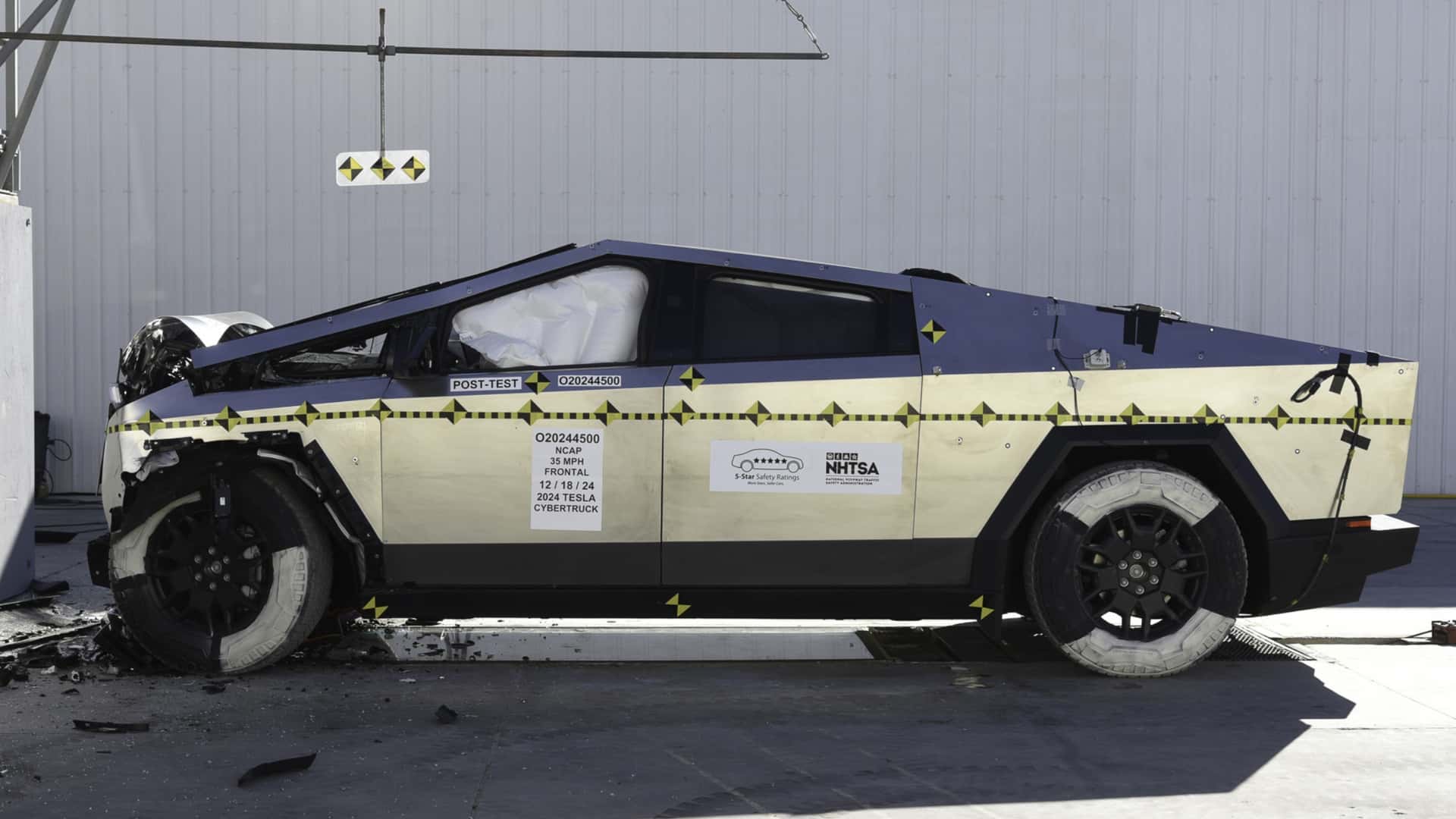
With 5 stars for safety, the Cybertruck offers the lowest probability of injury in a collision of all the pickups on sale in the North American market.
Since its launch at the end of 2023, there has been a lot of speculation about the safety level of Tesla’s electric pickup, even casting doubt on whether it is a safe vehicle because of the materials used in its construction. Tesla uses a somewhat special chassis in this vehicle, which it calls the “exoskeleton”, in which the ultra-strong stainless steel exterior panels form part of the vehicle’s main structure, reducing the need for a conventional chassis.
It is precisely the use of these ultra-strong stainless steel panels as integral elements of the “chassis” that has for a long time raised doubts about their ability to deform in a collision, as happens in any conventional vehicle, and thereby absorb kinetic energy at the moment of impact.
The National Highway Traffic Safety Administration of the United States, known by the acronym NHTSA, has finally allowed us to answer all these speculations that had been generated over all this time, after testing several units of the Cybertruck within its New Car Assessment Program (NCAP).
Results of the crash tests carried out by the NHTSA
In the frontal crash test, which recreates a head-on collision between two similar vehicles hitting a rigid barrier at 56 km/h, the Cybertruck achieved five stars for the driver and four for the front passenger. According to the report presented by the NHTSA, the frontal airbags deployed correctly, although those intended for the knee area did not. Tesla, for its part, has stated that this was the case because these airbags are designed not to deploy in a collision like this one.
In the side impact tests, the Cybertruck shone with a perfect five-star rating. This test includes two assessments: the moving barrier test, which simulates a collision at an intersection with a non-rigid moving barrier at 62 km/h striking the driver’s side, and the pole test, which simulates a collision with a fixed object, such as a tree, at 32 km/h with the vehicle at a 75-degree angle. In both cases, the Cybertruck obtained five stars for both front and rear seat occupants.
However, in the rollover resistance test, which measures the risk of rolling over in a single-vehicle loss-of-control scenario, the result was four stars. The NHTSA noted that, although the Cybertruck did not roll over during the dynamic test, there is a calculated risk of 12.4 percent that this could happen.
These assessments were carried out at the end of last year by Applus+ IDIADA KARCO Engineering at its facilities in the Californian town of Adelanto, and the final reports were published on January 15. So far, all Tesla vehicles evaluated by the NHTSA have achieved an overall five-star rating, which makes it clear that the engineers of the American company pay special attention to the safety of their vehicles.
https://www.youtube.com/watch?v=sINxIHVEj9A
Final conclusion
These crash tests have thus allowed us to settle any doubts about the level of safety offered by Tesla’s Cybertruck and call into question the arguments of those who have been insisting all this time that the Cybertruck could not be sold in Europe because it is not safe enough. Tesla’s electric pickup will probably never reach the European market, but that will be because of its size, which does not suit the needs of the European public, or because of the excessive restrictions of European regulations, but certainly not because it is not a safe vehicle, as the NHTSA has demonstrated.


 The seven finalists for the 2027 European Car of the Year (COTY) are exclusively electric
 Peugeot E-208 GTi: a battery-powered toy that revives the spirit of the 1980s sports cars
 New Lexus ES: luxury grows and goes electric
Deja un comentario