Ariya Nissan X-Trail Electric Cars SUV Technology
This is how the e-4ORCE technology of the new Nissan X-Trail and Ariya works
 David Lopez @espacionblanco
30 November 2022
3 min.
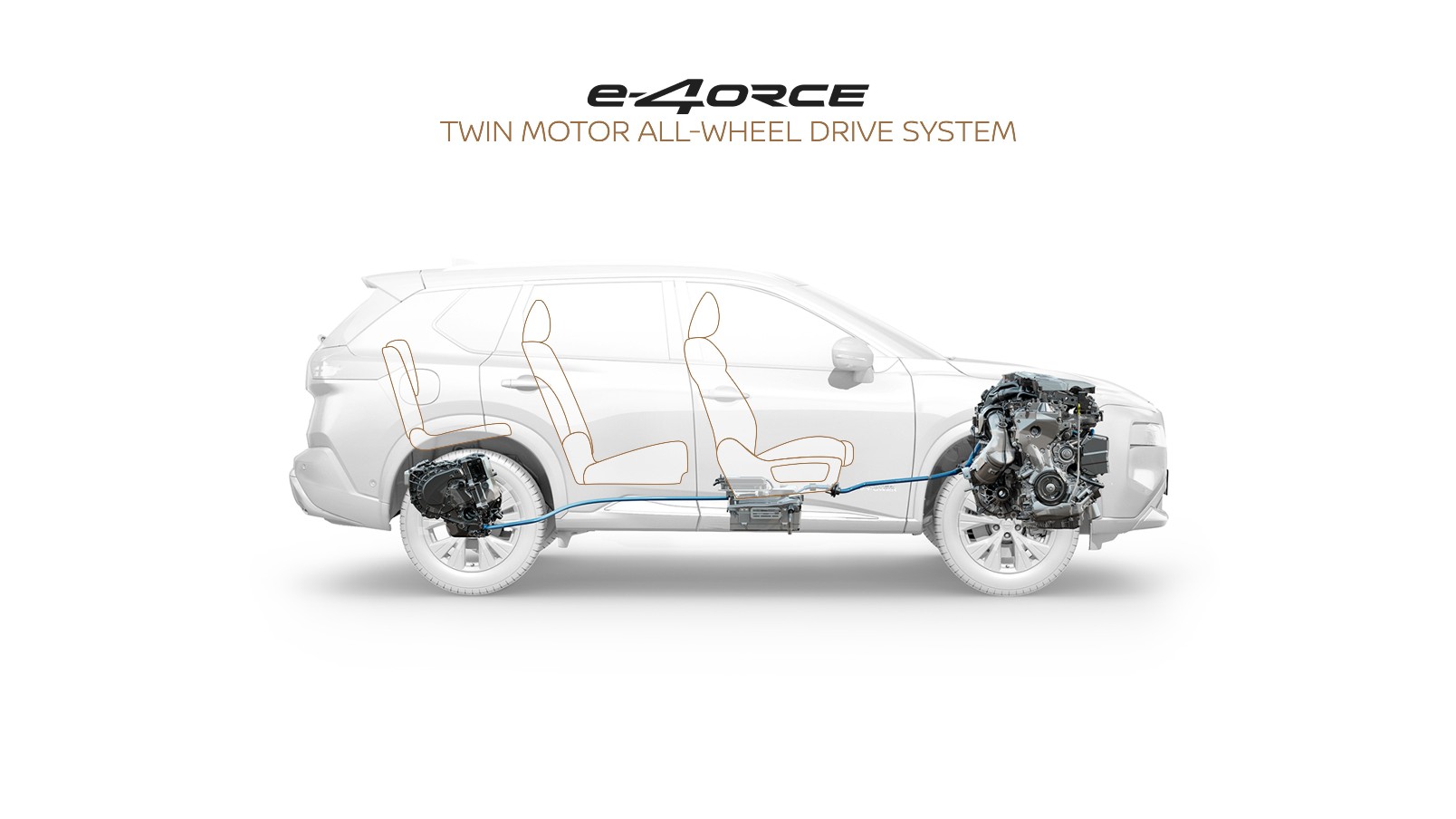
The arrival of the new Nissan X-Trail and the fully electric Ariya has brought the e-4ORCE all-wheel-drive technology of the Japanese brand
The arrival of the new Nissan Ariya and the refreshed X-Trail has brought with it the e-4ORCE technology they both feature, an exclusive all-wheel-drive system that the Japanese brand has developed for its electric or hybrid models (e-Power). The brand wants us to get to know it a little better and see what benefit this technology brings to its vehicles, besides providing greater traction on difficult terrain.
The particularity of the e-4ORCE system is that, whether in a fully electric vehicle like the Ariya or a hybrid like the X-Trail, the driven wheels are powered by electric motors fed by the battery. In the X-Trail, the dual electric motor system has a combined output of 157 kW, with 150 kW at the front and 100 kW at the rear, capable of generating a rear torque response 10,000 times faster than a mechanical all-wheel-drive system. Meanwhile, in the Ariya, the total system output is 225 kW, allowing it to accelerate to 100 km/h in 5.7 seconds.
Regardless of the model you choose, the e-4ORCE system relies on the battery to operate. That is, the battery powers the two electric motors installed on each axle, allowing independent control of the wheels, so it can follow our chosen line with minimal steering correction. It also continuously controls the chassis, so that in situations such as understeer the cabin remains level.
Maximum grip on any surface and minimal pitching
The e-4ORCE system achieves this by distributing torque to both the front and rear axles, allowing greater tyre grip depending on road conditions (whether on wet, slippery or snow-covered asphalt) and the vehicle’s situation, while braking is controlled individually for each wheel. According to Nissan, the key to the e-4ORCE system lies in the balanced distribution of power from the dual-motor system, which is much faster than mechanical all-wheel-drive systems.
Another issue, pitching is reduced to a minimum with the e-4ORCE system. This is one of the drawbacks of electric vehicles, which have regenerative braking that, depending on the selected level, can produce strong deceleration. Pitching is suppressed by controlling the regenerative balance between the front and rear axles. This might suggest energy is being lost to charge the battery, but with a dual-motor system the opposite happens and more regenerative energy is captured than with a single-motor system.
Technical specifications of this car


 Kia offers an electric range of 10 models, 50 versions and 400 possible combinations
 The seven finalists for the 2027 European Car of the Year (COTY) are exclusively electric
 Peugeot E-208 GTi: a battery-powered toy that revives the spirit of the 1980s sports cars
Deja un comentario