Ford Kuga Hybrid Cars ECO Tests SUV
We test-drove the new Ford Kuga and help you choose between the hybrid and the plug-in hybrid
 Antonio Roncero @roncero_antonio
6 June 2024
9 min.
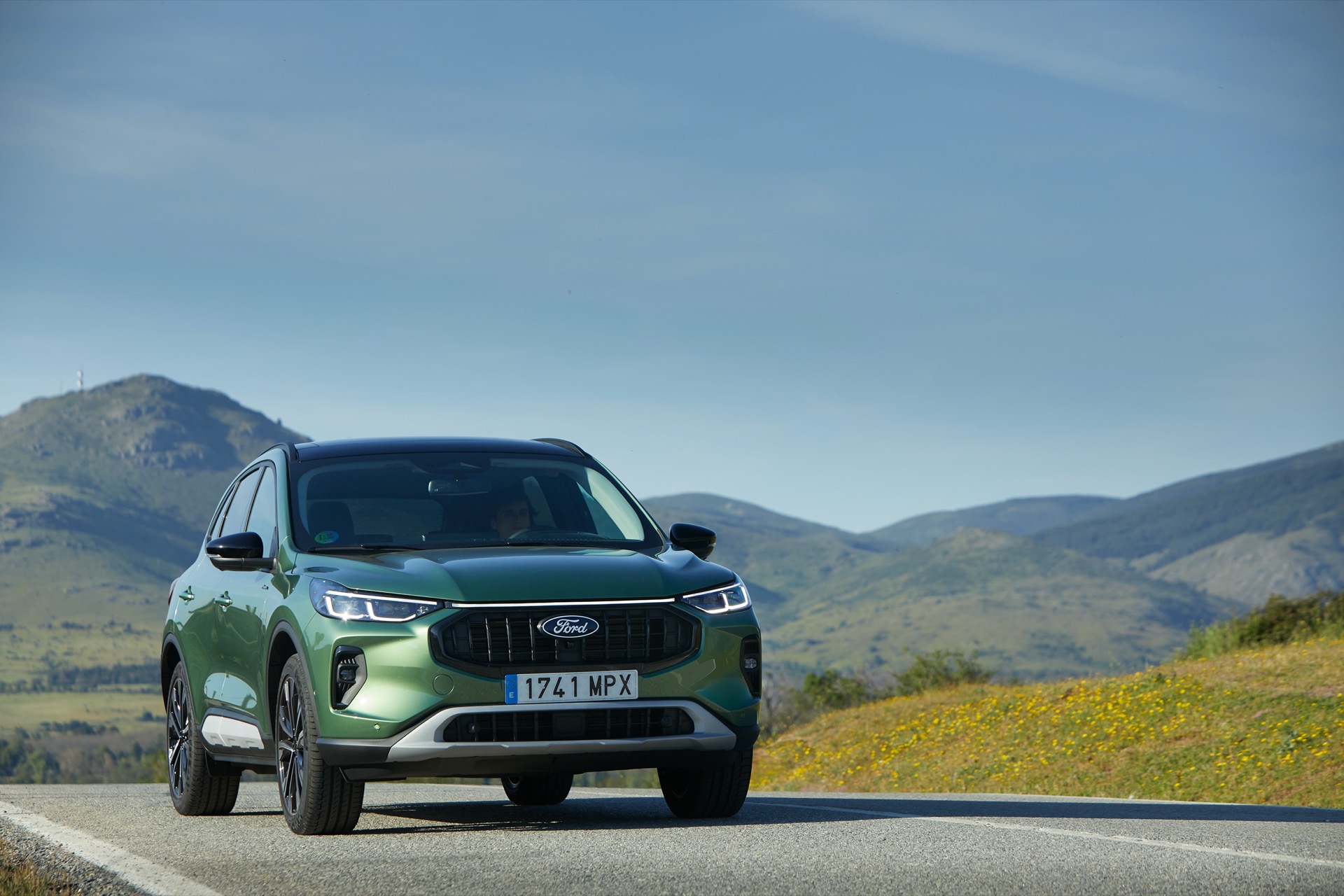
The new Ford Kuga MY24 is now on sale, with an interesting aesthetic and technical update affecting the exterior and interior design, connectivity, and the performance of the versions with the hybrid propulsion system, as well as a new Active trim variant that puts the focus on the more adventurous side of the Ford SUV. Now that we have driven it and know the detailed prices, we can go deeper into all these changes and, above all, resolve the main doubts a Kuga buyer may have: is the Active trim worth it? Is the FHEV hybrid or the PHEV plug-in hybrid version more worthwhile?
Let’s get to it…
Exterior and interior design update and new, more “rugged” Active trim
Exteriorly there aren’t many changes in this new range, but the few there are give it a “fresher” look. The full LED headlights are new, and in some versions with the optional matrix headlights they also incorporate an LED strip that joins them just above the grille. The bonnet, the grille itself (now with the logo integrated), the rear lights and diffuser are new, and there are new wheel designs and new body colours.
But the most important novelty is the arrival of the Active versions, which differ aesthetically from the other trim level, Style, through their more adventurous image. To achieve this, they feature a different design for the grille bars and air intakes, lower protectors at the front and rear in a contrasting colour, matching the side steps, “Active” badges, and a suspension raised 10 mm at the front axle and 5 mm at the rear, for greater ground clearance. In addition, these Active versions also add the “Trail” program to the drive mode selector, designed to adapt the operation of the traction control and the throttle response to the low-grip conditions we may encounter off tarmac, for example on dirt tracks or in mud.
When it comes to choosing, the truth is these Active versions barely cost 200 euros more – list prices – than the Style, and they look much more appealing, so they are sure to be well received. That higher ground clearance and the Trail mode can be of some help to venture onto well-maintained tracks with a bit more confidence – I recommend you opt for the All Season tyres offered as an option, for around 370 euros – and it does not affect performance or dynamic behaviour in any way, since the damper tuning is the same.
Inside, the highlight is the new centre console with a horizontal 13.2-inch multimedia screen, naturally with the latest connectivity from Ford, the SYNC 4 system. To run through it: it has quick-access modes, OTA updates, the option to consult the user manual digitally, wireless integration of Apple CarPlay and Android Auto, and 5G connectivity. The instrumentation is digital across all versions, with a configurable 12.3-inch screen. The seats are also new, varying their design and upholstery depending on the trim: in addition to AGR certification, which indicates they are designed and validated to “look after” your back health, the top-of-range models can have up to 18 adjustment directions.
Improved hybrid propulsion system: more efficiency
The new Ford Kuga range simplifies the offer to leave an entry-level version with the 1.5 EcoBoost petrol engine, with 150 CV, a six-speed manual gearbox and a C label, as it has no hybridisation at all. A version with “limited range”, despite the good performance of the small 3-cylinder engine even in a vehicle of this size. But for less than 2,000 euros more you get the Kuga FHEV hybrid, with automatic transmission already included, and which with 180 CV not only goes a lot further, but also consumes considerably less, and in addition adds the benefits of the ECO label.
First conclusion? The 1.5 EcoBoost is not worth it, and if you want a Kuga the smartest option is to opt for the hybrid. Moreover, the Active versions are not offered with the EcoBoost engine, which directs attention even more towards the FHEV version. In this case there is another second possibility, which is the FHEV variant with four-wheel drive. It is the only 4×4 Kuga, because the plug-in hybrid is only offered with front-wheel drive. And I’ll tell you right now that the 4×4 is not worth it either. Trust me: better save the almost 2,000 euros that the drive system costs extra, or invest them in equipment. I don’t want to be a bore, but if you are concerned about safety in low-grip situations, believe me, good All Season tyres are better than a 4×4 with summer tyres…
And above it sits the Kuga plug-in hybrid, which now raises the power up to 243 CV and allows an electric-mode range of up to 68 km, so it has the DGT CERO emissions label. Before continuing I’ll tell you that Ford has fitted a gearbox optimised for the FHEV 4×4 and PHEV versions – incomprehensibly the front-wheel-drive hybrid is left out, which keeps the same transmission as the outgoing model – which allows better performance: the PHEV cuts the 0 to 100 km/h acceleration by up to 2 seconds, which is a lot, and in both versions the towing capacity increases by more than 30%, reaching 2,100 kg.
And now back to the Kuga PHEV and the figures. Because at the same trim level, the PHEV costs about 4,000 euros more than the self-charging hybrid, a difference that can even be completely cancelled out if you take advantage of the MOVES Plan and have a car to scrap, or halved if you don’t hand in a car. Therefore, you have to do the sums very carefully… even if you have nowhere to plug it in daily, because when the battery has no charge the PHEV still works almost like a conventional hybrid, and the way things are going, the CERO label is a guarantee of mobility… and of a higher residual value should you need to change cars in the future. Moreover, you can always recharge it from time to time at some public charging point. That said, the biggest disadvantage of the plug-in hybrid is that you lose about 100 litres of boot space, although the longitudinally sliding rear bench is always a help.
During the test drive we could confirm what we already knew about the Kuga with hybrid engines: they work very well and use very little. With the HEV it is possible to travel in ECO mode at traffic pace and move at consumptions of between 5 and 6 l/100 km with total ease, while the PHEV allows you to use the electric contribution to cover the first 100 km with averages around 2.5 l/100 km, and stay below 5 l/100 km cumulatively over the next 100 km… If you start with the battery depleted, it will use a little more than the non-plug-in hybrid – it feels the extra weight of the battery above all – but consumption does not shoot up, with averages of 7.5 l/100 km.
Trim, equipment, price and discounts of the Ford Kuga
I could give you the official price list for the Ford Kuga here, but it would only help you draw comparisons between the different versions and little more, because Ford applies discounts to the list prices that you can only check if you configure the version you’re interested in on its website. What I can tell you is that, for example, the list price of the entry version, the ST-Line 1.5 Ecoboost, starts at 39,600 euros, but drops to 32,000 euros after applying the promotional discount and the one added for financing the purchase: almost 8,000 euros off.
In the case of the Kuga FHEV hybrid 4×2 with Active trim, which would be my “recommended purchase”, the list price is 42,350 euros, and it comes down to 33,600 euros with all the discounts. In the plug-in hybrid with the top-of-range trim, the 2.5 PHEV Active X, the discount can reach up to 10,000 euros, since the 50,750 euro list price drops to 40,700 euros with the promotion and the financing discount. Without a doubt, one of the hybrid SUVs with the best product-to-price ratio on the market, both in the self-charging versions and in the case of the plug-in hybrid.
When choosing a version, the ST Line and Active already come with practically everything: 18-inch alloy wheels, automatic full LED headlights, keyless entry and start, wireless charger, roof bars… In both cases a higher level is offered, ST Line X and Active X, which add the Bang & Olufsen audio system with 10 speakers, partial leather upholstery, sill kick plates, aluminium pedals, rear spoiler, AGR seats with memory and the Tech pack (optional on the other trims for 1,450 euros), which consists of adaptive cruise control, blind-spot presence alert, assisted parking, 360 camera, lane change warning and assist, pre-collision assist, reverse braking assist and door edge protectors.
As options, in addition to metallic paints, there are the openable panoramic roof (1,250 euros); the tow hitch (860 euros if detachable, 1,180 for retractable); the various wheel designs which can be up to 20 inches; the winter pack (around 460 euros) with heated seats, steering wheel and windscreen; and the safety pack, which costs 2,000 euros and includes high-end headlights, head-up display and the alarm.
Ford Kuga – Image gallery
Technical specifications of this car

 Kia offers an electric range of 10 models, 50 versions and 400 possible combinations
 The seven finalists for the 2027 European Car of the Year (COTY) are exclusively electric
 Peugeot E-208 GTi: a battery-powered toy that revives the spirit of the 1980s sports cars
Deja un comentario