Xiaomi completes its Nürburgring lap with an autonomous YU7 GT
 Javier Cantagalli
24 June 2026
2 min.
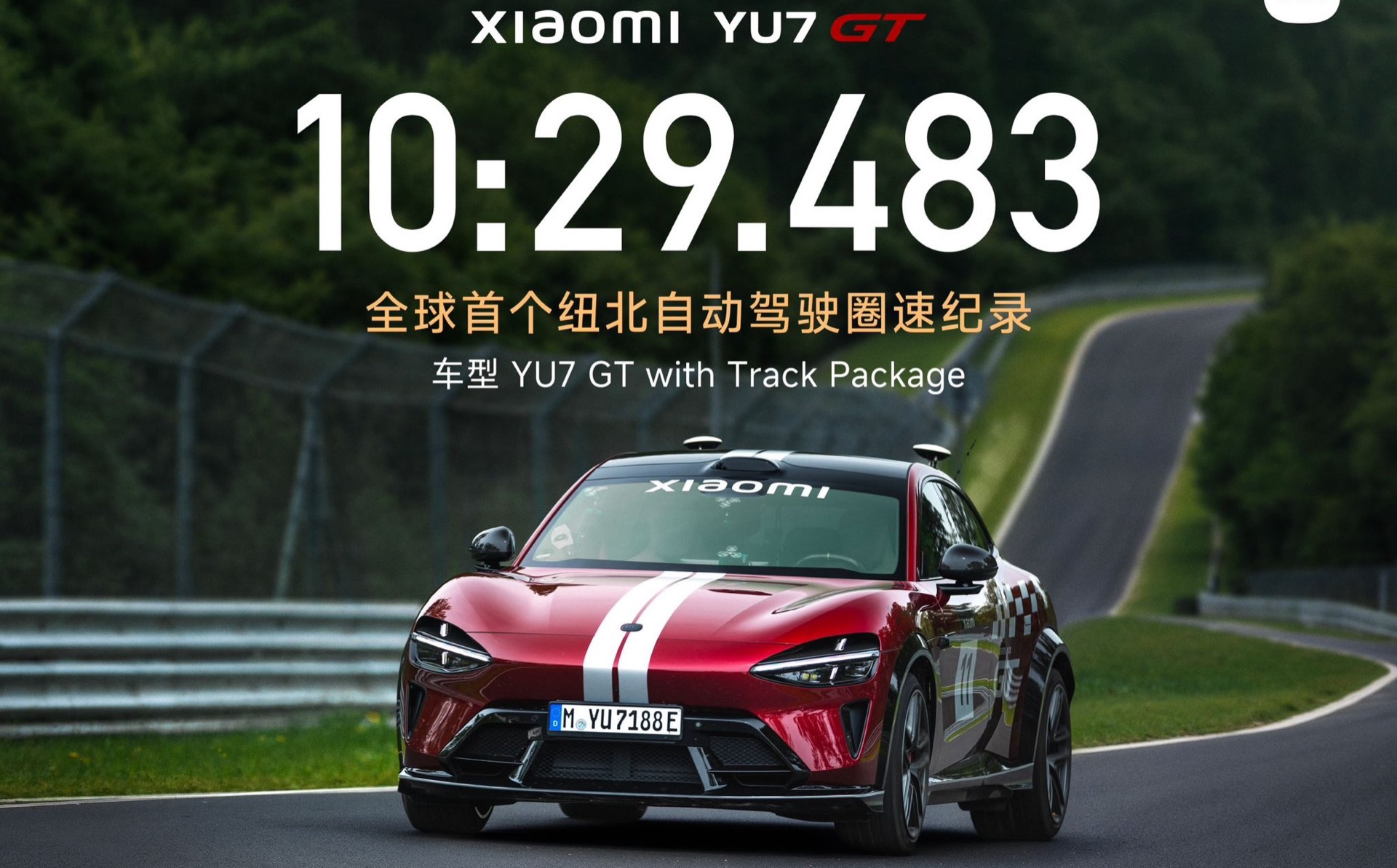
This autonomous record represents another step in Xiaomi’s ambition to demonstrate its technological capabilities on one of the most demanding stages in the world of motorsport.
Since spring 2025, Xiaomi has been the official partner of the Nürburgring circuit, which has allowed it to achieve several records in different categories. Now, the Chinese manufacturer has added a new milestone: the fastest time ever recorded by a fully autonomous vehicle on the legendary German track.
According to circuit officials, this is the first time in the history of the Nürburgring that an autonomous vehicle has completed an officially timed lap on the Nordschleife. The Xiaomi YU7 GT has thus become the first holder of the record in the new category for autonomously driven battery electric vehicles.
The high-performance SUV from the Chinese brand, equipped with the Track Package, covered the circuit’s 20.8 kilometres in 10 minutes and 29.483 seconds, at an average speed of approximately 119 km/h. During the test, the autonomous system successfully handled the track’s 73 corners, the nearly 300 metres of elevation change and the changing surface conditions, demonstrating that current technology can already complete a full lap without human intervention on a circuit as demanding as this one.
Autonomous driving still has a long way to go
However, the gap with the time set by a professional driver remains significant. Just a few weeks earlier, Belgian driver Vincent Radermecker completed the same lap in a YU7 GT in 7 minutes and 22.755 seconds. That is more than three minutes faster than the autonomous system. This result shows that, although artificial intelligence is capable of managing the complexity of the circuit, it still does not reach the level of performance that an experienced driver can achieve.
It should also be noted that the vehicle Xiaomi used to set this new autonomous record was a prototype based on the production YU7 GT, with autonomous driving technology not yet available to customers. To prepare for this test, the circuit had to be mapped beforehand, a common process in projects of this kind.
Thanks to this initiative, Xiaomi has been able to gather genuinely valuable data under extreme conditions that will help improve the models that will reach its customers, its control strategies and its redundant safety systems.
Although the YU7 SUV and the SU7 saloon are currently sold only in China, the company plans to begin selling them in Europe in 2027. Ahead of that date, Xiaomi has already opened an R&D centre in Munich, underlining the importance of the European market for the Chinese brand.


 Peugeot E-208 GTi: a battery-powered toy that revives the spirit of the 1980s sports cars
 New Lexus ES: luxury grows and goes electric
 First contact with the Dacia Sandero Hybrid 155: power and efficiency from €19,890
Deja un comentario