EBRO s700 Hybrid Cars ECO Review SUV
Ebro S700 HEV test drive: a hybrid SUV with very low consumption and a price-to-product ratio that is hard to match
 Antonio Roncero @roncero_antonio
5 August 2026
15 min.
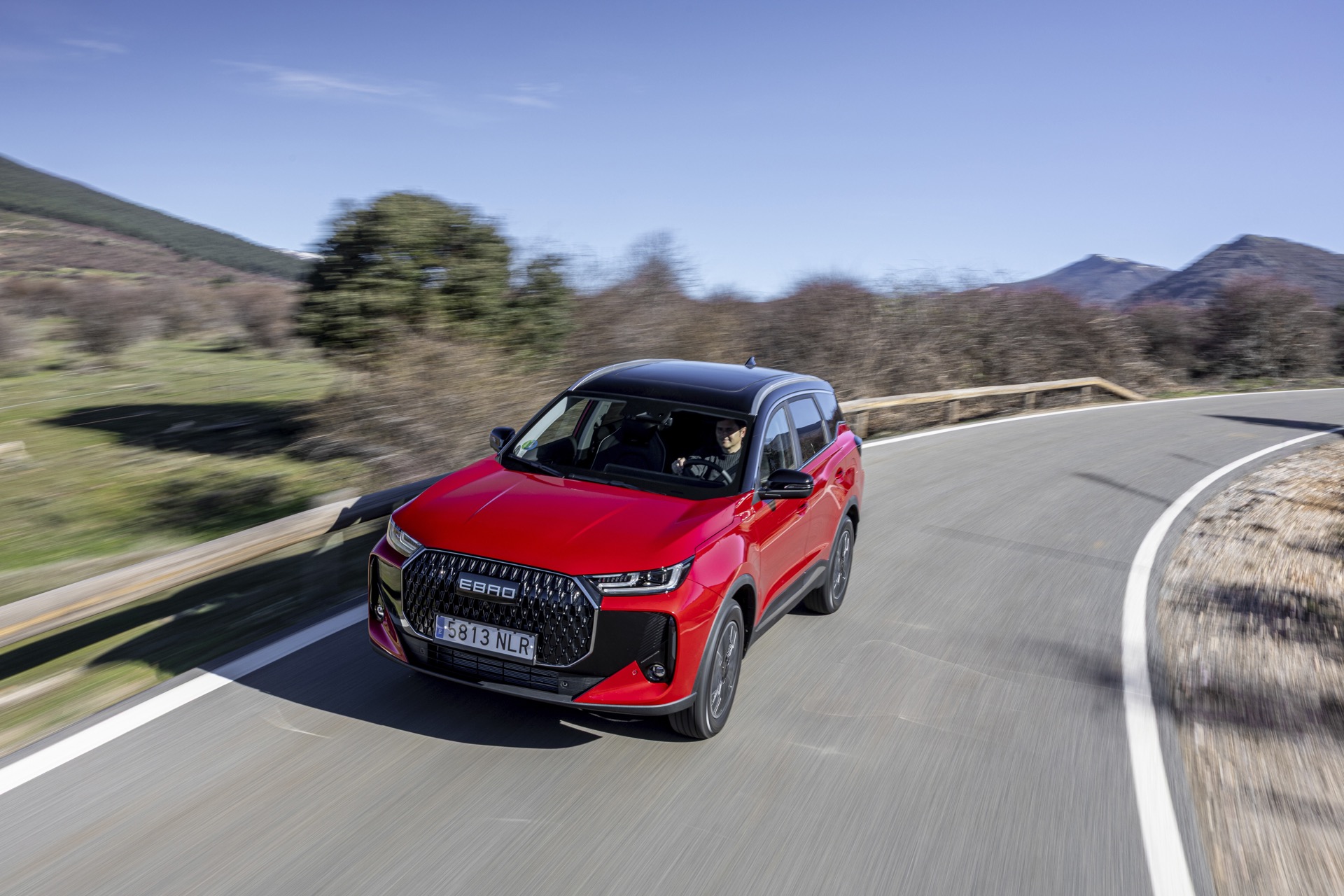
We put the Ebro S700 HEV through its paces to find out how much it consumes, how its steering and chassis have improved, and why this hybrid version is the most balanced and recommendable option in the range.
After living with the Ebro S700 HEV for several days in the city, on country roads and on the motorway, the good impressions from our first contact are confirmed. The hybrid system stands out for its smoothness and, above all, for surprisingly low consumption. The changes made to the suspension and steering are also clearly noticeable, improving its behaviour without altering its comfort-oriented character. Without a doubt, a smart move by the brand to complete the range with the variant that is set to be the most in demand.
Below it sits the petrol S700, with a C label, which costs around 4,000 euros less, but which cannot compete with the new hybrid S700 in responsiveness, performance, driving enjoyment and, above all, consumption. Meanwhile, the S700 PHEV occupies the top rung with its CERO badge. The latter costs about 3,500 euros more with the same equipment, but it is not available in the Comfort trim, so it starts from a higher price. It is a plug-in hybrid SUV that is also very competitive in its segment, but the arrival of the S700 HEV leaves it in a very clear position: only consider it if you have somewhere to plug it in on a day-to-day basis.
That first contact with the S700 HEV left us with a very good impression thanks to the smoothness of the hybrid system, the comfort on the road and the amount of equipment it offers for the price. But a short test does not always answer the question that matters most in a car of this type: how much does it really consume? We already suspected it had potential. But after using it for several days on urban routes, secondary roads, fast roads and motorway journeys, the answer is simple: the S700 HEV consumes little. And you don’t need to drive constantly as if you were in an efficiency competition.
We also wanted to check how noticeable the adjustments Ebro made to the suspension and steering were. And I can tell you now that the improvement is appreciable. The S700 HEV remains a family SUV oriented towards comfort, but it now feels more precise, better planted and gives more confidence at the wheel.
A 224 hp hybrid system that works with great smoothness
The Ebro S700 HEV combines a 1.5 TGDI four-cylinder petrol engine producing 143 hp with two electric motors integrated into a DHT transmission. One is mainly responsible for propelling the vehicle and the other works as a generator. The combustion engine operates on the Miller cycle and claims a thermal efficiency of 44.5%, which is a very good figure. The battery, of NCM type, has a capacity of 1.83 kWh and is installed between the two axles, so it does not take up space in the cabin.
Overall, the system delivers 224 hp and 295 Nm of torque. The S700 HEV accelerates from 0 to 100 km/h in 8.7 seconds and reaches a top speed of 175 km/h, figures more than sufficient for a family SUV of this size. But the best thing about the hybrid system is not its performance, but the way it delivers power. The electric motor plays a leading role when pulling away and when driving at low speeds. When the petrol engine kicks in, the transition is smooth and barely noticeable in normal driving. Nor does that annoying “flywheel effect” of other hybrids appear in any pronounced way, which we experienced without going any further in the Ebro S400 HEV, and which occurs in systems where the combustion engine revs up a lot while the car gains speed, forcing you to “caress” the accelerator or try to maintain a constant speed as far as possible.
Here there is none of that. When you accelerate hard, the engine can be heard, as is only logical, but the engine speed maintains a natural relationship with the acceleration and the gain in speed; it does not give the impression that the engine is going one way and the car another. The result is a refined hybrid system that is pleasant to use and well integrated into the whole. It reduces consumption, but it also greatly improves the driving experience because, thanks to the help of the electric motor, it offers plenty of push and an almost instantaneous throttle response.
Real-world consumption of the Ebro S700 HEV: under 5 litres in the city
Ebro homologates a combined consumption of 5.7 l/100 km, a competitive figure for an SUV measuring 4.55 metres and producing 224 hp. And although it is not usually the case, in practice, getting close to that official figure is quite easy with the S700 HEV. In the city it is easy to stay below 5 l/100 km and there is no need to drive especially slowly. You just need to anticipate traffic, accelerate smoothly and let the hybrid system manage the split between the two motors on its own.
Although the battery is much smaller than that of a plug-in hybrid, it is constantly charged and discharged, and very quickly so. On urban journeys it often allows you to move using only the electric motor, especially when pulling away, manoeuvring or maintaining low speeds with little power demand. In mixed use, combining city, ring roads, country roads and motorway, staying around 6.5 l/100 km requires no special effort. Again, it is a very good figure for a car of these dimensions, power and weight.
It is also surprising that consumption does not soar on the motorway. At sustained speed, the petrol engine takes on a greater role and the hybridisation loses part of its advantage, but even when travelling at a good pace the consumption remains within reasonable values. The fuel tank is not very large, holding about 50 litres. But since it is easy to stay around 6 l/100 km, the range between refuelling stops is high. Reaching the nearly 900 km claimed by the brand will depend on the type of route and pace, but it does not seem an outlandish figure under favourable conditions.
Two driving modes and three levels of regeneration
Another feature of the Ebro S700 HEV is that it is designed to make driving as easy as possible. The driver has just one rotary control on the console to choose between the two available modes, Eco and Sport. There isn’t even a control to prioritise electric propulsion. For daily use, Eco mode is clearly the most recommendable. The throttle response is progressive, the hybrid system works smoothly and the car has enough performance that you won’t miss more power. It does not convey sporty sensations, but it does not feel slow either. It has plenty of push to join a motorway, complete an overtaking manoeuvre or travel loaded while maintaining high speeds.
So much so that in the end the Sport mode is barely used, as it mainly changes the initial throttle response. At low speeds it offers a much more immediate push and makes the S700 feel more energetic during the first few metres, to the point that in slow bends, or for example when accelerating with the steering wheel turned at a roundabout, it can lose traction slightly. For everyday driving I stick with Eco mode, and I would reserve Sport perhaps for stretches with unfavourable terrain when travelling with a heavy load, on a mountain road or when a quicker response is wanted at a particular moment. In the city it can even feel slightly abrupt when you start to accelerate.
There is also a choice of three levels of regenerative braking. The difference between them is noticeable, although none of them allows for “one-pedal” driving; but I haven’t missed it either. The most intense level of deceleration is useful in the city and on roads with gradients: when you lift off the accelerator, the car loses speed more quickly and recovers more energy. On the motorway, however, I particularly like to select a low level of deceleration, because it allows you to make better use of inertia and you can coast for longer without having to accelerate again.
And this is where I miss paddle shifters behind the steering wheel. In a hybrid they are very practical for adapting the regeneration to each situation without having to dig through menus. The good news is that the customisable button on the steering wheel can now be configured as a direct shortcut to the regeneration levels. It is not as convenient as paddles, but it avoids having to navigate the central screen every time you want to change the setting.
The changes to the chassis have really paid off
Ebro has revised the set-up of the S700 HEV’s suspension and steering. The aim was not to turn it into a sporty SUV, but to improve body control and offer a response more in line with the tastes of the European driver. The difference is noticeable from the first kilometres, and it is convincing. The suspension still filters potholes well and maintains a clear comfort orientation, but now it controls body movements better. There is less body roll when linking bends, fewer oscillations during changes of load, and a greater sense of stability when braking hard.
That said, the S700 HEV is not a particularly agile car. Its dimensions, family-oriented layout and a steering that is still quite assisted make it clear that it does not aim to deliver sporty sensations. Even so, it now feels more precise, more settled and, overall, more pleasant to drive. On secondary roads it inspires more confidence than the early versions of the S700. It allows you to maintain a reasonably high pace without the body feeling uncomfortable, although it still appreciates smooth driving and gentle lines.
The steering has also improved. It remains light, especially in town, and does not quite convey all the information I would like about the available grip when linking bends at a moderate pace, but it guides the front axle better and requires fewer corrections on fast roads. The result fits well with the type of buyer it is aimed at. It is comfortable, well insulated and now feels more consistent when the road gets complicated.
A spacious, well-finished and more practical interior
The cabin remains one of the strong points of the Ebro S700. The presentation is well considered, the fittings feel solid and the materials used in the most visible areas offer a good sense of quality. This version introduces some changes that improve ergonomics, such as the new physical button panel for operating the climate control – which, by the way, works wonderfully -, located below the ventilation outlets. Being able to change the temperature or air distribution without going into the screen is more comfortable and also safer. Many others should take note… The previous gear selector, with its more eye-catching design, has also been replaced by a conventional-looking lever. It may seem a minor detail, but it fits better with the rest of the interior and is easy to use.
The front seats offer a good balance between support and comfort. They have a slightly sporty appearance, although the padding is clearly designed for long journeys. In the Luxury trim they feature electric adjustment, heating, ventilation and Eco-Skin upholstery. And here I must say that this type of upholstery is very attractive, but beware of the first few moments after parking the car in the sun in summer.
The driving position is elevated and it is easy to find a comfortable seating position. The rear seats offer good legroom and headroom, and allow two adults to travel comfortably even when the front occupants are tall. The completely flat floor makes access easier and makes better use of the middle seat. As for the boot, it has almost 370 litres up to the parcel shelf and nearly 500 if loaded up to the roof. With the rear seatbacks folded down, capacity increases to 1,269 litres. The figure under the parcel shelf is not especially outstanding for an SUV of this size, but the shape is practical and the real volume improves quite a bit when you use the space above the parcel shelf.
The dashboard is dominated by two 12.3-inch screens, one for the instrument cluster and the other for the multimedia system, placed one after the other. Ebro boasts about using the Qualcomm Snapdragon 8155 processor for the operating system, and it makes its case: the response is quick and the menus move smoothly. I was also pleasantly surprised by how well the wireless connection via Apple CarPlay works: you connect the car the first time and from then on it is practically instantaneous every time you get back into the cabin. It may seem a minor detail, but in daily use it makes a difference. Getting in, starting up and having navigation, music and phone apps immediately available is especially convenient for me.
Plenty of equipment and extensive safety provision
The range is structured around two trims: Comfort and Luxury. Even from the entry-level version the equipment is generous. It includes dual-zone climate control, keyless entry and start, Full LED headlights, digital instrumentation, multimedia system, wireless connectivity, parking sensors and front seats with electric adjustment and heating.
The Luxury trim adds features such as the 1.1 square metre panoramic roof, the electric tailgate, Eco-Skin upholstery, front seat ventilation, wireless charger, ambient lighting and 540-degree cameras.
The safety equipment includes seven airbags and 24 driver assistance systems. These include adaptive cruise control, lane keeping, automatic emergency braking, blind spot detection, rear cross-traffic alert and door opening warning. The general warranty covers seven years or 150,000 km. The hybrid system components and the battery are covered for eight years or 160,000 km.
Ebro S700 petrol, HEV or PHEV: which makes most sense
With the arrival of the HEV version, the S700 range lets you choose between three types of propulsion. The petrol version is the cheapest, but it is also the one that consumes the most and has the poorest performance. The plug-in hybrid is the most powerful, with 279 hp, and claims around 90 km of electric range. It makes sense for those who have a charging point at home, can plug it in every day and genuinely make use of their journeys in electric mode. In return, it earns the CERO badge.
The S700 HEV sits right at the balance point. Compared with the petrol, the price premium is offset by much higher performance, more refined operation, the ECO badge and a significant reduction in consumption. The gain in driving enjoyment alone makes it worthwhile. The PHEV loses much of its advantage when it is not charged frequently, because in that case you are carrying a larger, heavier battery without taking advantage of its full potential. I have even recommended it to those who have nowhere to plug it in daily, because once the battery runs out it still works very well as a conventional hybrid. But with the arrival of the S700 HEV, things change.
Compared with the PHEV, it costs less and does not require a charging point. Prices for the three variants range roughly between 27,000 and 36,000 euros, although the differences depend on the trim and the sales campaigns applied. With the promotional prices announced at launch, the Ebro S700 HEV starts at 28,990 euros in Comfort trim and reaches 31,490 euros in the Luxury version. As offers may change, it is always advisable to compare cash prices, financing conditions and equivalent equipment.
The most balanced version of the range
After a longer test, the Ebro S700 HEV confirms that for most buyers it is the most balanced version and probably the most interesting in the range. It consumes very little in the city, keeps figures that will make you forget about diesels on the motorway and allows you to travel without depending on charging points. The hybrid system works smoothly, offers sufficient power in Eco mode and avoids the excessive rise in revs that appears in other hybrids when accelerating hard.
The changes made to the suspension and steering are also noticeable. It is still not an agile or sporty SUV, but it now feels more precise, controls body movements better and is more enjoyable to drive without losing comfort. On top of that, it has a spacious cabin, good finishes, plenty of equipment, a fast multimedia system and an extensive warranty. The boot could offer a little more capacity under the parcel shelf and paddle shifters would make managing the regeneration easier, but these are two areas for improvement within an otherwise very convincing package.
The petrol version suits above all those who want to minimise the initial outlay. The PHEV makes sense if you can charge it every day. For everyone else, the S700 HEV offers the most sensible combination of price, consumption, performance, comfort and ease of use.
Ebro S700 HEV – Image gallery
Technical specifications of this car


 Kia offers an electric range of 10 models, 50 versions and 400 possible combinations
 The seven finalists for the 2027 European Car of the Year (COTY) are exclusively electric
 Peugeot E-208 GTi: a battery-powered toy that revives the spirit of the 1980s sports cars
Deja un comentario