EBRO S700 test drive: a stylish, comfortable SUV with an affordable price
 Óscar Sanz
27 May 2025
10 min.
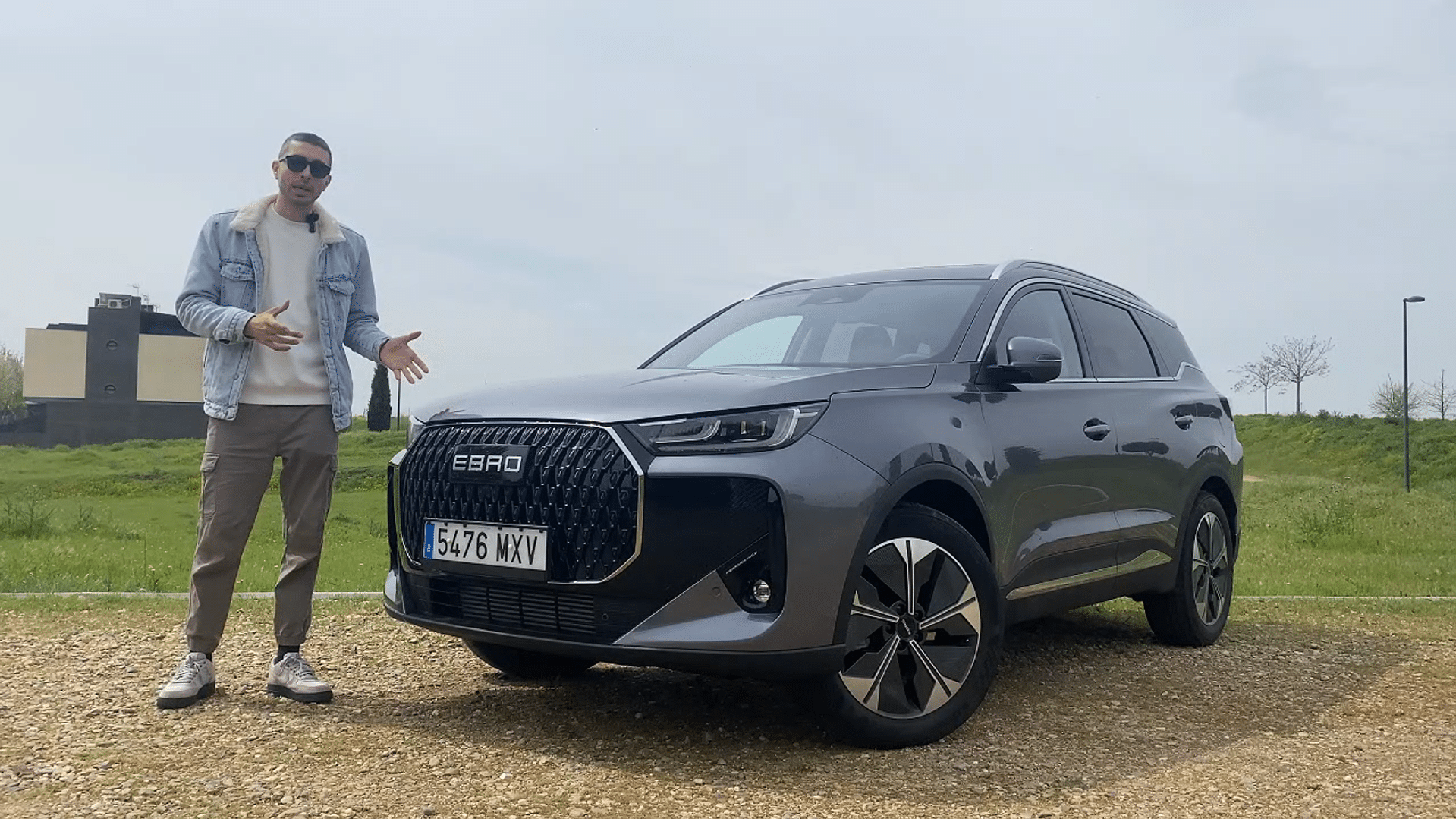
We test the new Ebro S700, the compact SUV that marks the return of a legendary Spanish brand. In this article we tell you everything you need to know about its design, road behaviour and our first impressions behind the wheel
From its founding in 1954 until its disappearance in 1987, EBRO manufactured buses, vans, off-road vehicles and tractors, but it stopped doing so because imports were heavily restricted, petrol was rationed, electricity was only supplied a few hours a day, and the few trucks produced did not sell because there were no tyres. Almost three decades after passing into the hands of Nissan and disappearing as a brand, EBRO announced its return in 2023 with a vehicle that, in principle, fitted the brand’s roots perfectly as a 100% electric pickup.
https://youtu.be/M9JcvAEzOLg
The idea looked promising, but it never quite took off… until barely a year later, EV Motors, EBRO’s parent company, signed an agreement with the Chinese giant Chery to resume activity at the factory in the Zona Franca industrial area of Barcelona and manufacture SUVs under the EBRO brand. The first two models assembled at the now renamed EBRO Factory in Barcelona are the S700 and the S800, and we have already driven the first of them.
We will very soon be driving the S800 as well, which will not be the brand’s last新 release this year: both models will offer plug-in hybrid powertrain variants, which will reach the market before summer. And at the end of 2025 a third, smaller model will join the range. Without getting ahead of ourselves, I can assure you that this is an SUV that is going to make a strong impact.
Exterior design
With a length of 4.55 metres, a width of 1.86 metres and a height of 1.69 metres, the S700 has a pleasant and spacious design. It is one of those cars that does not grab attention, but that nobody dislikes. Compared with the Omoda 5 and the Jaecoo 7, two other SUVs from the same group with which the EBRO shares its platform and mechanics, the EBRO is, so to speak, the most “conventional”, with a design that, in my opinion, can appeal to everyone.
Its main signature feature is the large octagonal grille, topped by the brand logo, which is without doubt one of the most eye-catching details of its design. Another distinctive trait is the C-pillar, painted black to create a floating roof effect. At the rear, the most notable elements are the light clusters joined by a light bar, a roof spoiler that integrates the brake light, and a diffuser that adds another distinctive touch.
Its appearance changes considerably depending on the body colour chosen: this version wears Phantom Grey, but if I had to choose one I would opt for the two-tone finish that combines a Khaki white body with a carbon black roof, although it is a optional extra costing 550 euros and can only be ordered with the most luxurious finish (Luxury). The other optional paints, in colours and Carbon Black, carry a surcharge of 300 euros over the standard colours.
A spacious interior with a great deal of quality
The sound when opening and closing the doors, the feel of the various controls, the visual appearance of the materials and their presence, and the different finishes used on the trims and upholstery make it clear from the moment we get into the EBRO S700 that we are dealing with a car with a finish quality well above what you would expect given its price. That feeling is even stronger in the top-of-the-range Luxury finish, which lives up to its name.
It is no coincidence that the dashboard of the EBRO S700 recalls that of the aforementioned §6Cheryh45§ and Jaecoo 7, with which it shares many controls and, especially, the instrument and multimedia screens, placed one after the other and in both cases 12.3 inches. Nothing new here: good definition (the resolution is 1,920×720 pixels in both), easy and sufficiently smooth operation through the different menus, and connectivity with Apple CarPlay and Android Auto, either wired or wireless.
But one of the main assets of the EBRO S700 is its good balance between exterior size and interior space. It is a pity that it lacks a rear bench that slides fore and aft to adjust legroom or boot volume according to needs, but both the rear seats and the boot are on a par with what is expected of a family car in this class. Ebro quotes a boot capacity of 500 litres, expandable to 1,305 litres by folding down the rear seatbacks. The boot shape is very regular and usable, and an emergency spare wheel can be fitted in the space under the floor.
Engine and chassis
As for the engine, it is more of the same and of what is already known from the Omoda and Jaecoo: the 1.6 TDGi 4-cylinder turbocharged engine, which produces 147 CV, delivers performance that is more than reasonable for this type of car, paired with a dual-clutch automatic gearbox that works more than correctly as long as you do not ask it to “shift”, which it does not lend itself to, since there are no paddle shifters on the steering wheel or a lever that can be operated sequentially for manual use. The enjoyment it provides is notable because the engine runs smoothly and delivers its maximum torque, 275 Nm, very early.
On the less positive side, it has no kind of hybridisation and therefore has to make do with the C environmental label from the DGT, although I am sure that if they launched a hybrid powertrain, even a 48V one, on these models they would sell like hot cakes.
A very well-judged dynamic
The platform of the EBRO S700 is the internally designated T1X, used by many models of the Chery Group. This means it inherits its virtues… and also some of its shortcomings. The main one is steering with excessive assistance, even when the Sport driving mode is selected on the multimedia screen. This, which can be an advantage when parking or manoeuvring in town, becomes a drawback when driving on winding roads.
It does not affect safety at all, and in many everyday driving situations you will not miss greater precision at the wheel. But the overall result could be better if the steering conveyed more of what happens between the tyres and the tarmac. Otherwise, it is comfortable over potholes, even though the suspension tuning is not soft, which helps keep body movements well controlled.
Overall it has a dynamic that works very well. It has a centre of gravity somewhat higher than its siblings, so the handling is a little less agile in this model, which is more focused on family use. The dual-clutch automatic works flawlessly and delivers its power the moment you ask for it.
Fuel consumption is not its main asset either, although it is not difficult to average around 8 l/100 km in mixed use without worrying too much about driving style. There are three modes, Eco, Normal and Sport, which slightly alter the throttle response and the engine speed at which gear changes occur.
But we are back in the same territory: at 30,000 € in the top trim you get a 1.6 147 CV engine that works perfectly and for which it is hard to find competing options on today’s market. That said, if I had to choose between its siblings, in the JAECOO the soundproofing and ride comfort caught my attention more, while in the OMODA the low centre of gravity and the few sporty details of that model stand out more.
Unbeatable price
Ebro offers the S700 in two trim levels, Comfort and Luxury, with a recommended retail price of 29,990 euros for the Comfort, and 32,990 euros for the Luxury. With the discounts available, the entry version drops to 27,640 euros if bought outright, and the most luxurious comes to 30,400 euros. And if the purchase is financed, you can get a Comfort S700 from 24,990 euros, a very competitive price given the standard equipment.
Take note, because for that price you get the S700 with 18-inch alloy wheels, roof rails, LED headlights, dual-zone climate control, keyless entry and keyless start, a camera, a six-speaker sound system, sports seats, a double 12.3-inch screen for the digital instrument cluster and the multimedia system, voice recognition, and a comprehensive package of driver assistance systems, including adaptive cruise control.
The Luxury adds about 3,000 euros to the bill, but the equipment it adds is worth much more: among the highlights, 19-inch wheels, a panoramic roof, electrically operated tailgate, ambient interior lighting, electrically folding and heated exterior mirrors, a head-up display, synthetic leather upholstery, front seats with electric adjustment, memory and heating and ventilation functions, a panoramic camera, a 50W wireless phone charging tray, and a Sony audio system with eight speakers.
Among the rivals of the S700 in terms of similar size and family-oriented positioning, its main price rivals are models such as the Dacia Bigster or the MG ZS, although the EBRO is also an alternative to the Hyundai Tucson, Kia Sportage, Jaecoo 7 or Nissan Qashqai.
7-year warranty
Doubts when buying a car from a new brand, however Spanish it is and however its models are assembled in Spain, may arise when assessing reliability, or where and how to receive assistance. To address the first point, EBRO does not do things by halves and offers as standard a seven-year warranty -or 150,000 km- on all its models.
As for the second, you can also rest easy: EBRO already has more than 30 dealerships spread across Spain, and the brand’s plans are to keep growing and reach 80 dealerships by the end of 2025. Moreover, the supply of spare parts is guaranteed within 24 hours to any point on the Iberian Peninsula thanks to the brand’s warehouse in Guadalajara. And among the services the brand offers is a replacement car for up to a week should your vehicle need to visit the workshop for any repair.
Technical specifications of this car


 Peugeot E-208 GTi: a battery-powered toy that revives the spirit of the 1980s sports cars
 New Lexus ES: luxury grows and goes electric
 First contact with the Dacia Sandero Hybrid 155: power and efficiency from €19,890
Deja un comentario