EBRO s800 Hybrid Cars Tests SUV
EBRO S800 PHEV road test: more than 1,000 kilometres between Madrid and Murcia to check out its strengths
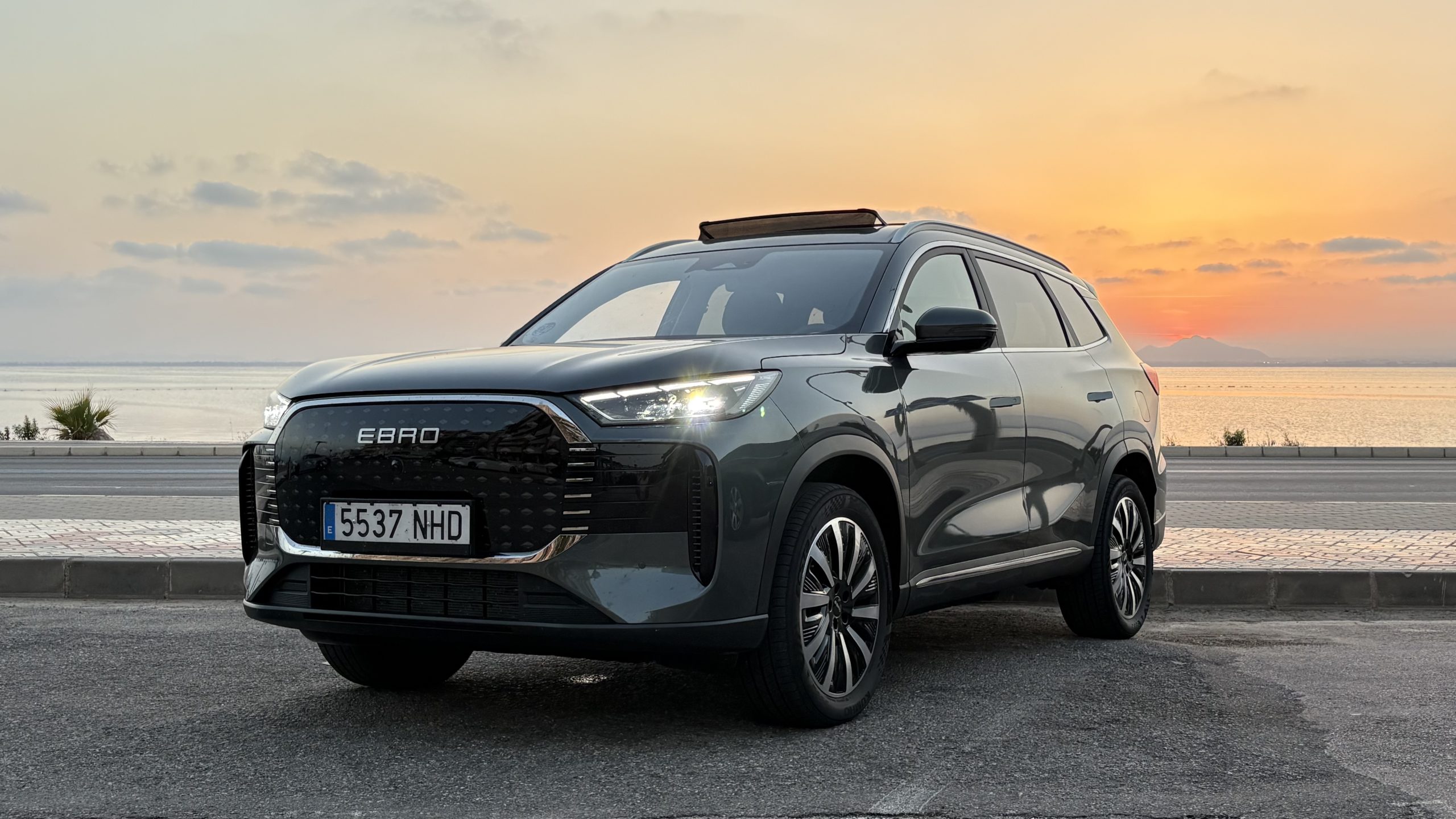
We get behind the wheel of the EBRO S800 PHEV. Can a 1,990 kg car deliver low consumption, good agility in the city and performance you would expect from far more expensive cars?
Some cars are easier to understand on a spec sheet, and others need kilometres. Lots of kilometres. The EBRO S800 PHEV clearly belongs to the second group. On paper, its recipe is attractive: a large SUV, seven seats, plug-in hybrid technology, ZERO label, 279 CV of combined power, up to 90 kilometres of electric range and more than 1,100 kilometres of total range. But the important question is a different one: does all of that work when it’s time to hit the road?
To find out, we set up a very simple test: a Madrid-Murcia-Madrid trip of more than 1,000 kilometres. Motorway, city, heat, air conditioning, luggage, traffic and several hours behind the wheel. No laboratory. No routes designed to chase the lowest possible consumption. Just real-world use, similar to what any family might do on a getaway, a holiday or a long journey.
And that is where the EBRO S800 PHEV starts to show its best arguments.
A large SUV that feels comfortable from the very first kilometre
The first thing that stands out about the EBRO S800 PHEV is that it doesn’t try to hide what it is: a spacious, family-oriented SUV built for travelling. It measures 4.72 metres long, 1.86 metres wide and 1.70 metres tall, with a wheelbase of 2.71 metres. These dimensions explain much of its exterior presence, but also its interior roominess.

On this kind of trip, comfort is no minor detail. The driving position, the space for occupants, visibility, how easy it is to live with the car for hours on end and the overall feeling of spaciousness end up being just as important as range or consumption.
The S800 PHEV conveys precisely that idea of a long-distance cruiser. It doesn’t aim to be sporty or particularly radical in its behaviour. Its natural territory lies in comfort, smoothness and the ability to make the kilometres pass without fatigue.
Its technical approach helps too. The Chery Group’s T1X platform has been designed to accommodate combustion, hybrid and electric systems, prioritising interior space, rigidity and dynamic behaviour. On the move, that translates into a car that feels stable, comfortable and very much geared towards covering long distances.
The interior, one of its great strengths
The cabin is one of the areas where the EBRO S800 PHEV scores the most points. Not just for space, but for presentation, equipment and technological feel.
EBRO speaks of an interior with 79% soft-touch materials, something that shows in the car’s overall impression. The door panels, the centre console, the metallic buttons with a machined finish and the black trim help create a more refined atmosphere than many might expect in an SUV at this price point.
The driving position is comfortable, with a steering wheel that is flat at the bottom, heated and fitted with multifunction controls. The 10.25-inch digital instrument cluster presents the main information clearly, while the Head-Up Display lets you check essential parameters without taking your eyes off the road.
The front seats also play an important part in that feeling of comfort. Both have electric adjustment, heating and ventilation for the seat base and backrest. In addition, the driver’s seat has three memory settings, while the passenger’s adds a massage function and a footrest. In a car designed for travelling, this kind of detail stops being a luxury and becomes a real selling point, especially when you look at its price.
The Eco-Skin upholstery, designed to make cleaning easier and withstand intensive use, fits the family character of the model very well. Because the EBRO S800 PHEV is not just a large SUV: it is a car that wants to work for everyday life, for travelling, for carrying children, luggage and everything that usually comes with a family on a long journey.
Seven seats and a boot that doesn’t lose capacity for being a PHEV
One of the most interesting points of the EBRO S800 PHEV is that it offers up to seven seats, something rare among plug-in hybrids in its class. The third row greatly expands its versatility, especially for those who need extra seats occasionally or regularly.
What’s more, the 18.3 kWh battery does not penalise load space compared with the combustion version. In the five-seat configuration, the boot keeps 889 litres of capacity measured up to the roof. With all seven seats in use, the volume is 117 litres, and if all the rear seats are folded down, capacity rises to 1,930 litres.
These figures explain well why the S800 PHEV can be defended as an all-round family car. It is not just an electrified SUV with good electric range; it also retains a very large load capacity and a flexible interior layout. On a long trip, that combination is welcome. There is room for passengers, for luggage and for adapting the car to different uses without the feeling that plug-in hybrid technology has stolen any practicality.
Screens that aren’t just there to impress
The interior of the EBRO S800 PHEV also stands out for its technological display. The 15.6-inch central screen takes centre stage on the dashboard and gives a clear read-out of the infotainment system’s information. But here, what matters is not just the size or the visual impact. What matters is that it works well.
In many current cars, especially the most digitalised ones, screens can become a source of frustration: slow menus, delayed responses, unintuitive interfaces or systems that look great when stationary but not so much on the move, and the truth is that this has always been conspicuous by its absence in the Chery group.
The system runs smoothly, the touch response is quick and navigating the menus feels natural. The key is the Qualcomm 8155 chip, one of the most advanced processors in the automotive world, with an eight-core CPU, an Adreno 640 GPU and dedicated processors for audio, image and digital signals.
This hardware allows the screens, sensors, communication modules, infotainment system and connectivity to work in an integrated way. In addition, EBRO has developed software designed to take advantage of that technical base, with responsive menus, configurable shortcuts and a clear organisation of functions, such as quick access to the menus we use most, ventilation, seats, personalisation…
Connectivity, voice and 540º vision
The EBRO S800 PHEV’s multimedia system also lets you control many of the car’s functions, from the navigation or the sound system to the climate control, connectivity, driver assistance systems, ambient lighting or exterior vision.
Voice control adds another interesting point, as it allows you to manage functions such as calls, temperature, radio station, windows or sunroof. It can also be activated from any seat in the vehicle, which is consistent with its family-oriented, seven-seat approach.
Added to this is compatibility with Apple CarPlay and Android Auto, 50 W cooled wireless charging and front and rear USB ports to connect several devices at the same time.
The 540º HD panoramic camera also deserves a mention. It combines a 360-degree overhead view with a 180-degree front or rear view, as well as a 3D view of the vehicle and additional functions such as adjustable bodywork transparency. In an SUV of this size, this system brings a lot of peace of mind when manoeuvring, parking or in tight spaces.
The Sony sound system is perhaps one of the few elements of the interior that doesn’t quite live up to the rest of the package. On paper, the specification is promising: 12 speakers spread around the cabin, with low-frequency, high-frequency and mid-range speakers, a subwoofer and even speakers built into the headrests. In real use, however, it lacks some punch, volume and depth. It doesn’t sound bad, but it doesn’t deliver that premium experience you expect when you see the Sony name and such an array of speakers.
A hybrid system with 279 CV and up to 90 km of electric range
The mechanical basis of the EBRO S800 PHEV is the Chery Group’s third-generation hybrid system, known as CSH —Chery Super Hybrid—. It combines a 143 CV 1.5 TGDI DHE engine with a 204 CV electric motor, for a combined output of 279 CV and a combined maximum torque of 525 Nm.
The combustion engine claims a thermal efficiency of 44.5%, a particularly high figure in the industry, and works alongside a DHT hybrid transmission with 92% overall efficiency and up to 98.5% efficiency in electric mode.
In practice, the system can operate in different modes: pure electric, series hybrid, parallel hybrid, combustion and energy recovery. In the city and at low speed, the car prioritises electric mode. If the battery runs out or speed increases, it can switch to series hybrid mode, with the electric motor driving the car and the combustion engine generating electricity. On the open road or under heavy acceleration demands, both engines work together. And at high, constant speeds on the motorway, the combustion engine can take over delivering power to the front wheels. Even so, it also includes a button to switch between EV and HEV mode in case we ever want to make the most of its battery and achieve ridiculously low consumption.
Consumption: the S800 PHEV’s great real-world argument
Beyond the theory, one of the most convincing points of the EBRO S800 PHEV is its consumption. And here it’s worth separating the two scenarios clearly.
In day-to-day use, with the battery charged, the 90 kilometres of homologated electric range cover a good share of everyday journeys without using any petrol. That is the use where a PHEV makes the most sense: urban trips, commuting, errands, access to low-emission zones and electric driving whenever your routine allows frequent charging.
But the real test comes when it’s time to travel. And there the S800 PHEV has arguments as well. EBRO homologates 0.7 l/100 km in the WLTP combined cycle and 6 l/100 km with a depleted battery, a particularly interesting figure for a large, seven-seat SUV that is 4.72 metres long and weighs 1,991 kilos. During our test, we wanted to see how efficient the battery was and how far we could really go in electric mode, and the results surprised us: we managed to cover exactly 96 km from the moment we started the car, mixing city and motorway.
The second part of the journey will surprise you as much as it did me because, despite the depleted battery, the car moved with remarkable ease, both when overtaking and when cruising calmly in the cabin without an annoying engine noise. During this second stretch, consumption was 6.2 litres, nearing 7 l/100 km on some climbs. But the car is able to regenerate the battery in an incredible way, managing to move a 1,990 kg beast around town with a fuel consumption of 4.6 litres and an electricity consumption of 3.6 kWh/100 km.
The total range exceeds 1,100 kilometres, which explains very well why this car makes sense in a Madrid-Murcia-Madrid test. It doesn’t just play the card of the ZERO label or electric driving in the city; it also lets you tackle the open road with reasonable consumption when the hybrid system works like a conventional hybrid, keeping the battery charge within a stable range and managing energy according to the type of road, the speed or the driver’s demand.
That is probably one of its greatest virtues: it can be very efficient in daily use and, at the same time, not send consumption through the roof when it’s time to set off on a trip.
DC fast charging and V2L function
The 18.3 kWh battery also provides interesting figures. It can charge on direct current at up to 40 kW, going from 30 to 80% in 19 minutes. On alternating current, it accepts up to 6.6 kW, with a charging time of 3 hours and 15 minutes.
In addition, the S800 PHEV incorporates a bidirectional charging V2L function, with power of up to 3.3 kW to run external devices. It is a particularly useful function on trips, outdoor activities or situations where you need power away from the car.
The battery is designed specifically for hybrid vehicles, has an operating range of -35 ºC to 60 ºC and features a comprehensive protection system with three-layer shielding against collisions and fire, as well as waterproofing.
Behind the wheel: comfort, smoothness and a bit of extra bounce
Behind the wheel, the EBRO S800 PHEV makes it clear that its priority is comfort. The hybrid system’s response is smooth, the power delivery is sufficient for merging, overtaking and sustained motorway speeds, and the driving experience invites calm, steady pace.
The propulsion system works smoothly and the DHT transmission helps make transitions between modes progressive. In the city, the S800 PHEV is very pleasant to move around in, especially when running in electric mode. It is quiet, easy to modulate and comfortable on streets, roundabouts, speed bumps and urban traffic.
The suspension also fits that philosophy. EBRO uses an independent layout on both axles, with McPherson at the front and multi-link at the rear, and states that the bushings, silentblocks, springs and dampers have been tested and adapted to the extra weight of the PHEV versions compared with the petrol ones.
In the city, the result is very pleasant. It filters out irregularities well and reinforces the feeling of a comfortable car. On the open road, however, it doesn’t always maintain the same level of composure. In certain changes of support, undulations or areas of uneven asphalt, the body can show some bounce. It never becomes uncomfortable or conveys insecurity, but you can tell the package clearly prioritises comfort over body control.
The car remains comfortable and pleasant for travelling, but on the open road a slightly firmer suspension would be welcome, especially given its size, its weight and its long-distance focus. A suspension that barely changes no matter how much we alter the driving mode.
Even so, the dynamic balance is consistent with what the model sets out to be. It is not a car that seeks to convey sportiness. Nor does it need to. In a family SUV of this kind, what matters is that it is comfortable, stable, quiet and easy to drive. And there the S800 PHEV delivers on what it promises.
Safety and assistance systems to travel with more confidence
A long trip is also a good way to assess safety and assistance systems. In this area, the EBRO S800 PHEV has a very complete specification.
The body uses high-strength steels, with a torsional rigidity of 21,000 Nm/º, and was developed through 100,000 virtual and real tests. The key areas are reinforced with six hot-formed ultra-high-strength steel parts, with a yield strength of 1,500 MPa.
On top of this come up to nine airbags and 24 ADAS driver assistance systems, which work with information gathered by 17 cameras and sensors distributed around the vehicle. These include lane departure control, front and rear collision warning, automatic emergency braking, adaptive cruise control, traffic jam assist, sign recognition, door-opening warning, rear cross-traffic alert and driver monitoring, among others.
Conclusion: a PHEV with real arguments for travelling
After more than 1,000 kilometres between Madrid and Murcia, the EBRO S800 PHEV leaves a fairly clear conclusion: a plug-in hybrid can indeed make sense for travelling, as long as it is well conceived and the user understands what kind of car they have in their hands.
Its greatest virtue lies not in being the sportiest, nor in promising consumption miracles, nor in completely replacing a pure electric car. Its real argument lies in combining two worlds: electric driving for everyday use and enough range to tackle long journeys without complications.
On top of that it adds a spacious interior with up to seven seats, 889 litres of boot space in the five-seat configuration, screens that run smoothly thanks to the Qualcomm 8155 chip, a well-executed technological experience, 279 CV of combined power, 90 kilometres of electric range, 6 l/100 km with a depleted battery and more than 1,100 kilometres of total range.
It isn’t perfect: the Sony sound system could have more punch and the suspension, although extremely comfortable in the city, can feel a little bouncy on the open road. But even with those caveats, the package makes a lot of sense.
The EBRO S800 PHEV doesn’t need to convince with a single figure. It convinces better as the kilometres add up. And after more than 1,000 of them, its proposition is quite easy to understand: a comfortable, technological plug-in hybrid SUV designed for those who want to electrify without giving up travelling the way they always have. A car that, if it proves reliable, certainly has plenty to say for itself.
EBRO S800 PHEV technical specifications
| Engine and performance | |
| Type | 1.5 TGDI 4-cylinder inline |
| Layout | Front transverse. Overhead camshaft. Turbo. Intercooler |
| Displacement (cm3) | 1,499 |
| Bore x stroke | 72 x 92 |
| Maximum combustion engine power (CV) | 143 at 5,200 rpm |
| Maximum electric motor power (CV) | 204 |
| Combined power (CV) | 279 |
| Compression ratio | 14.5:1 |
| Maximum combustion engine torque (Nm) | 215 at 2,500 rpm |
| Maximum combined torque (Nm) | 525 |
| Top speed (km/h) | 180 |
| Acceleration 0-100 km/h (s) | 9 |
| Weighted petrol consumption (l/100 km) | 2.5 |
| Combined consumption without battery (l/100 km) | 6 |
| Emissions standard | Euro 6e-A |
| CO2 emissions (g/km) | 16-136 |
| Dimensions | |
| Body type | AB |
| Length (mm) | 4,725 |
| Width (mm) | 1,860 |
| Height (mm) | 1,705 |
| Wheelbase (mm) | 2,710 |
| Front/rear track (mm) | 1,582/1,604 |
| Weight (kg) | 1,991 |
| Seats | 7 |
| Boot capacity (l) up to the roof | 889/1,930 |
| Fuel tank capacity (l) | 60 |
| Approach angle (º) | 19.6 |
| Departure angle (º) | 23.5 |
| Transmission | |
| Transmission type | Automatic DHT |
| Number of gears | 1+R |
| Drive | Front-wheel drive |
| Chassis | |
| Front suspension | McPherson |
| Rear suspension | Multilink |
| Brakes (front/rear) | Ventilated disc / solid disc |
| Parking brake | Electric operation |
EBRO S800 PHEV image gallery
Technical specifications of this car


 Peugeot E-208 GTi: a battery-powered toy that revives the spirit of the 1980s sports cars
 New Lexus ES: luxury grows and goes electric
 First contact with the Dacia Sandero Hybrid 155: power and efficiency from €19,890
Deja un comentario