Mercedes-Benz successfully completes the winter tests of the eArocs 400 and is preparing to begin its commercialization
 Javier Cantagalli
23 February 2026
3 min.
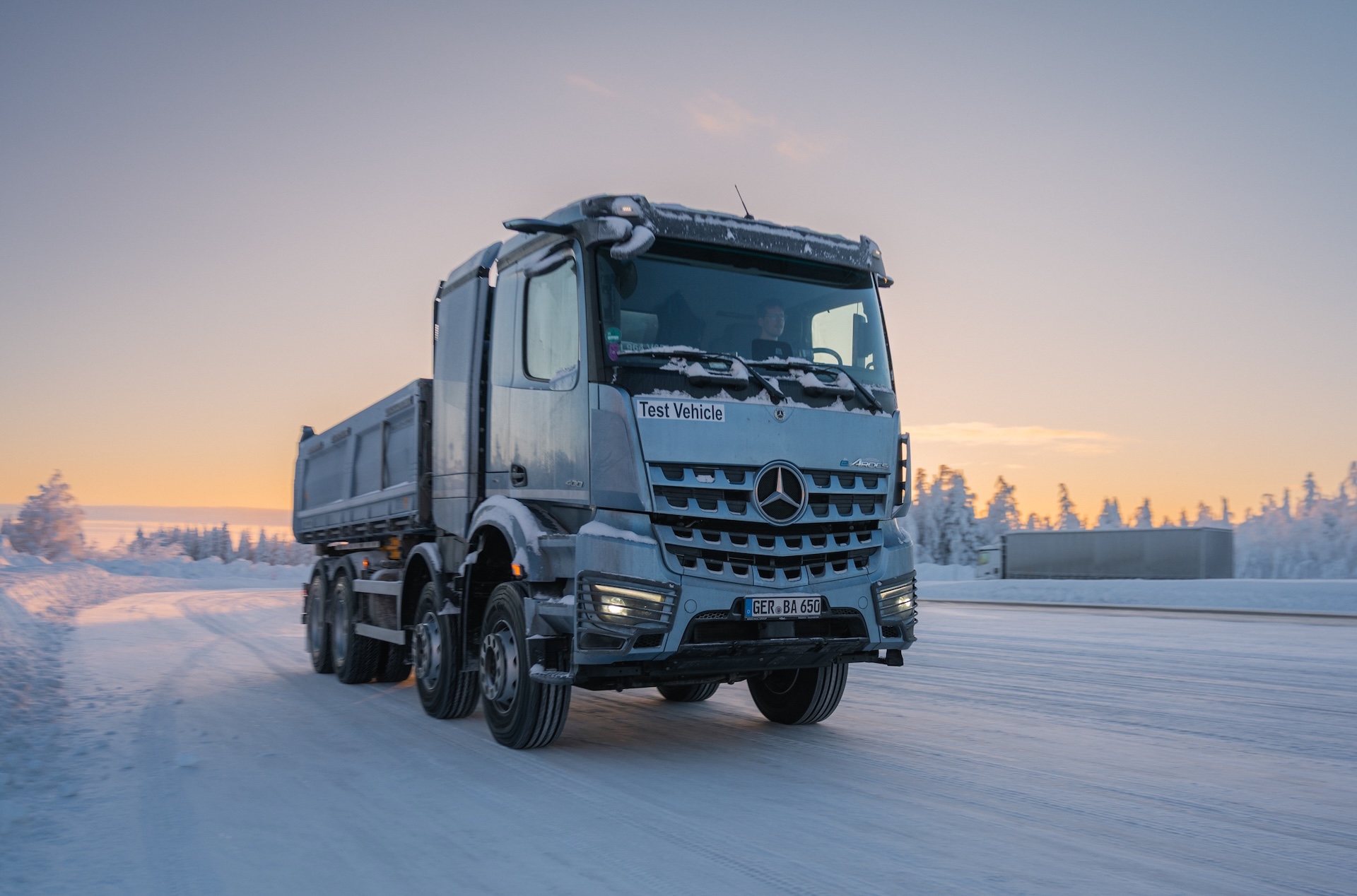
Mercedes-Benz advances its strategy of electrifying transport in the construction sector, with a Zero Emissions model that also generates less noise, ideal for sensitive urban areas.
The Mercedes-Benz eArocs 400 electric truck, designed specifically for construction work in urban environments, has successfully passed the demanding winter tests in extreme conditions to which it was subjected by the brand’s engineers. This latter achievement has allowed the German manufacturer to announce its upcoming commercialization starting next April, shortly before the first production units begin to roll off the assembly line.
The Mercedes-Benz Arocs truck has been a benchmark for the construction sector since 2013, always using diesel combustion engines until now. The new eArocs 400, with a fully electric propulsion system, was presented by Mercedes-Benz last April and, like the eActros 600 intended for long-distance freight transport, will use battery packs with lithium iron phosphate (LFP) cells, which offer a higher level of safety and durability. This model will be offered in mixer and tipper configurations.
In a first phase, production of the eArocs 400 will be limited to a small series of just 150 units per year, aimed at selected markets in the European Union, with a more ambitious goal in a more or less near future.
Unstoppable
Ahead of its commercial launch, the eArocs 400 passed the demanding winter tests to which it was subjected near the Arctic Circle, with temperatures of up to 20 degrees Celsius below zero. These tests evaluated key aspects to ensure reliable operation in very cold climates, such as traction and stability on snowy or icy roads, cold starts, battery behavior and charging at low temperatures, the performance of the electric powertrain, or the efficiency of energy recovery in winter conditions.
The eArocs 400 takes advantage of key components from the eActros, such as the front system and the power take-off (PTO). It features two LFP battery packs of 207 kWh each, totaling 414 kWh, mounted in a tower behind the cab. It also has an 800-volt architecture, which allows it to charge from 10 to 80 percent in about 46 minutes, supporting up to 400 kW of power through its two CCS2 ports located on both sides of the vehicle.
According to the German manufacturer, the Arocs 400 will initially be available with gross weights of 37 and 44 tonnes. As a mixer, it will offer a range of up to 200 km, while the tipper variant will reach up to 240 km. Although these figures may seem somewhat limited at first glance, they should allow a standard working day to be completed without the need for any intermediate charging.
If everything goes according to plan, production of the base chassis will start in the third quarter of 2026 at the Mercedes-Benz plant in Wörth, Germany, while the final integration of the electric system will be carried out in collaboration with Paul Group in Vilshofen an der Donau.


 Peugeot E-208 GTi: a battery-powered toy that revives the spirit of the 1980s sports cars
 New Lexus ES: luxury grows and goes electric
 First contact with the Dacia Sandero Hybrid 155: power and efficiency from €19,890
Deja un comentario