Momenta gets the green light from German authorities to carry out urban tests with its robotaxis
 Javier Cantagalli
1 August 2026
3 min.
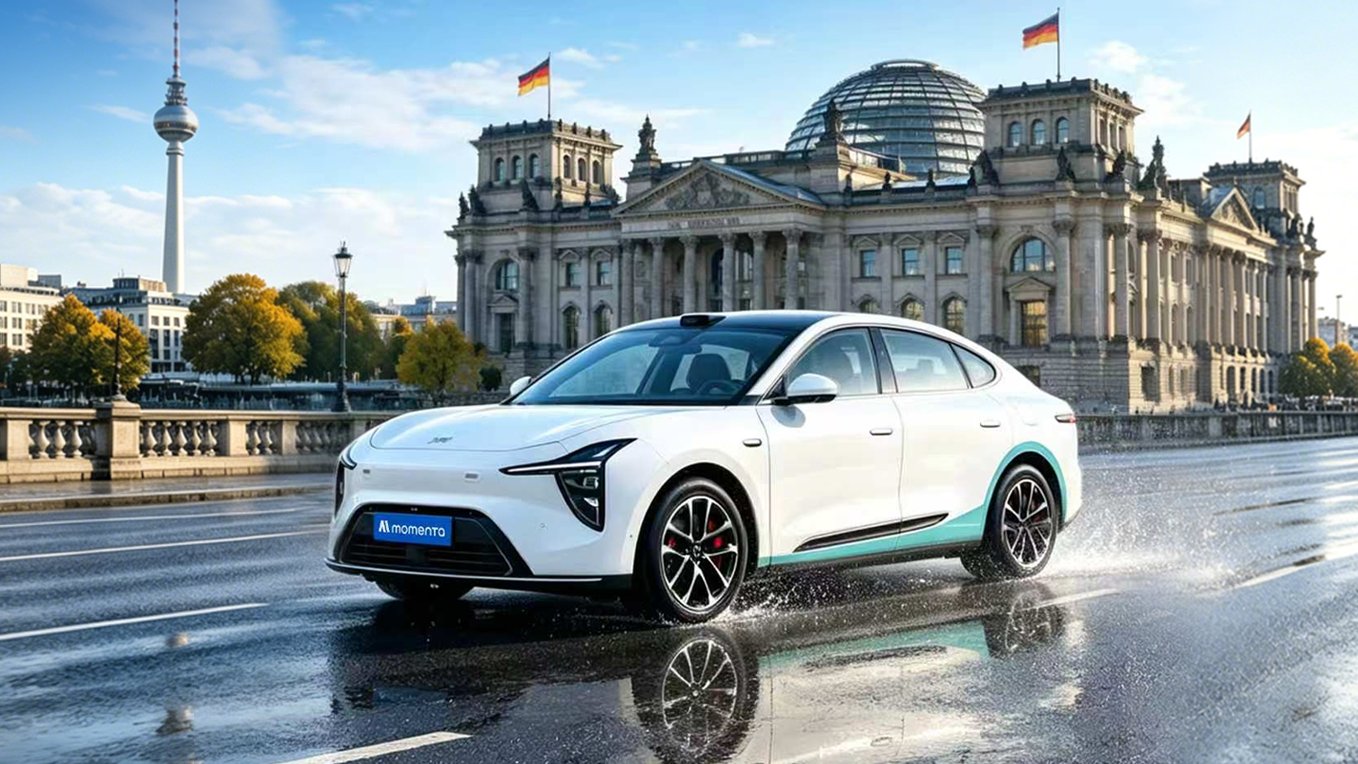
The race for Europe’s first robotaxi fleet is under way, and Chinese companies appear to have gained a certain advantage in this market, at least for the moment.
Germany’s Federal Motor Transport Authority (KBA) has granted Momenta, a well-known Chinese company specialising in autonomous driving, nationwide authorisation to carry out Level 4 autonomous driving tests in urban traffic. This is a decisive regulatory step for the robotaxi project in Munich that the Chinese firm announced a year ago.
Momenta thus becomes the first Chinese company to obtain this type of nationwide permit from the KBA for driving in urban areas. Until now, developers had to apply for a separate authorisation in each locality, a bureaucratic obstacle that ended up holding back this kind of initiative even more than the technical limitations of the software. With the new licence, Momenta can move, expand or continue its tests in any German city without restarting the administrative process. In addition, the safety validation is aligned directly with European regulations, which should make it easier to enter other European Union markets.
As you probably already know, Level 4 autonomous driving means that the vehicle is able to drive completely autonomously within a defined operational domain and to reach a safe state without human intervention in the event of a failure. A safety driver who takes control in emergency situations is therefore not required.
Germany was one of the first countries to create a specific legal framework with the Autonomous Driving Act of 2021, in which the KBA acts as the approval authority. This body’s reputation as a particularly demanding reviewer gives the authorisation considerable international weight.
Technically, Momenta is based on what it calls a World Model: a system that not only perceives the environment, but also anticipates how it will evolve. The company defines it as the ability to see the road, understand it and foresee how a situation will unfold before it happens. In dense urban traffic with cyclists, badly parked delivery vans or pedestrians emerging from between vehicles, this predictive capability makes the difference between a reactive assistance system and a fully autonomous vehicle.
Target: Munich
In September 2025, Uber and Momenta announced their intention to test robotaxis in the Bavarian capital from 2026, and to subsequently expand to the rest of Europe. The company’s European headquarters is in Böblingen, near Stuttgart, but it also has offices in Munich. Momenta supplies assistance systems to the Chinese models of BMW and Mercedes-Benz, the latter having been an investor since 2017. There are also certain links between Momenta and the Volkswagen group, especially with the Audi brand.
This announcement comes shortly after Momenta’s stock market listing in Hong Kong on 8 July. With that operation, the company raised around 6.8 billion dollars, of which approximately one fifth will be allocated to the robotaxi business. With this listing, Uber increased its stake in the company and now holds around 1.19 million shares, valued at about 45 million dollars, through a subsidiary. Investors also include Grab, Lumo and EnjoyGo, SAIC Motor’s mobility service.
 Peugeot E-208 GTi: a battery-powered toy that revives the spirit of the 1980s sports cars
 New Lexus ES: luxury grows and goes electric
 First contact with the Dacia Sandero Hybrid 155: power and efficiency from €19,890
Deja un comentario