Rivian drives autonomous driving forward with the development of a new AI-driven architecture
 Javier Cantagalli
14 December 2025
3 min.
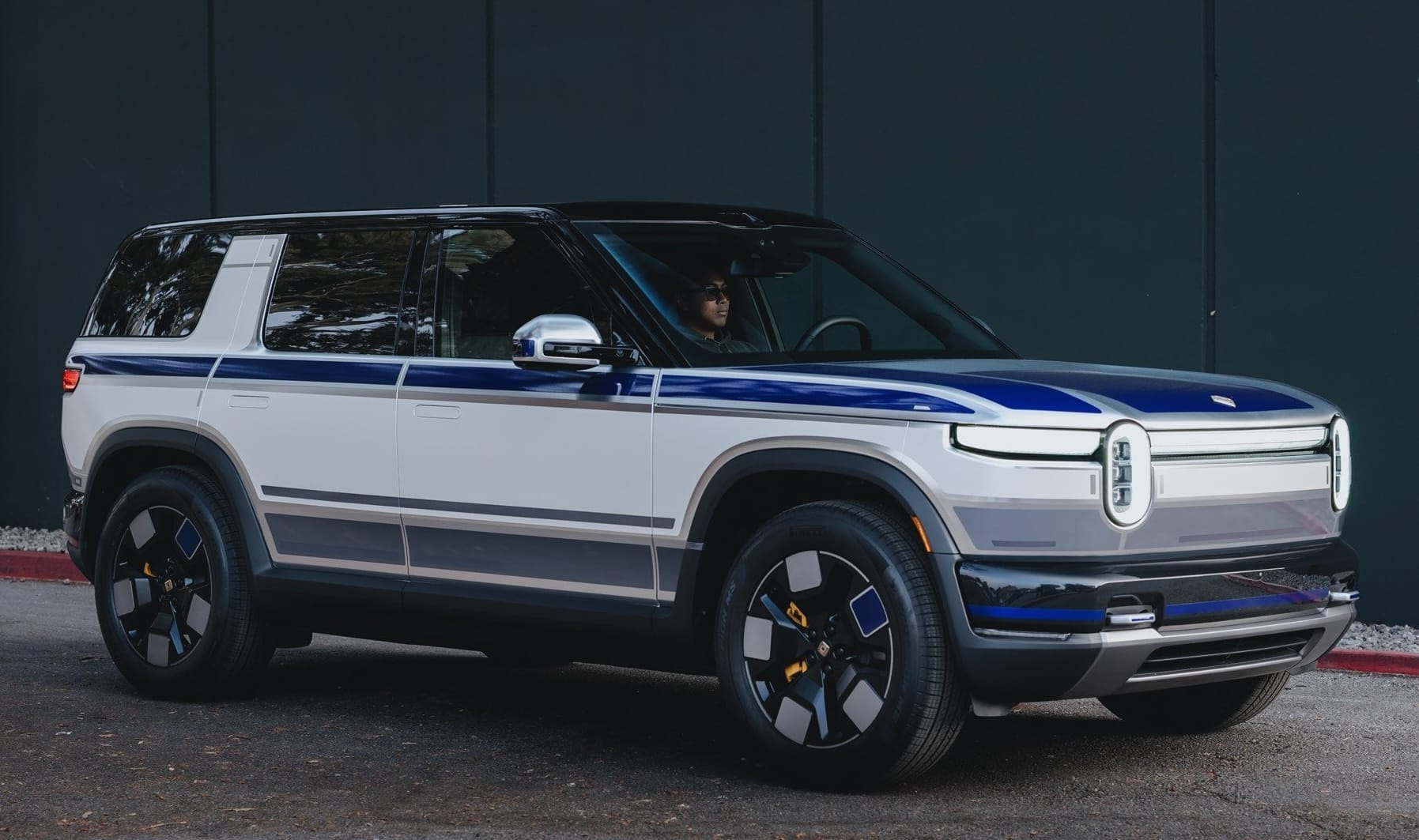
Rivian has a plan so it does not fall behind the advances other competitors have achieved in autonomous driving, which could tip the balance against brands that do not offer these capabilities.
During the company’s first event devoted exclusively to advances in autonomous driving and Artificial Intelligence, Rivian announced that it is working on the development of a new silicon chip that will serve as the foundation for the company’s next-generation autonomous driving system, as well as for a new AI-driven software architecture.
The Rivian Autonomy Processor -RAP1- is a 5-nanometre chip designed entirely in-house by the company. This processor integrates compute and memory in a single module and is optimised for AI based mainly on vision. It will be the basis of Rivian’s autonomous ambitions, with initial deployment for Level 3 autonomous driving and later evolution towards Level 4, which is necessary for the American manufacturer’s vehicles to offer a robotaxi service.
RJ Scaringe, founder and Chief Executive Officer of Rivian, could not hide his enthusiasm for this revelation. The new hardware that includes this chip, capable of reaching 1,600 TOPS of inference, will enable decisive progress towards Level 4 autonomous driving. The RAP1 will power the third autonomous compute module (ACM3), capable of processing up to 5 billion pixels per second, a power essential for handling in real time the enormous volumes of data that autonomous driving requires.
Rivian moves away from autonomous driving models based solely on vision
It should be noted, however, that unlike Tesla, which relies exclusively on cameras and computer vision, Rivian will incorporate LiDAR in its future vehicles starting with the R2 electric SUV scheduled for 2026. This laser sensor will complement the multimodal sensor strategy, providing precise three-dimensional maps and redundancy to better detect edge-case situations. The company also presented its Large Driving Model (LDM), a foundation driving model trained in a similar way to large language models, which extracts optimal strategies from huge data sets.
For the time being, the second generation of the R1 will improve its advanced driver assistance systems with Universal Hands-Free (UHF), which will allow hands-free driving on long stretches and on more than 5.6 million kilometres of roads in the United States and Canada. This is an advanced Level 2 system, which requires the driver to keep their attention on the road and be ready to intervene at any moment. Rivian plans to evolve to Level 3, which lets the driver stop paying continuous attention to the road as an intermediate step, to eventually reach the long-sought Level 4.
The Autonomy+ package, which will include Universal Hands-Free (UHF) and will be improved over time through software updates, will cost 2,500 dollars if paid once or 49.99 dollars per month from early 2026, prices that are notably more competitive than those of some rivals offering similar features.
Scaringe made clear that, although the initial focus is on private vehicles, the technology developed also enables future opportunities in shared mobility and robotaxis, a field already explored by competitors such as Waymo. Rivian thus moves firmly forward towards a future of fully autonomous driving.


 Peugeot E-208 GTi: a battery-powered toy that revives the spirit of the 1980s sports cars
 New Lexus ES: luxury grows and goes electric
 First contact with the Dacia Sandero Hybrid 155: power and efficiency from €19,890
Deja un comentario