Santana Cajal: this is the new 4x4 from the Spanish brand that wants to take on the Toyota Land Cruiser
 Antonio Roncero @roncero_antonio
23 July 2026
11 min.
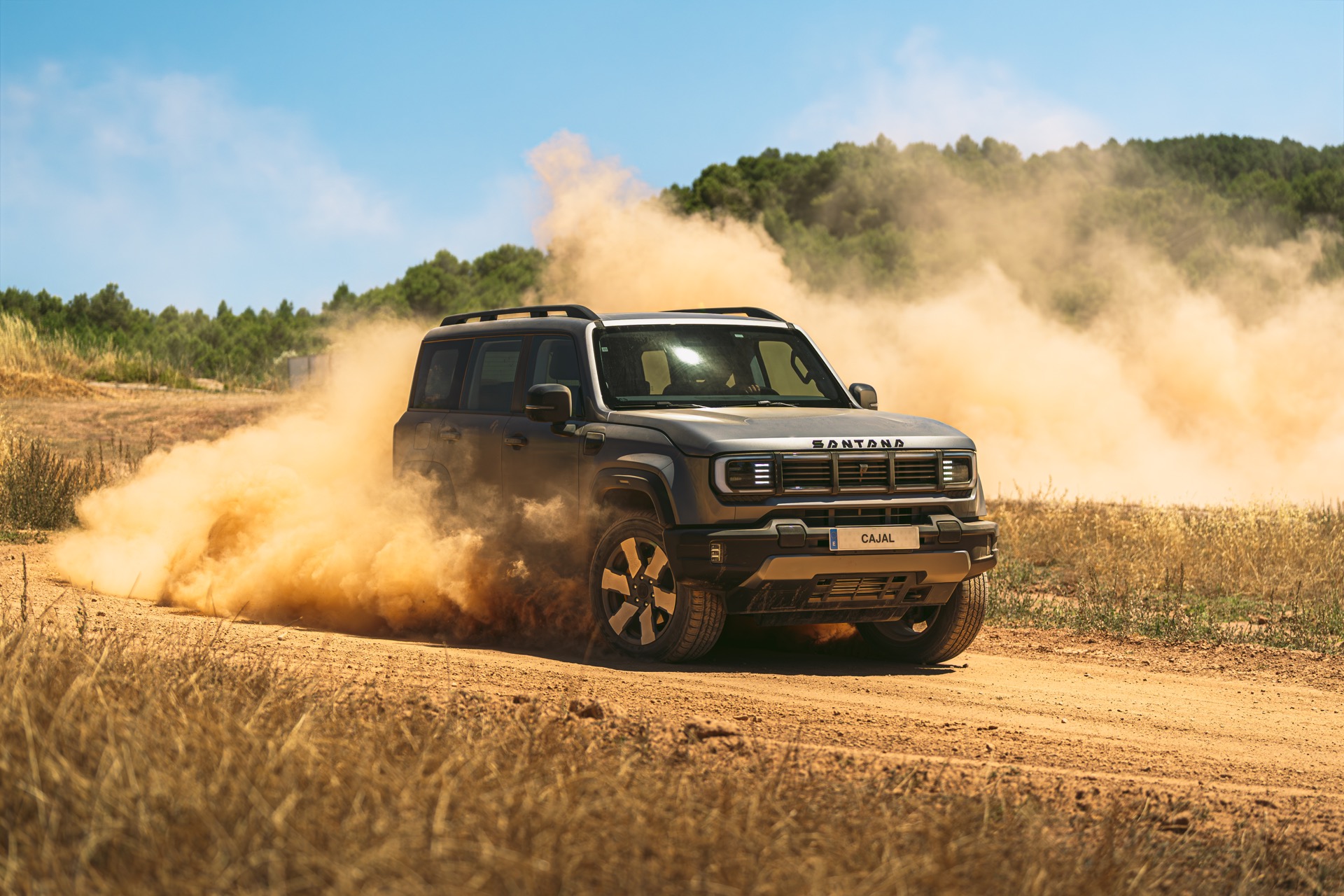
Santana is returning to its most off-road spirit with the new Cajal, a 4×4 with a ladder frame chassis, diesel engine, transfer case, differential locks and an interior that impresses with its quality and technology.
Santana is starting a new chapter, and it is doing so by reclaiming a territory that belongs to it by history: that of the robust, functional and capable 4×4. But the market is no longer what it was twenty or thirty years ago. Today a pure off-roader has to be effective off the tarmac, but also comfortable, technological and sufficiently refined. And to prove it, there are models such as the latest generations of the Toyota Land Cruiser or Jeep Wrangler. Or the Ineos Grenadier, to name but one. Not forgetting a full Mercedes G-Class, bearing in mind, of course, the differences in price and approach.
And that is where the new Santana Cajal wants to play its cards. A “Spanish” 4×4, although it must be made clear that the Cajal is, originally, a Chinese model, the BAIC BJ40, which Santana assembles at its plant in Linares, in Jaén. We have been able to make a first contact with the car at its static presentation in Madrid, and these are our impressions… and the main features of the Cajal, which, as you may have guessed, pays tribute with its name to Santiago Ramón y Cajal, the first Spanish Nobel Prize winner in medicine.
A traditional off-roader with the presence and technology of a modern car
The first impression is very good. The Cajal has stature, presence and a much more premium image than one might expect from a model that Santana wants to position with a target price below 50,000 euros. It is not a discreet car, nor does it intend to be. It has a square-lined body, pronounced wheel arches, a powerful front grille and a silhouette that clearly conveys that we are looking at a real 4×4, the kind that hides a ladder frame chassis beneath its bodywork.
But what is interesting is that at no point does it come across as a crude or outdated car. The design is very refined and there are details rarely seen on this type of body, such as frameless doors, a solution we normally associate with cars with a sportier or premium approach, not off-roaders with a transfer case and differential locks where body rigidity is a priority. And we all know that doors with frames are always more rigid. In this regard, it is worth mentioning a video projected by the brand during the presentation in which the Cajal -actually the BAIC, but we are talking about the same thing- is put through a test witnessed by a notary in which the car rolls down a desert dune, performing more than 20 barrel rolls, while keeping the cabin intact.
The split tailgate also catches the eye. The glass section opens upwards for quick access to the boot, while the lower section, which opens sideways, integrates the spare wheel, in pure 4×4 style.
Santana will initially offer the Cajal in four exterior colours: white, grey, black and green. The last of these will probably be the one that best suits the adventurous character of the model; personally, white doesn’t do much for me, and grey doesn’t look bad either.
Ladder frame chassis, rigid axle and transfer case
The great difference between an SUV with a rugged look and a genuine off-roader like the Cajal lies beneath the bodywork. And here we find a classic recipe if you want to boast about being a 4×4: ladder frame chassis with cross members, rigid rear axle, selectable four-wheel drive, transfer case and differential locks.
In other words, we are not dealing with a raised SUV with generously profiled tyres and driving modes with adventure-sounding names, which is what is in fashion now. We are dealing with a vehicle designed to perform at its best off the tarmac and to tackle difficult terrain with real mechanical guarantees. To this end, the 4×4 system offers different operating modes: 2H, 4A, 4H and 4L in the transfer case, plus no fewer than 11 driving modes, designed to adapt the vehicle’s response to different scenarios: road, snow, mud, sand, rocks, fording or difficult tracks.
The most striking fact is that the Cajal offers three differential locks: centre, rear and front. This is not common even among modern off-roaders, and it clearly marks the ambition of the model. When the terrain gets really tough, being able to lock the differentials remains a solution that delivers results that cannot easily be achieved with electronics alone.
Cummins diesel engine: 163 CV and plenty of torque
Under the bonnet we find a 2.0-litre turbodiesel engine from Cummins, with 163 CV and 390 Nm of maximum torque. On paper the power figure is not especially impressive for a car of this size -it measures 4.79 metres long- and weight -2.2 tonnes-. But in a pure off-roader, what matters is not always the available power.
Here, torque, robustness, the ease of moving the car at low speed, the ability to work in difficult terrain and the reliability of the whole package matter more. And in this sense, the name Cummins says it all: we are talking about a manufacturer with a very solid reputation in industrial diesel engines and professional applications. For now there are no official performance figures regarding acceleration. It is only announced that the top speed is 160 km/h. There are no provisional consumption figures either.
The engine is paired with a ZF eight-speed automatic gearbox, another component that inspires confidence. ZF is a benchmark in automatic transmissions, and in a car of this type it is essential that the gearbox shifts smoothly on the road, but is also durable and precise when driving off-road, in low range or at low speed.
The transmission technology features solutions from BorgWarner, another top-tier specialist in 4×4 systems. Santana seems to have wanted to build the Cajal around well-known and proven components, which is very important for winning the trust of a customer who does not buy this type of car purely for its looks.
Very serious off-road figures
The off-road capabilities are also in line with the car’s approach. The Santana Cajal claims 22 centimetres of ground clearance, an approach angle of 37 degrees, a departure angle of 31 degrees and a wading depth of 80 centimetres.
These figures clearly place it in the territory of real 4x4s. It also offers a towing capacity of up to 2,500 kilos and a fuel tank of 85 litres, an important detail for those who want to use it on long journeys, rural work or routes where real-world range remains a decisive factor.
Another interesting detail is the so-called tank-turn function, which locks the inside rear wheel to help change direction on narrow tracks. It may seem like a showy solution, but on enclosed paths, rural access roads or areas with limited manoeuvring space it can be very useful.
Inside, it surprises more than expected
The exterior makes it clear that the Cajal wants to be a serious 4×4. But the interior is probably where it impresses most in a first static encounter. The feeling is very good, both in terms of design and perceived quality. The finishes convey a rather premium image, something we increasingly find when we get to know a new model from a Chinese brand. There is a good overall presentation, leather-upholstered seats, contrast stitching, a panoramic roof, retractable side steps and an atmosphere that has nothing to do with the spartan idea of an off-roader that accompanied this type of vehicle for years.
There is also plenty of space. The high body and the 2.76-metre wheelbase help create a noticeable sense of roominess, especially in the front and rear seats. Habitability is one of its strong points, and the boot should offer good versatility thanks to the rear seats, which fold flat.
It is too early to judge adjustments, ergonomics or dynamic behaviour, as we have not yet been able to drive it. But the first impression inside the car is magnificent. And it does not stop at appearance or materials. It also stands out for passenger and luggage space, with a boot that claims a capacity of 530 litres.
Five screens and technology for the driver… and for the front passenger
Santana has also ensured that the Cajal does not fall behind in equipment and technology. The cabin integrates a digital cockpit that boasts up to five digital screens: the three main ones are the 10.25-inch instrument cluster, the 12.8-inch central screen of the multimedia system and the 12.8-inch screen for the front passenger; to reach five, Santana includes a small configurable 1.92-inch screen integrated in the area around the start button and the digital interior mirror with rear camera view.
The passenger screen not only provides access to entertainment or connectivity functions, but can also display useful information for off-road driving, such as inclination, wading depth, compass, transmission status or differential operation. The equipment also includes 50 W wireless charging, ten power points distributed around the cabin and a 10-speaker sound system with subwoofer.
A different rival for the Toyota Land Cruiser
The Toyota Land Cruiser is the inevitable reference when we talk about tough, reliable off-roaders that can be used every day. It is also a very established car with a reputation built over decades… but with a very high price. That is why the Santana Cajal arrives at an interesting moment, as a forerunner of what we will see in the coming months: the return of new 4x4s from China, models that want to revive a type of vehicle that seemed doomed by the SUV craze, emissions regulations and rising costs.
The Cajal may find its place among those looking for real capability off the tarmac without giving up luxury, comfort and equipment, and who do not want or cannot pay what a Land Cruiser costs. Because if Santana manages to keep the price below 50,000 euros, offering a good warranty, a sufficient dealer network and aftersales service to match, it will have a very strong argument: a large, diesel off-roader with a transfer case, three differential locks and a premium look at a very competitive price compared with the segment’s benchmarks.
The key will be how it drives; it still needs to be driven
The first static encounter leaves a very good impression. The Santana Cajal wins you over at first sight, convinces with its technical approach and surprises with its interior. It has presence, good finishes, plenty of equipment and a mechanical layout that, on paper, fits very well with what a genuine off-roader should be. We will have to check how it behaves on the road, whether the 163 CV diesel engine moves the whole package with ease, how the ZF gearbox performs, what level of refinement it offers on the motorway, how the suspension filters bumps and, of course, how far it can go off the tarmac once the transfer case and differential locks are engaged.
Santana has an very interesting car on its hands. Not because it is nostalgic, although the weight of the brand and of Linares is inevitable. But because it offers something the market has left almost empty: a real 4×4, with serious mechanical solutions, a modern interior and a price that could put it within reach of customers who until now had few alternatives. If it lives up dynamically to what it promises when stationary, the Santana Cajal could become one of the most significant surprises in the new Spanish off-road market.
Questions and answers about the Santana Cajal
What engine does the Santana Cajal have?
The Santana Cajal has a 2.0-litre turbodiesel engine from Cummins, with 163 CV and 390 Nm of maximum torque.
Is the Santana Cajal an SUV or an off-roader?
It is a genuine off-roader, with a ladder frame chassis, selectable 4×4 drive, transfer case, rigid rear axle and three differential locks.
How long is the Santana Cajal?
The Santana Cajal measures 4.79 metres long and has a wheelbase of 2.76 metres.
How much will the Santana Cajal cost?
Santana talks about a target price below 50,000 euros, although the final price has yet to be confirmed.
Who will its main rivals be?
In terms of approach, the Santana Cajal can be compared with off-roaders such as the Toyota Land Cruiser, Jeep Wrangler, Ineos Grenadier or Ford Bronco, although its target price would place it in a more accessible position.
Santana Cajal – Image gallery


 Kia offers an electric range of 10 models, 50 versions and 400 possible combinations
 The seven finalists for the 2027 European Car of the Year (COTY) are exclusively electric
 Peugeot E-208 GTi: a battery-powered toy that revives the spirit of the 1980s sports cars
Deja un comentario