Test drive of the Mercedes-Benz E 300 de, a PHEV with a diesel engine and very economical
 Diego G. Moreira
10 September 2025
6 min.
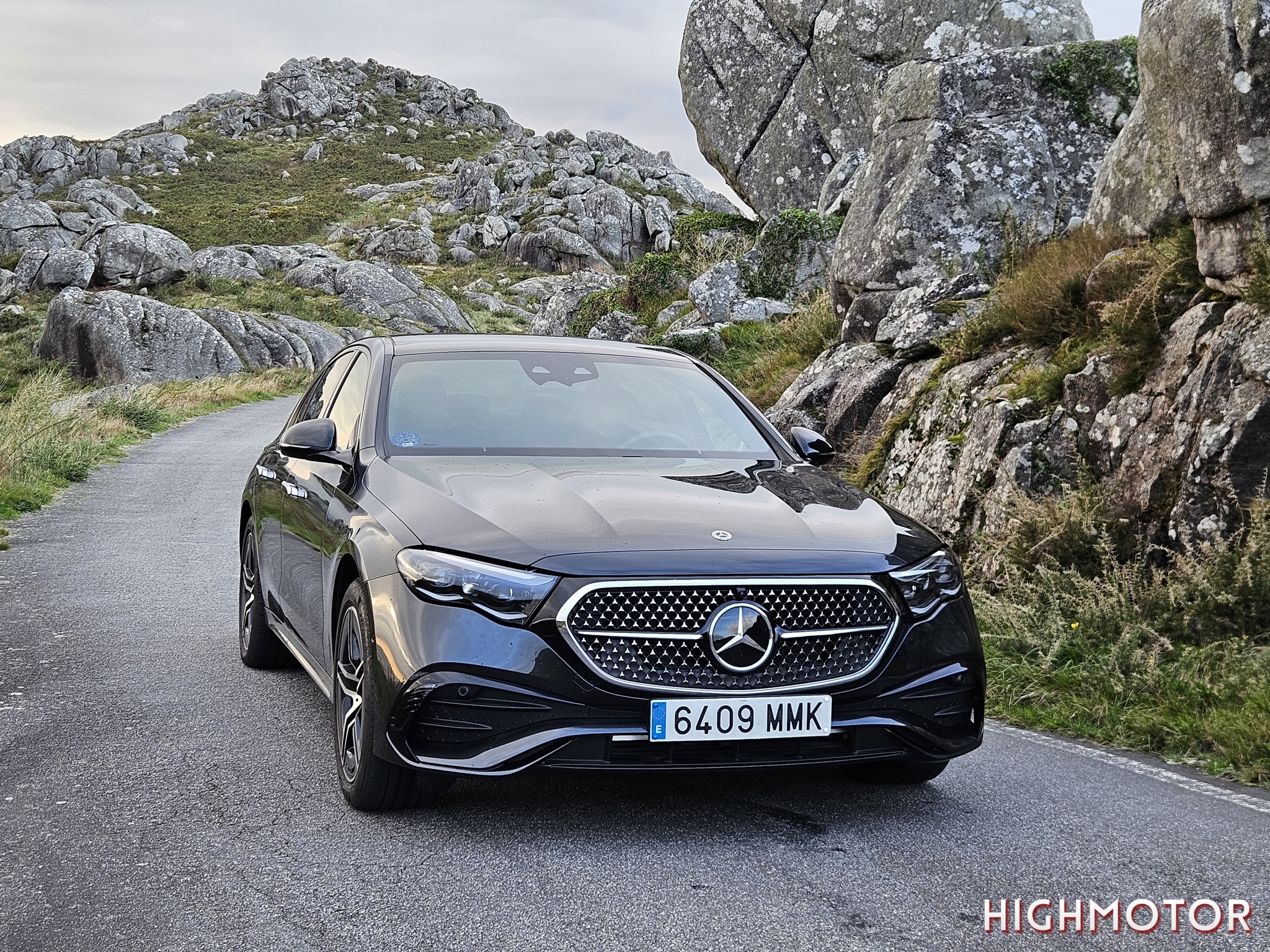
We took a detailed look at the Mercedes-Benz E 300de, that is, the diesel plug-in hybrid version (PHEV) that offers an electric range of up to 100 km and very frugal consumption when we travel.
Mercedes-Benz has been betting on plug-in hybrids for a few years now, not only in petrol versions but also in diesel. This route has been little explored, and in history only a few brands have dared to launch hybrid models with diesel engines.
The reality is that we have tried the diesel plug-in hybrid combination in this Mercedes E-Class E 300 de, and the impression it left us is that it has the best of both worlds: the low consumption of a diesel when the battery is empty, and the ability to drive up to 100 km in fully electric mode.
1. Elegant design with a high-tech interior
On the outside the E-Class shows its character: its fluid-lined design, which has evolved slowly over the last generations, still presents an elegant car, and if we add our exterior colour, the stately touch is guaranteed (personally, I like that combination).
The front features LED lights for all lighting functions, and at the rear, LED lights run along the entire tailgate. From the side you see a large car, nearly five metres long (4.94 metres), with eye-catching wheels below the AMG line.
Inside, what impresses most is the technology, with its three multimedia screens (optional) thanks to the MBUX Superscreen. Alongside the digital instrumentation and the central screen, a third screen for the front passenger allows control of multimedia options, seat comfort functions and a few other details. I don’t think it is essential, but it does add a technological touch to this E-Class.
Inside, it is a spacious car with generally high-quality finishes. The piano-black trim has been improved, but it is still present in some areas of the interior and detracts from an otherwise well-finished ensemble that is up to the standard of its segment.
The rear seats have every kind of comfort (which can be increased by adding options) and are very comfortable for two occupants. The boot, however, suffers in this plug-in hybrid version, its capacity dropping from 500 litres to 370 litres because of the batteries.
2. Smooth, diesel and with 313 hp
The powertrain consists of a 2-litre, four-cylinder diesel engine delivering 197 CV (it is the successor to the long-running 2.2 that is no longer fitted in the 220 range). Combined with the hybrid system, this gives a total output of 313 CV and 700 Nm of torque, a figure that gives an idea of the pushing power of this saloon.
But this version is not a sports car; it clearly aims for comfort and smoothness. We should also not forget that it has a total weight of 2.2 tonnes, and that shows at the wheel: it is smooth but limited in dynamics by its enormous dimensions and weight. Still, when we press the accelerator, the horses come alive and the torque is felt, pressing us into the seat.
Without a doubt, its purpose is to cover kilometres, whether in town or on the open road, because the interior comfort is high, especially the sound insulation, and the suspension, which is designed to absorb any irregularity in the road surface.
3. Electric battery with up to 100 km of range in 2.5 hours
This PHEV version, that is, a plug-in hybrid, has an electric battery of 19.5 kWh net capacity, which makes it easy to cover 100 kilometres in fully electric mode. In tests on urban and out-of-town routes, consumption was always below 20 kWh per 100 km, so the final range figure is realistic.
It can charge at up to 11 kW, but it does not have fast charging (which would be useful on motorway journeys). This option is available on the E 300 de 4Matic version, and I do not understand why it is not standard across the range. To make the most of the full charging power, it is important to set it in the charging functions on the central screen, because otherwise, to protect the battery, it will not charge at maximum power.
It can also be charged from a home charger in the conventional way, which takes around 7-10 hours depending on the power contracted for the home.
4. Diesel and plug-in hybrid: 3.5 litres per 100 km after 2,098 km
As I mentioned earlier, with a full battery it is easy to cover 100 km, and if you charge it daily at home or at work, you will probably forget about refuelling. In our case, after a week with it, we only had to refuel at the end of the week to return to Madrid.
Let me explain: as always, our tests start from Madrid, and I drive to Vigo (600 km on the motorway) and, at the end of the week, back to Madrid. During that week, with 1,200 km covered on motorways and the rest in urban areas and surroundings, the average consumption was 3.5 litres per 100 km, a really good figure.
Without the battery it is not difficult to reach 3.2-3.5 litres per 100 km on country roads, a figure that rises in town (without battery), as expected. But if we are able to combine things, charging and running on diesel, the end result is very efficient indeed.
5. Cutting-edge equipment and price
The starting price of the Mercedes-Benz E 300 de (diesel plug-in hybrid) is 70,000 euros, based on the “Avantgarde” trim, which includes: interior ambient lighting, 19-inch wheels, partially leather seats, the MBUX system, reversing camera, unintended lane-change assistant, Android Auto and Apple CarPlay, among other items.
Within the enormous list of options, standouts include “MBUX Superscreen” that is, the third screen for the passenger (honestly dispensable: beyond the technological touch it is not practical given its price of 1,800 euros) or the “Plus driver assistance package” which adds a range of driving assistants (an interesting extra).
Another surprising detail is the presence of an air freshener linked to the climate control. We have seen it on other cars in the segment, but it is still striking (“AIR Balance” for 450 euros). We can also choose seats with massage programmes combined with the interior lighting to create different moods, among other optional details.
In short, a frugal mechanical combination with the diesel as the star, Zero-emissions label, and equipment and comfort close to the flagship of the German brand.
Photos | Test team
 Kia offers an electric range of 10 models, 50 versions and 400 possible combinations
 The seven finalists for the 2027 European Car of the Year (COTY) are exclusively electric
 Peugeot E-208 GTi: a battery-powered toy that revives the spirit of the 1980s sports cars
Deja un comentario