Kangoo Combi Renault Electric Cars ECO Minivans Tests
Test drive: Renault Kangoo Combi E-TECH: an electric with plenty of space and a large boot
 Antonio Roncero @roncero_antonio
10 February 2023
9 min.
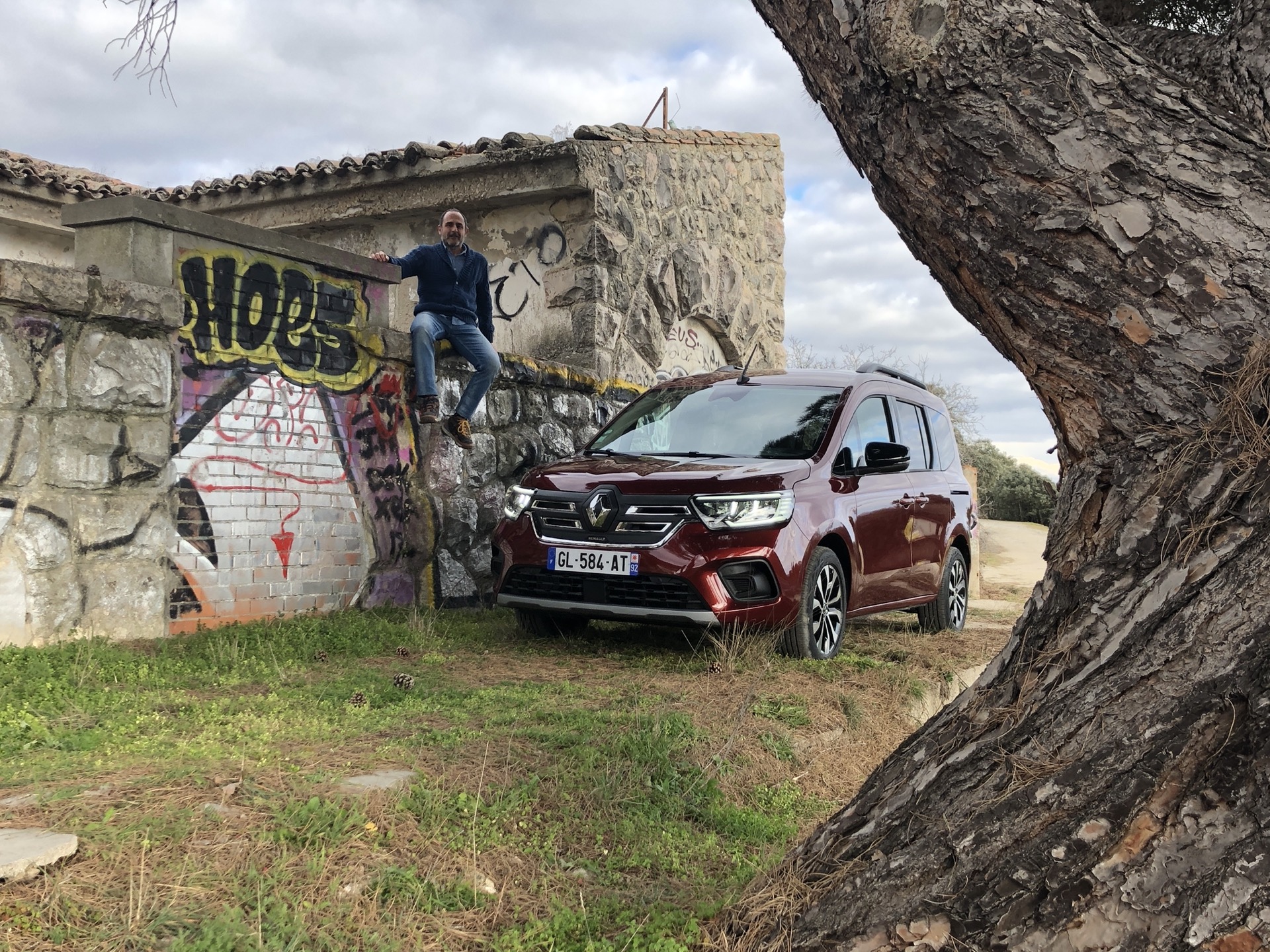
We drive the Combi version of the Renault Kangoo E-TECH, a 100% electric MPV that stands out for its interior space, a boot of almost 900 litres and its 285 km of range.
After twenty-five years, 5 generations and 4.4 million units sold of the Renault Kangoo, the Combi version of the Renault MPV now has a 100% electric propulsion version, the new Renault Kangoo Combi E-TECH. A model preceded by the electric variant of the Kangoo Van, the segment leader among light commercial vehicles. Let us recall that Renault and Kangoo are pioneers in electrification in this segment: five years after the launch of the first Kangoo in 2002, the brand already presented the first electric prototypes, the Kangoo electricité and elect’road. Later, in 2009, came the Kangoo Be Bop Z.E Concept, which anticipated what materialised in 2011 as the first electric Kangoo, the Kangoo Z.E.
Renault Kangoo Electric: a pioneer
But things have changed a great deal in recent years. On the one hand, technology allows manufacturers to offer electric vehicles with much greater range and performance, as well as the possibility of high-power fast charging. For example, the electric motor of the 2011 Kangoo Z.E. produced 60 hp, was homologated for a range of 170 km on the NEDC cycle -on the current WLTP it would be even less- and needed, at the very least, 6 hours to recharge the battery.
To put it in context: the new Kangoo E-TECH delivers 90 kW (120 hp), its 45 kWh battery gives a WLTP range of 285 km -or up to 435 km in the city- and, recharging with direct current at 80 kW, it can recover in 30 minutes 170 km, the range offered by the first electric Kangoo. In addition, the market situation is different. The share of electric vehicles in the light commercial vehicle market reached 3.9% in 2022, compared with less than 1% in 2019. And the curve is expected to keep rising almost vertically, given the new rules that from 2023 impose low-emission zones (ZBE) in municipalities with more than 50,000 inhabitants.
As for the light commercial vehicle segment, it should be noted that passenger Combi versions account for 35% of the total, compared with 52% for van bodies -the rest are chassis and pick-up versions-. Among Combis, models in the small segment, where the Kangoo competes, account for 65%. In the case of the Renault Kangoo, the Combi bodywork mix is 44% against 56% for the van. And 20% of Kangoo buyers already opt for the electric version, a figure that will surely grow with the arrival of this new Kangoo Combi E-TECH variant. A model that joins the range of 100% electric E-TECH vehicles from Renault, alongside Twizy, Twingo, ZOE and Mégane E-TECH Electric.
An electric solution for professionals and private buyers
With the Kangoo Combi E-TECH, Renault offers an electric vehicle that, like the petrol and diesel Kangoo Combi versions, can suit both private customers and professionals. This is because, first of all, it does not lose the characteristics that make this model an excellent choice for those who need a vehicle in which passenger space and boot capacity are a priority.
Compared with the combustion versions, the rear seats sit a little higher to accommodate the floor-mounted battery. But since there is ample headroom available, this does not compromise habitability. What is noticeable is that passengers in these seats have their legs raised higher relative to their hips, and there is less room to place their feet under the front seats.
In any case, three very comfortable seats are still available, and passengers in these seats will also appreciate how easy it is to get in and out through the double sliding door, which leaves an opening of 615 mm, or the additional comfort provided by the dedicated rear air-conditioning vents. Moreover, in the electric version the rear seats offer 14 cm of longitudinal adjustment. The boot, which in its most favourable position reaches 850 litres of capacity (under the parcel shelf), can reach up to 2,500 litres with the seats folded down.
Another very interesting feature is the roof bars, with an ingenious system that includes integrated transverse beams that are easy to operate without tools. It allows a maximum load of 80 kg on the roof. They are standard on the top trim and can be optionally fitted on the entry version for 270 euros.
As for the driving position, the difference with the combustion versions lies mainly in the digital instrument cluster. Finish, presentation -with versions that even include elegant wood inserts- and ergonomics are at an excellent level. It comes as no surprise at this stage that behind the wheel of this type of vehicle one feels very much as if in a conventional car. Air conditioning comes as standard with a heat pump, and optionally heated windscreen, steering wheel and front seats can also be fitted, features that make more sense in an electric vehicle, since in winter they provide thermal comfort and allow range to be increased by reducing the use of air conditioning.
On the road with the Renault Kangoo Combi E-TECH
Driving the Kangoo E-TECH could not be simpler. Although it weighs almost 2 tonnes, the motor allows agile starts from standstill and easy acceleration, for example when merging onto a slip road. During a short urban route and a longer stretch on the motorway, we recorded an average consumption of 18.5 kWh/100 km, which is not bad at all. Pending more thorough testing, it is not unreasonable to estimate a real-world range of around 230 km in mixed use, without giving up the air conditioning or using ECO mode.
In this driving mode engine power is reduced -and this can be felt through the accelerator- and the top speed is lowered from 135 km/h to 110 km/h. From the gear selector lever you can easily play with the three regeneration modes, from the one that allows driving without any braking so the car coasts, to the one that offers the maximum energy recovery, which does not brake the car excessively either, but helps in many situations to reduce speed without having to use the brakes.
Thanks to the tuning of the suspension and the insulation of the cabin -against both noise and bumps- the Kangoo E-TECH surprises with its great ride comfort. In general, ECO mode is very suitable for driving in town, where it will not be difficult to achieve around 300 km of real-world range. In normal mode no extra performance is missed, at least with the car unladen, which is how we drove it. Towing capacity is 1,500 kg.
As for the battery, which carries an 8-year or 100,000 km warranty, with the standard charger it can be recharged at a maximum power of 11 kW, so 5 hours would be enough to go from zero to 100% charge; on a Wallbox at 7.4 kW this time rises to 7 hours, which is also more than enough to charge overnight. Using a domestic socket the times stretch to 26 hours at 2.3 kW, or 15 hours on a reinforced 3.7 kW socket.
Renault also offers versions that come as standard with a 22 kW alternating current charger, which brings with it the possibility of direct current fast charging at up to 80 kW. This allows going from 15 to 80% charge in one hour with alternating current at 22 kW, or in less than 40 minutes charging with direct current at 80 kW. In these “22 kW” versions, the battery is liquid-cooled.
Range and prices of the Renault Kangoo Combi E-TECH
Renault offers two trim versions for the Kangoo Combi E-TECH: equilibre, aimed at more professional use; and techno, for private customers or the taxi sector. In each of these two trims you can choose the 11 kW charger or the 22 kW option. Prices, with no discount applied, are as follows:
- Kangoo Combi E-TECH equilibre EV45 11 kW: €39,204
- Kangoo Combi E-TECH equilibre EV45 22 kW: €40,535
- Kangoo Combi E-TECH techno EV45 11 kW: €41,745
- Kangoo Combi E-TECH techno EV45 22 kW: €43,076
All versions come as standard with lane keeping assist, a 4.2-inch digital instrument cluster, full LED headlights, light sensor, emergency braking assist with pedestrian detection, electric parking brake and cruise control. With the techno trim, in addition to distinctive design elements, roof bars, rear-view camera, Easy Link radio, anti-dazzle interior mirror and hands-free card are added.
https://www.youtube.com/watch?v=OD4cXg1AYd0&feature=youtu.be
The options list includes individual items or groups them into attractive packs with competitive prices. Using them, you can equip the Kangoo Combi E-TECH with safety, multimedia or comfort systems typical of high-end cars, such as the two-zone climate control, the advanced driver assistance (combining active cruise control with lane keeping for semi-autonomous driving), navigation with an 8-inch screen and connected services, or the interesting Extended Grip pack, which adds All Season tyres, a hill start assist and a dedicated traction control to improve grip in low-adhesion conditions. The bodywork colour range has seven options: white, blue, brown, red, black and two shades of grey. Apart from white, the rest carry a surcharge of 350 euros.
Among the alternatives to the Renault Kangoo Combi E-TECH, almost all cheaper with current discounts, we find the passenger versions of the Citroën e-Berlingo, the Opel Combo-e, the Fiat E-Dobló or the Mercedes-Benz e Citan, with which the Kangoo E-TECH shares its platform.
Renault Kangoo E-TECH Combi – Image gallery


 Peugeot E-208 GTi: a battery-powered toy that revives the spirit of the 1980s sports cars
 New Lexus ES: luxury grows and goes electric
 First contact with the Dacia Sandero Hybrid 155: power and efficiency from €19,890
Deja un comentario