This is how our cities are going to change: are you ready for the mobility of the future?
 Antonio Roncero @roncero_antonio
25 May 2021
13 min.
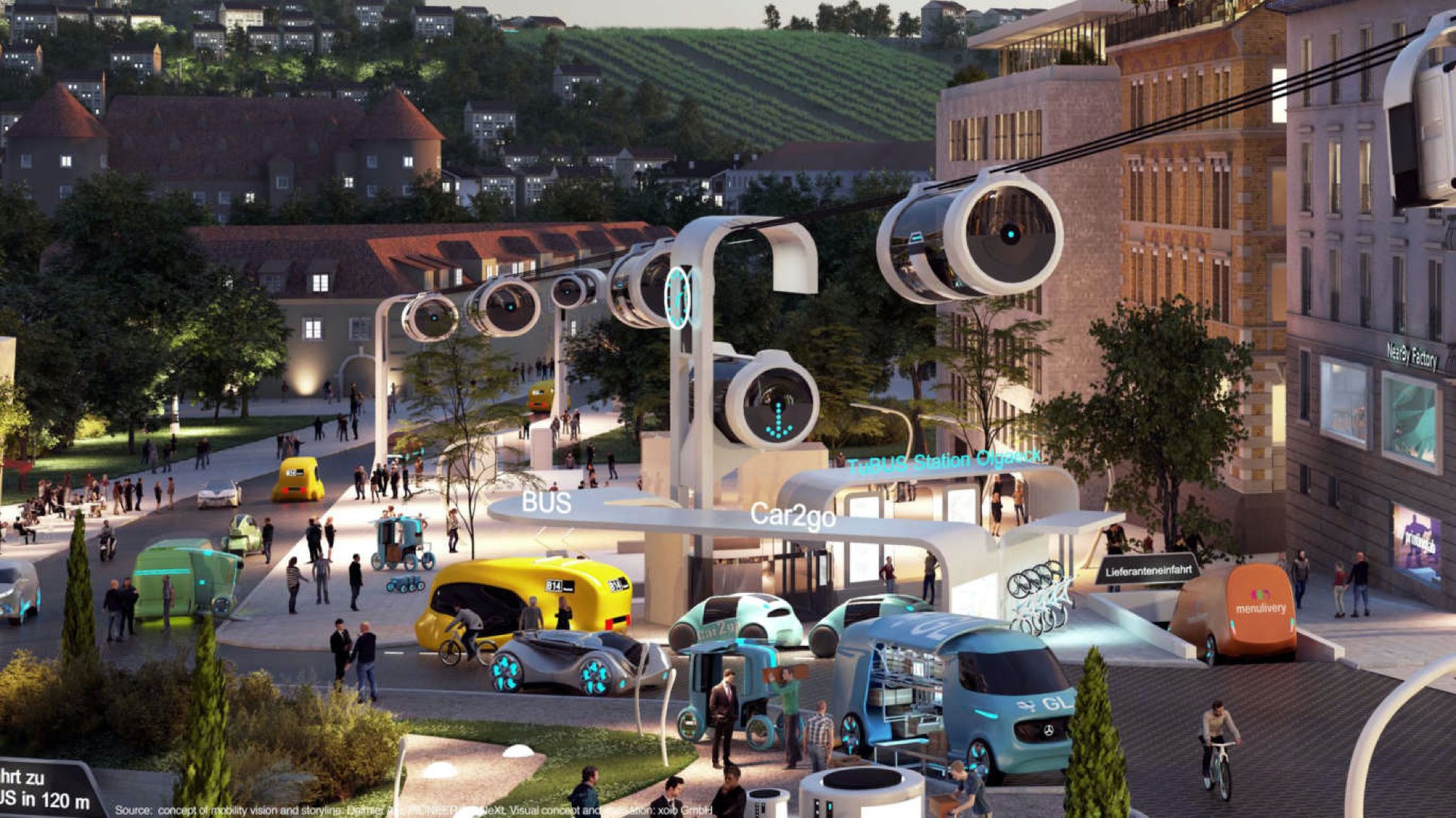
Digital, sustainable and intelligent. This is how mobility in cities is being transformed, with the aim of making them more human. These are the changes that await us and for which it is advisable to be prepared.
Mobility in large cities is a real challenge. Well, in fact it is not only mobility that is, but the management of everything related to daily life in large urban areas in order to achieve a better quality of life for citizens: management of energy, water and waste, reduction of CO2 emissions, new forms of mobility…
It must be taken into account that, at present, more than 55% of the world’s population is concentrated in large cities. And this figure is estimated to continue rising, exceeding 60% already by 2030, reaching almost 70% by 2050. In Spain, for example, more than 70% of the inhabitants are concentrated on barely 1% of the surface area, and cities such as Madrid and Barcelona host practically a quarter of the population.
All experts predict a drastic change in large cities in the coming years, due to high pollution, demographic developments, property pressure or transport costs, among many other factors. Not to mention the covid-19 pandemic, which has brought new challenges and has acted as a catalyst for rethinking the urban environment and the way we use it.
Undoubtedly, one of the greatest changes in the cities of the future in the transformation towards the smart city will occur in mobility, always understanding future mobility as a solution. This transformation has already begun. But smart cities present us with new challenges and bring technologies for which it is advisable to be prepared.
Let us review the most important ones.
Electrification: plug-in hybrids and electric cars
However ideal solutions such as carsharing may be, the private car will continue to play a key role among the different urban mobility offers of the future. This is something we are already experiencing. And for a car to be technologically attractive in the city of tomorrow, it will have to meet requirements that pass, firstly, through electrification; and secondly, through its networking capability.
In fact, there is already an environmental labelling system for vehicles that classifies them, curiously, not on the basis of their real emissions, but according to the type of technology they use. Although the label system is going to undergo changes, there is one thing that will remain the same: if you want a car with which to access the centre of large cities, and enjoy additional advantages (reductions in parking fees, use of the BUS-VAO lane, etc.), you have to consider a car with ECO or ZERO label from the DGT.
There are cars such as those running on gas, whether LPG or CNG, that can obtain the ECO label. But the trend is towards electrification. Self-charging hybrids are already a standard, and plug-in hybrids are the best alternative to bridge the gap between the latter and the 100% electric drive car. There are already electric cars at every price and in every market category, and although progress is slow, it seems the authorities are “getting their act together” to accelerate the rollout of charging infrastructure that meets the needs.
What I mean is that, sooner or later, you will have to start thinking that to get around the city in a private car, you will have to “plug in”. And if not, one of the solutions as an alternative to public transport can always be shared cars.
Carsharing: the shared car option gains momentum
Emov, Zity, Share Now, Wible… If you are one of those who know what we are talking about and have already used their services, get ready to see new contenders added, because more will arrive. If not, it would be advisable to get to know carsharing services.
Basically, they are companies that offer car rental services that differ from traditional rental in that you can enjoy the vehicle even for minutes, although there are packages or bundles to do so by the hour, day, week… They work through an app in which you must sign up and register to access the vehicle through the application itself, without using a card or key. The app itself lets you locate where a parked car is in the city near your current location, and after using it, you can simply leave it parked wherever you want, always within the area regulated by each company.
Normally carsharing cars are small, electric or low-emission, and they allow you to get around the city without restrictions if you do not have your own car or cannot use yours. They usually have affordable rates (around 20 cents per minute), and you can park for free in restricted parking zones.
Micromobility: the future of urban mobility?
According to experts, integrating urban micromobility into cities will be one of the keys to the success of future urban transport. But… what is micromobility?
Well, this name covers all forms of transport using light vehicles that allow short distances to be covered. This would include both bicycles (conventional or electric), the increasingly popular e-scooters and scooters… We can say that the term micromobility includes those light transport systems that do not need combustion engines and allow distances of about 10-15 km to be covered without emissions.
And here again comes the concept of mobility as a service. Can you imagine leaving home and getting on an electric bicycle that you have booked from an app to reach the metro station and, once you leave public transport, using a scooter to reach your final destination? China and the United States are already ahead in micromobility as a service. The possibilities are enormous, always through digitalisation: special passes that allow combined access to public transport and use of e-scooters or electric bicycles, smart cards or integrated mobility smart cards…
Cars connected to each other… and to the infrastructure
Cloud and 5G. You have surely heard of these concepts too. What is more: it would be rare for you not to have some file or data stored in the cloud, if you use a computer or a mobile device at all. And 5G… well, it will end up reaching everyone, just as 3G did, and then 4G. The connectivity between vehicles, people and infrastructure is what will make it possible to optimise the use of space, the management of buildings or traffic.
Think of the potential offered by ultra-connected services, which allow information to be accessed in real time. The car communicates with the infrastructure, merging reality and virtuality. In this way, the vehicle itself will become a means of social interaction, and an interface with the digital city. Using its multiple cameras and sensors it could, for example, even automatically warn of the appearance of a pothole in the road, or of a tree that needs pruning because it is blocking a traffic sign. We have already analysed how 5G technology is going to revolutionise driving.
But let us go step by step. For now, this is the first thing we will look at:
Traffic flow control
A smart city must be flexible when it comes to managing traffic. Currently, total access to some cities is being prohibited, but a traffic flow control system could make it possible to manage the different users who may enter the city depending on the time, the type of car, the purpose of the trip and the time each user needs to spend in the city… A system of incentives could even be established that allows users to earn and accumulate points if they switch transport systems.
Smart traffic lights
One of the clearest examples of traffic flow management is smart traffic lights. Audi already offers, in some European cities, a traffic light information system that allows drivers to take advantage of what they call the “green wave”, with indications on the instrument panel that allow them to adapt their speed so as to travel and make the most of the lights when they are green.
This becomes especially important in the case of electric or plug-in hybrid cars: why accelerate, use up energy and pollute if I am going to arrive at a traffic light only to stop? It is better to let the energy recovery system work and build up charge in the battery. Other applications would be, for example, the automatic adjustment of traffic light sequences according to traffic, or even according to specific needs at a given moment, such as facilitating the passage of an emergency vehicle, such as an ambulance.
Piloted and automated parking.
No, I am not going to talk here about cars with sensors that detect a parking space and manoeuvre by themselves when you press a button. Even from outside the vehicle, controlling the manoeuvre with a mobile phone, something that has been possible for some time.
It is also already possible for cars of the same brand, connected to each other and through the cloud, to exchange data to inform other users when one of them frees up a parking space.
The next step is fully piloted and automated parking, in areas designed for this purpose in collaboration with property developers. The user will arrive at a parking area where it will suffice to leave the car and let it park by itself, moving autonomously inside the garage, which will offer better use of space by not needing room between cars for drivers to get in and out of the vehicle.
In these assisted car parks, stairs, lifts, pedestrian walkways… will disappear. The driver will only have to leave the car at the entrance and “call it back” on return through an app on their mobile device, to then use some other urban micromobility system until they need the car again. Applying this formula to buildings such as hotels, large public car parks or shopping centres will free up underground and surface space, with the benefit that this brings to citizens.
The autonomous car… when?
Although lately the craze for autonomous cars seems to have subsided a little, this technology continues to advance, and it will play a fundamental role in the smart city of the future. Above all in fleets of vehicles that will make specific journeys, reserved for this type of vehicle, which will not need a driver.
For example, from the city to the airport, or to a railway station. Or on main axes from the outskirts to the city centres. It will still take a while before we see this technology deployed with its full potential. Manufacturers have already shown what they are capable of, but there is a lack of regulation and standards in this area governing autonomous or piloted driving. Especially regarding who is ultimately to blame in the event of a fault or accident.
Flying cars: not so far away…
No, they are not just around the corner. But they are not that far away either. Do not think that in the future you will be able to choose to press a button when you reach a traffic jam and your car will deploy its wings or rotors to swap asphalt for air, driving your own flying car. At least not in the medium term.
However, many brands already have flying car projects underway. Although it would be more accurate to call them air mobility vehicles, or air taxis, which could be autonomous, travelling along certain predefined routes.
Mobility hubs of the future will be very important in this regard, since they could connect means of transport such as driverless shuttles or air taxis with other urban transport options.
Big data, artificial intelligence and blockchain technology
This may sound, like flying cars, a bit like science fiction, but it is all related. Bear in mind that a smart city is nothing less than a dynamic system which, due to the necessary connectivity between vehicles, people and infrastructure, requires data capture, processing in the cloud and, of course, wireless communication.
As investment is made and these technologies are developed, it will be possible to progress towards smart cities. The technologies of the so-called Internet of Things (IoT) provide us with the platform for different devices to connect and exchange information. And this is not only applicable to cars: think of the transformation of services such as waste collection, street lighting, irrigation…
But now comes the second part: the IoT generates such a volume of data that technologies such as artificial intelligence and big data become necessary. Only in this way can data be stored and processed for later analysis, so that relevant information can be extracted to keep moving forward, for example by generating predictive models.
We have already discussed it: apps that report free parking spaces, for example. Another one: brands Ford use Big Data to develop intelligent solutions that help identify where traffic incidents occur, which allows authorities to take preventive measures. It is also possible to analyse, for example, how the scheduling of delivery vehicle journeys in the city works, sending data to the cloud to change timetables and improve traffic.
Finally, there is blockchain technology. It is what will make it possible to increase trust in all this data, favouring the best possible use of the infrastructure and the resources that cities offer us.
The challenges of the smart city
The application of all these technologies has disadvantages. Some experts point to the possible limitation of human contact, but what really causes concern is the confidentiality and security of data.
On the other hand, for the successful implementation of many of the technologies we have discussed in a smart city, maximum collaboration between the public and private sectors will also be necessary, as well as between government organisations and citizens.
Because what is clear is that the technology itself for the development of the smart city already exists. The rest is only a matter of will, understanding… and time.
If you want to know more about mobility and the cities of the future, we encourage you to visit MOGY from 24 to 26 September, Spain’s first global sustainability fair.


 The seven finalists for the 2027 European Car of the Year (COTY) are exclusively electric
 Peugeot E-208 GTi: a battery-powered toy that revives the spirit of the 1980s sports cars
 New Lexus ES: luxury grows and goes electric
Deja un comentario