EBRO s700 s800 Hybrid Cars Tests SUV
This is how they look, how they drive, and how much the new Ebro S700 and S800 plug-in hybrids cost, with up to 1,200 km of range and a CERO environmental label
 Antonio Roncero @roncero_antonio
20 May 2025
9 min.
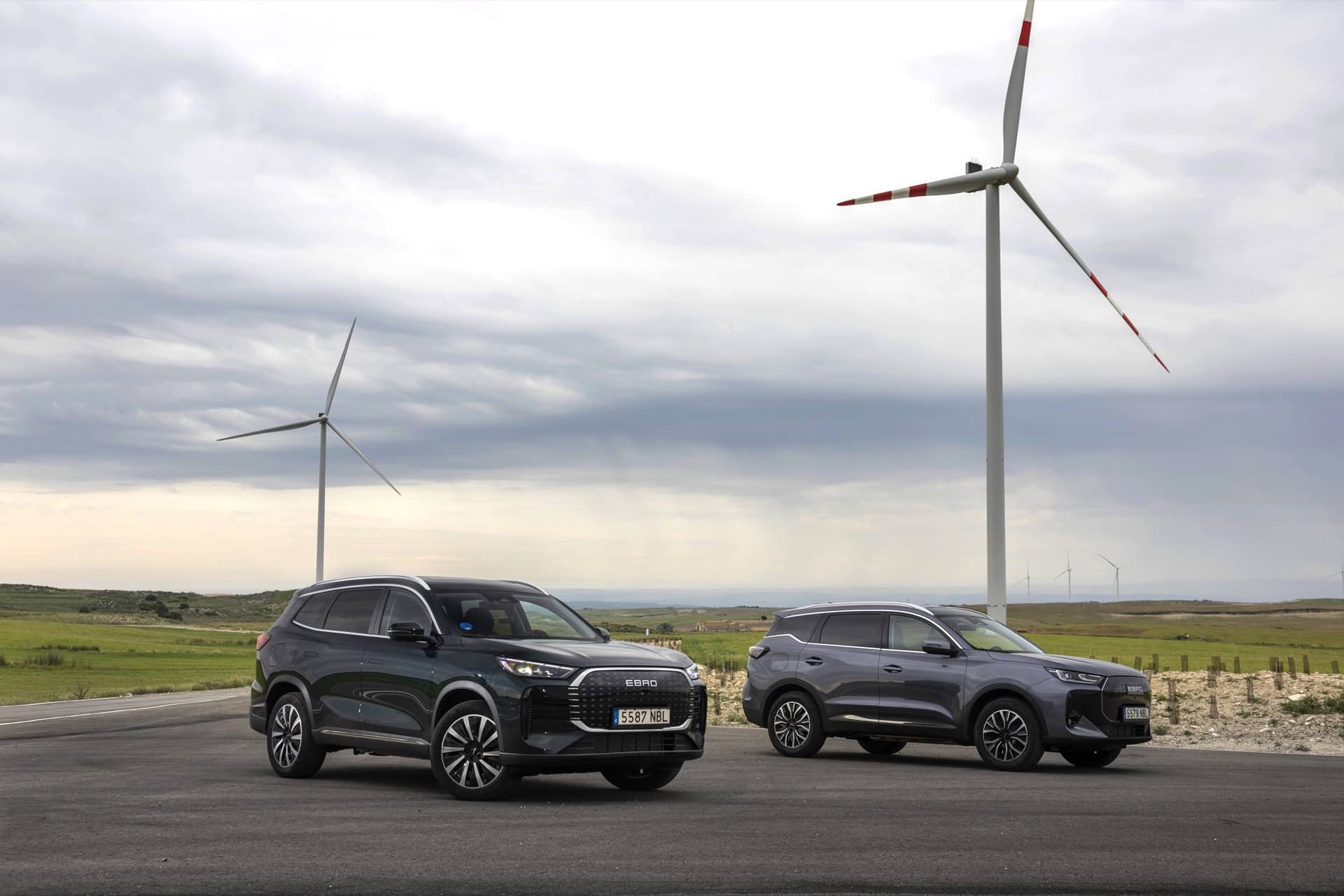
After testing the Ebro S700 and Ebro S800 with petrol engines, and knowing the virtues of the plug-in hybrid system of its “cousin” the Jaecoo 7 PHEV, it was not difficult to anticipate what we would find in the first contact with the new PHEV versions of Ebro’s SUVs, which has made a very strong start in the Spanish market, with more than 2,000 units sold in just six months and 50 dealerships already operating across the country. In addition, the Spanish brand had already announced the prices of the Ebro S700 and S800 PHEV, leaving us wanting more.
And after testing them, the reward could not be sweeter. We have two SUVs: the more compact S700 and the more family-oriented, seven-seat S800, which stand out for their spaciousness, good finish, very complete equipment, a plug-in hybrid system that works really well and allows up to 90 km of electric-only range or up to 1,200 km in total, a CERO zero-emissions DGT label… and a “bargain” price, with practically no competition. Let’s look at it in more detail.
The plug-in hybrid system of the Ebro S700 and S800
And as it could not be otherwise, we will begin with the propulsion system, which is the truly new element of these versions. Both models share the same technology, with a 1.5 turbo petrol engine producing 143 hp and 215 Nm of torque, an electric motor of 204 hp and 310 Nm that works as the drive motor, a second electric motor of around 80 hp that acts as a generator, and a sophisticated transmission that the brand calls Super Electric Hybrid DHT, which integrates the two electric motors, all connected to the front wheels. Ebro has not yet committed to announcing a total system output, but everything suggests it will not match the 340 hp that the Jaecoo 7 boasts, even though it uses the same powertrain.
The sensation when driving both the Jaecoo 7 PHEV and the Ebro S700 and S800 PHEV is not that of being behind the wheel of a car with so much power. But in any case, whatever the final homologated figure or the real maximum power the system delivers, I can assure you that you will not miss more horsepower: the system moves the SUVs with ease, even when you travel with the car loaded. The acceleration figures give an idea: the S700 PHEV takes 8.2 seconds to go from 0 to 100 km/h, while the S800, which weighs almost 130 kg more and nearly reaches two tonnes -1,991 kg, to be exact-, stops the clock at 9 seconds. These are figures that could classify these Ebros as more than agile cars, but they fit better with a real output of around 250/280 hp. Top speed is limited to 180 km/h in both cases.
The plug-in hybrid propulsion system is completed by a high-voltage battery with a capacity of 18.3 kWh, which allows both models to claim an electric-only range of 90 km. With the 60-litre fuel tank -which is quite large-, the combined total range reaches 1,200 km for the S700, and up to 1,100 km for the S800, which has a slightly higher consumption because it is larger and heavier. Keep in mind that these are homologated figures, and by now you should know -just in case, we never tire of repeating it- that the homologated consumption of plug-in hybrids tends to differ greatly from real-world figures.
Up to 90 km in EV mode and 1,200 km of total range… homologated
And since we are on the subject, I will say that, pending a more in-depth test, these Ebros do not seem to use much fuel. Achieving around 60 real km in electric mode on a single battery charge seems more than possible if driven very gently, and that is a good figure. So is an average consumption of around 7 l/100 km on the motorway, which in total can get you close to 1,000 km of real-world range without much trouble. Again, these are not the official figures, which no plug-in hybrid meets once you drive them day to day; but they are genuinely good results. And beyond a good balance between performance and consumption, what stands out about the PHEV system of these Ebros is how smoothly it works and the driving pleasure it provides.
The system is focused on ease of use. There are no paddle shifters on the steering wheel, and although you can choose between the usual driving modes, it is best to let it work on its own. The system will run in electric mode when driving in town or at low speed, it will switch to the hybrid mode called “parallel” when driving on the open road or when acceleration is demanded (the combustion engine and the electric motor work together to propel the vehicle), and it will run in series hybrid mode when the battery is depleted, with the combustion engine acting as a generator and leaving the main electric motor in charge of turning the wheels.
By the way, these PHEV versions receive specific adjustments to the suspension and steering to cope with the extra weight compared with the combustion variants, and it shows. A clear focus on comfort is maintained, but I found that the steering now conveys much better what is happening between the wheels and the tarmac, which was one of the points I felt could be improved on the petrol versions. The automatic gearbox also works much better, especially because of the way it interacts with the three motors, the combustion engine and the two electric ones.
Another interesting feature of the Ebro PHEVs is that, in addition to charging at up to 6.6 kW with alternating current -about 3 hours and 15 minutes for a full charge-, they also accept DC fast charging at up to 40 kW, which allows the battery to go from 30 to 80% capacity in just 20 minutes. They also offer V2L bidirectional charging to supply energy to external devices with a power output of 3.3 kW. With slow charging from a domestic socket, at 1.65 kW, it takes around 12 hours to fully charge the battery.
For the PHEV versions, the propulsion system carries an 8-year or 160,000 km warranty, while the brand’s official vehicle warranty of 7 years or 150,000 km applies across the whole range.
Ebro S700 PHEV – Image gallery
Range and prices of Ebro’s PHEV SUVs
The differences between the Ebro S700 and S800 and their petrol counterparts are minimal. On both, the grille changes: it becomes enclosed and has a specific frame design. On the S800 the frame is chrome, and the round twin exhaust outlets of the petrol version become trapezoidal, integrated into the diffuser. On both models the wheels are specific to the PHEV versions, with 18-inch wheels for the S700 and 19-inch for the S800. A new feature of these versions is that they come with a key with hands-free access to the vehicle that also allows you to start driving without a start button.
Otherwise, the exterior dimensions and interior space of both models remain unchanged compared with the combustion-engine versions. Let us recall that the S700 measures 4.55 metres in length and has a boot of 500 litres, expandable to 1,305 litres by folding the rear seats, measured up to the roof. The S800 PHEV, for its part, measures 4.73 metres and keeps the third row of seats and seven seats. The boot is rated at 889 litres with five seats, and 1,930 litres in the two-seat configuration, again measured up to the roof. With all seven seats in use, the boot shrinks to 117 litres.
The initial range starts with the Premium and Luxury versions in the case of the S700 PHEV, and for now only the most luxurious trim for the S800 PHEV. List prices start at €39,900 for the S700 PHEV Premium, from €41,990 for the S700 PHEV Luxury, and from €46,990 for the S800 PHEV Luxury. There is therefore a €2,000 difference between the two trims, and €5,000 between an S700 and an S800 with identical equipment. But if offers and the aid of the MOVES Plan come into play, Ebro announces an S700 PHEV in Luxury trim from €28,260, and an S800 PHEV Luxury from €32,860.
There are no alternatives in this category with such abundant equipment, with everything standard except the paint, which costs between €300 and €550 if you choose black, grey, or black and white as an alternative to white on the S700, or black, green, or grey on the S800. Among the standout equipment, the S700 already includes an electrically operated tailgate, dual-zone air conditioning, a SONY sound system with 8 speakers, full LED headlights, eco-skin leather upholstery, a head-up display instrument cluster, a panoramic roof, electrically adjustable sport seats that are heated and ventilated, an infotainment system with two 12.3-inch screens, and a 540-degree HD camera.
The S800 adds, in addition to the 19-inch wheels and the third row of seats, an infotainment system with a 10.25-inch screen for the instrument cluster and 15.6 inches for the multimedia system, a 12-speaker audio system, and seats with a massage function.
Ebro S800 PHEV – Image gallery
Technical specifications of the cars in this article

 Kia offers an electric range of 10 models, 50 versions and 400 possible combinations
 The seven finalists for the 2027 European Car of the Year (COTY) are exclusively electric
 Peugeot E-208 GTi: a battery-powered toy that revives the spirit of the 1980s sports cars
Deja un comentario