BYD ventures into the pick-up world with the Shark, a plug-in hybrid with up to 90 km of electric range
 David Lopez @espacionblanco
21 July 2026
4 min.
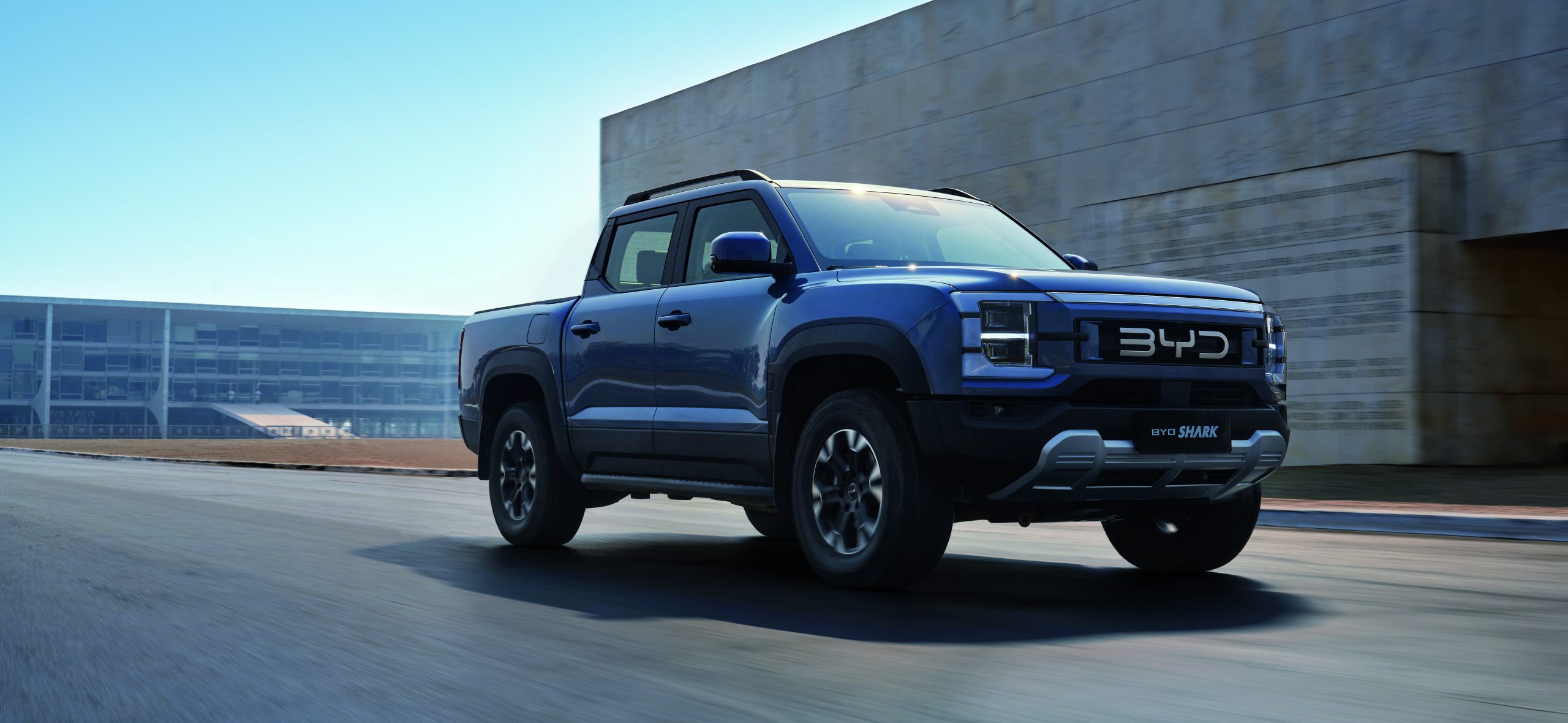
BYD will venture into the pick-up world with the Shark, its proposal for this segment, equipped with its Súper Hybrid DMO plug-in hybrid system
Europe is not a market where pick-ups particularly stand out, although they obviously have their share of the market, a segment where two models with a long tradition reign, one of them being the Ford Ranger, which has recently ventured into electrification with a plug-in hybrid version offering everything a Ranger provides plus the possibility of savings when driving in electric mode.
Until now, the Ford Ranger plug-in hybrid was comfortable, but its leadership may start to tremble with the emergence of another player that has already caused havoc in other segments. This is the Chinese BYD and its new pick-up called Shark, which will also arrive as a plug-in hybrid, with characteristics that, as you can imagine, could shake up the segment, including the all-powerful Ranger.
Speaking of the Ford Ranger, when looking at the BYD Shark it is inevitable to think of the American pick-up, since just by looking at its front end we can see a certain strong aesthetic resemblance to the Ranger and, more specifically, to its Raptor version. According to the Chinese brand, the front of the Shark recreates, through its light unit and large front grille, both the eyes and mouth of a shark, hence its name, while from the side its aerodynamic design is also inspired by sharks. And let us not forget the 18-inch alloy wheels, finishing at the rear with a light bar running from end to end across the tailgate, accompanied by the largest BYD logo they have ever made.
This whole design rests on a length of 5,457 mm, a width of 1,971 mm and a height of 1,925 mm, while the wheelbase is 3,260 mm. Thanks to these dimensions, it has a approach angle of 31º along with a departure angle of 19.3º, which allows it to tackle narrow terrain, not to mention a ground clearance of 230 mm. Other figures offered by the BYD Shark are its maximum towing capacity of 2,500 kg, a maximum payload of 790 kg and a bed with a volume of 1,200 litres.
For the interior of the BYD Shark, the focus has been on blending a design that conveys robustness in elements such as the prominent grab handles on the centre console, functionality represented in other elements such as the gear selector on the steering column and large controls that are easy to operate even while wearing gloves, all the way to the comfort of an SUV, reflected in features such as the sporty heated and ventilated front seats. Meanwhile, the rear seats will not be uncomfortable either, thanks to a flat floor, almost 90 cm of legroom or rear seatbacks that recline up to 27º; all of this complemented by the typical BYD dashboard, featuring a 10.25-inch digital instrument cluster or the high-definition infotainment system with a 15.6-inch screen.
Mechanically, the BYD Shark will also stand out, making use of Dual Mode technology, which is also found in other models of the brand such as the SEAL U DM-i or the recently presented DOLPHIN G DM-i, among others. The Súper Hybrid DMO system uses two electric motors, one on the front axle producing 231 CV and 310 Nm and another on the rear producing 204 CV and 340 Nm, together with a turbocharged four-cylinder 1,500 cc petrol engine that works most of the time as an electricity generator, achieving a combined output of 436 CV and 650 Nm of torque.
The ladder frame chassis of the BYD Shark has been designed to integrate the Blade Battery through CTC (Cell-to-Chassis) technology. This battery, incidentally, has a capacity of 32.2 kWh, which allows it to certify up to 90 km of range in fully electric mode and up to 675 km of combined range. Combined fuel consumption with the battery charged is 3.5 l/100 km and, with the battery depleted, it stays at 9.6 l/100 km according to the WLTP cycle. When the battery is at 15%, it needs a little over three hours on 11 kW three-phase AC, a time that drops to 21 minutes to go from 30% to 80% with DC fast charging.

 Peugeot E-208 GTi: a battery-powered toy that revives the spirit of the 1980s sports cars
 New Lexus ES: luxury grows and goes electric
 First contact with the Dacia Sandero Hybrid 155: power and efficiency from €19,890
Deja un comentario