Honda Prelude Hybrid Cars Coupés Tests
Honda Prelude e:HEV: behind the wheel of the most anticipated hybrid coupé
 Antonio Roncero @roncero_antonio
9 March 2026
15 min.
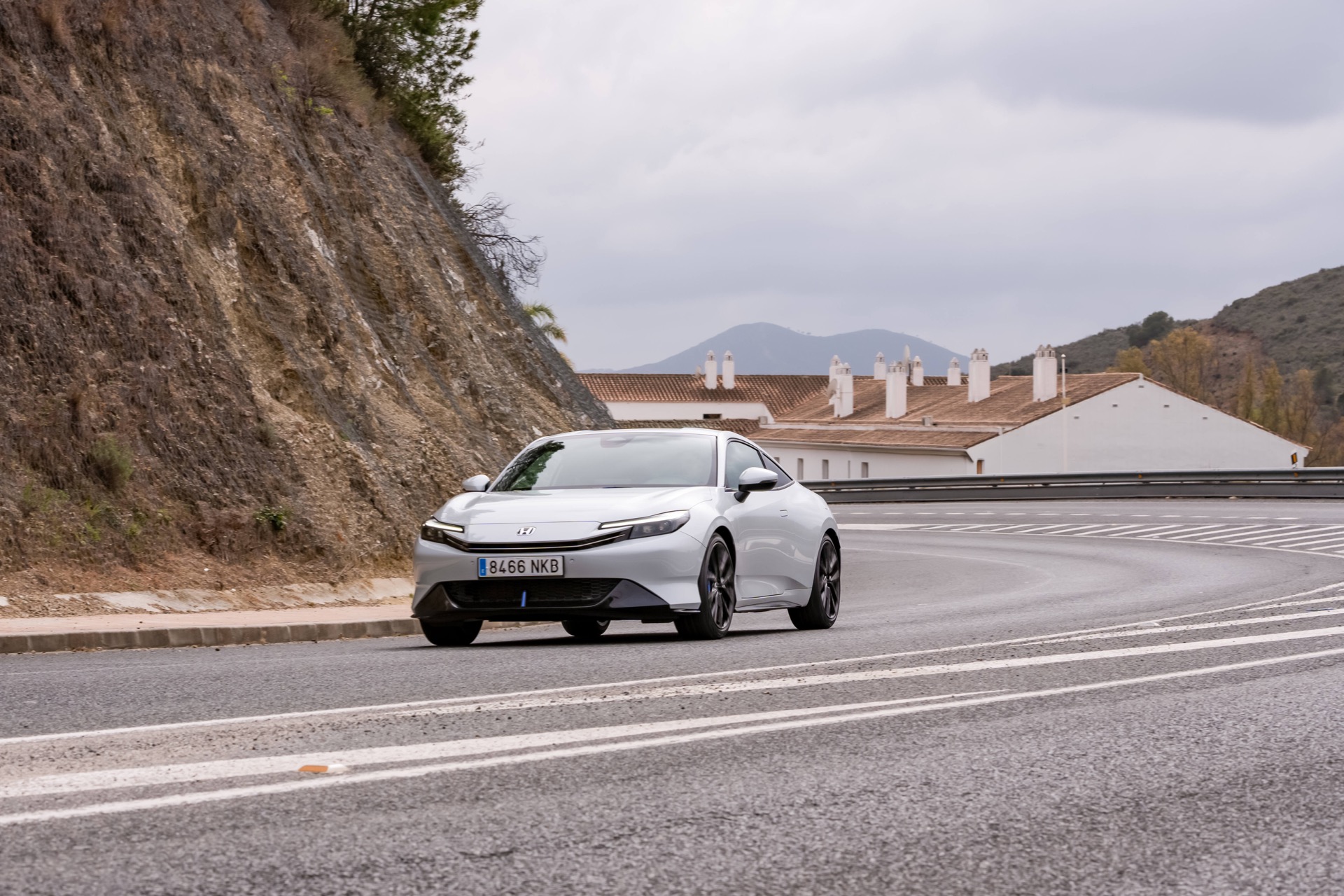
After 25 years, Honda brings back one of its most iconic models, the Prelude, now a 184 CV hybrid coupé that puts the joy of driving ahead of the numbers. We’ve put it to the test.
In the nineties, Japanese manufacturers dominated the coupé segment, which enjoyed a true golden age. You’ll surely recognise many of them: Mitsubishi Eclipse, Toyota Celica, Mazda MX-6 and its “cousin” the Ford Probe, Fiat Coupé, Volkswagen Corrado, Opel Calibra… and the veryHonda Prelude. They were cars that, in general, combined bold design, GTI-like performance, a sharp chassis that could put a smile on your face on twisty roads, and a reasonably affordable price.
Among them all, the fourth and fifth generation Prelude, which I had the chance to test and compare against some of its rivals more than once, was already synonymous with cutting-edge engineering. In the case of the fourth generation (1991-1996), it was the refined VTEC engine. In the fifth generation Prelude (1996-2000), it was its active torque distribution system and, above all, the four-wheel steering that had debuted on the third generation of the model. Twenty-five years have passed, but I still have very fond memories of this model and, of course, of the magazines with their corresponding road tests and comparisons.
And then came MPVs first, and then SUVs. In little more than a decade, the segment of affordable coupés was practically wiped out. The Prelude was among the first to say goodbye, right at the turn of the century, as if it knew the times ahead were not its own.
Today, if you want to buy a coupé of this kind in Europe, you don’t have much to choose from. In fact, you can count them on one hand… and have fingers to spare. The alternatives to the new Honda Prelude boil down to the BMW 2 Series Coupé, although we could also look at the Alpine A110, which has a more radical layout and plays in a different price league. And beyond that, the niche is practically empty.
That is why the news of the Prelude’s return carried real weight among enthusiasts. It’s not just a matter of nostalgia — though that too — it’s that, in my opinion, there is a real gap in the market for a coupé with an ECO label and Gran Turismo ambitions. Honda has seen it, and we’ll see how the move pans out.
Design of the Honda Prelude: inspired by a “glider”
In photos or video it may leave you a little cold; it did me. But I can assure you that in person, the Prelude gains a great deal of appeal. Honda says it drew on gliders as its aesthetic guide. It’s not a particularly eye-catching car; depending on the body colour it can even go largely unnoticed. But I find it attractive, with a well-resolved design featuring a low, sharp nose, a clearly descending roofline, clean flanks with air outlets integrated behind the front wheels, and an LED rear bar that stretches from end to end. There are no wings or flashy spoilers, but it doesn’t need them.
The flush door handles add a touch of modernity without fuss. And the 19-inch alloy wheels fitted as standard peek out, a racing nod and a statement of intent, along with blue Brembo-branded brake calipers. Speaking of colours, four are available for the bodywork: a metallic grey, three pearlescent tones — white, black and the blue I got to drive, which is the one that draws the most attention.
Interior: physical buttons… and magnificent seats!
The cabin follows the same philosophy as the exterior: clean, driver-focused, without excess. Quite traditional, even, when compared with the fashion for “all-screen” dashboards. In fact, you could mistake it for that of a
The materials are of good quality, there are padded surfaces across most of the centre console and dashboard, and the main functions are controlled by switches with a pleasant feel. The “Prelude” lettering embroidered on the dashboard and the nod to the houndstooth fabric of the 1978 model on the seats are the two details your hands go to when you first explore the cabin. A two-tone finish can be chosen, combining white and blue or black and blue.
The digital instrument display, with a 10.2-inch screen, is customisable and changes its colour theme according to the drive mode: neutral grey in GT, relaxing blue in Comfort, intense red in Sport. I like the way it presents information, mimicking analogue dials and giving more prominence to whatever matters most for the selected mode. Curiously, and contrary to what is usual nowadays, the infotainment screen is smaller than the instrument display.
It measures 9 inches and has a few physical buttons on the bezel, compatible with Apple CarPlay and Android Auto, though wireless only in the first case. At first glance it seems to work properly, smoothly, and without the user having to navigate endless menus to reach the most common functions. To be honest, I didn’t spend much time on it. I also want to highlight the Bose audio system, with eight speakers and a sound that won’t disappoint even the most demanding ears.
But what surprised me most about the interior were the seats, something I value more and more, especially in a car you’re supposed to be taking through corners at some point. The driver’s seat has more lateral bolstering and slightly firmer padding, designed for dynamic driving; the passenger’s is softer and easier to get in and out of, prioritising passenger comfort. It may sound secondary, but for everyday use I find them surprisingly comfortable. And when it’s time to get serious on mountain roads, their wrap-around design and those extra supports make all the difference, holding you in place without squeezing. They are, quite simply, fantastic.
The hatchback-style tailgate and the ability to fold the rear seats to reach more than 660 litres of cargo space make it clear that Honda has designed a coupé for the times we live in. Even with the rear seats up, which are of little use — only for children and small people — the boot capacity is very good. The tailgate opening isn’t huge, but I assure you the boot offers plenty of room.
The Prelude’s e:HEV hybrid system: more efficient than powerful
The Prelude’s e:HEV hybrid system combines a 2.0-litre naturally aspirated petrol engine running on the
Atkinson cycle, producing around 140 CV, with two electric motors: one for propulsion, delivering 184 CV, and another acting as a generator to recharge the 1.1 kWh lithium-ion battery or supply electricity to the traction motor while driving. Yes, it’s the same propulsion system used in the Civic, and that has sparked debate ever since Honda presented the Prelude… and it will keep doing so. Although I can already tell you it will silence many doubters who get the chance to drive it.
Let me say upfront that I’m with you. The 184 CV advertised — the same output as the traction electric motor — and the 8.2 seconds the Prelude needs to go from 0 to 100 km/h are figures that may seem rather modest, especially now that performance has been democratised by electric cars. And here I can’t help but think back to the first Prelude I drove, the third generation, with its “rabid” 2.3-litre VTEC engine, 160 CV… and 210 Nm of peak torque within a very narrow rev range that you had to keep above 4,000 rpm.
That era is history. Now, with hybridisation, and with the powerful electric motor driving the wheels in most situations, the 315 Nm of torque available almost from the first moment make the advertised 184 CV feel like more than 200 from a non-hybrid engine. And I’d be underselling it. Throttle response is immediate, as if you had a turbo engine under the bonnet without “turbo lag”. In slow corners, leaving a roundabout, joining a fast road… the Prelude responds with a liveliness its numbers don’t suggest.
The propulsion system works wonderfully. And the best part is that the driver barely notices how it’s doing it: purely electric at low speeds, hybrid with the petrol engine acting as a generator in most driving situations, and direct mechanical connection of the combustion engine to the wheels at motorway speeds.
Honda S+ Shift: a virtual gearbox that fools you whether you like it or not
As I always do when I can before getting behind the wheel at a new car launch, I had read the Prelude’s dossier and a few reviews about the
S+ Shift, the main novelty of the Prelude’s propulsion system compared with the Civic, which in theory “could change everything”. It isn’t the first time Honda has tried to bring a “fun to drive” hybrid to market: it did so in the early 2010s with a manual gearbox in the CR-Z. But this is something else.
The S+ Shift can be activated in any of the three drive modes by pressing a button on the centre console, and it turns the steering wheel paddles, which in normal mode manage regenerative braking across seven levels, into shift paddles controlling a virtual eight-speed transmission. Yes, virtual, because the Prelude doesn’t have a real gearbox. That’s why, in practice, the surprise is enormous: the S+ Shift makes you feel as if you’re driving a car with a dual-clutch automatic. The engine sound rises and falls, and the car “feels” the shift. It even simulates heel-and-toe downshifts, and it’s really very well done.
The hardest thing to simulate in a hybrid without a real gearbox is downshifting, and the S+ Shift handles that competently too: engine braking increases, you even notice a slight blip of the throttle to match revs, and the sound, largely from the engine but with an artificial contribution, accompanies the manoeuvre. It really works wonderfully, far better than I expected, although on downshifts you don’t “feel” real engine braking because the petrol engine isn’t always connected to the wheels.
The virtual tachometer in full-screen mode on the instrument display when S+ Shift is active and Sport mode selected is another success. It puts you in the role. And the system is smart enough not to intervene if conditions don’t allow it — vehicle speed, gradient, battery state of charge — avoiding awkward situations. Is it a trick? Of course it is, as I’ve said. It’s a “virtual” gearbox, almost video-game-like. But it is, by far, the best “trick” — I resist calling it a gear change — that I’ve tried in a hybrid.
Behind the wheel of the Prelude: a suspension I didn’t expect, brakes that deliver
Honda uses suspension components taken directly from the Civic Type R in the Prelude, with adaptive dampers and a setting between the Civic and the Type R, to achieve a noticeably more Gran Turismo character. And the Prelude’s chassis was another of the aspects that surprised me most during this first contact.
Even in Sport mode the Prelude offers a ride comfort over bumps that I didn’t expect. There are no jolts or harsh impacts, not even over speed humps or speed bumps, and the car corners flat without feeling like it’s on a board. Overall, it conveys solidity and precision without sacrificing comfort. The steering plays a big part here, with a precise feel; it’s the kind of steering that doesn’t demand special concentration.
The first kilometres with the Prelude linking corners made me cross off one of the questions I’d planned to ask the brand’s engineer, and that I’m sure you’re asking yourself too by now:
why not keep the Prelude’s trademark and equip it with four-wheel steering? The answer is that it isn’t necessary. Twenty-five years have passed, and now there are simpler — and lighter — ways to make the car feel agile without the rear wheels having to join in the turn. One is the so-called AHA (Agile Handling Assist), which is hardly new, but works wonderfully, intervening lightly and selectively on the brakes to help the car take the corner.
As for the brakes, despite being the same as those on the Civic Type R and bearing the Brembo name, I also had some doubts that hybrid drivers know well. My question was how Honda had resolved the transition between regenerative braking — where the electric motor acts as a generator to recover energy — and conventional mechanical braking, a “problem” the Type R doesn’t have. Well, the result is excellent. The pedal always has a natural, progressive feel and travel, lets you modulate with precision, and the Brembo bite when you need it is powerful.
Fuel consumption: efficient even in sport mode
A characteristic of Honda’s e:HEV hybrid system is that it isn’t only very efficient when you drive calmly. That also applies to the Prelude.
Getting close to the official consumption of 5.2 l/100 km isn’t impossible if you set out to do it: drive gently, and use the paddles in energy recovery mode, which works very well.
And the average of 7 l/100 km shown by the trip computer on our route through the inland roads of Málaga, alternating between GT and Sport modes on a demanding, twisty route, is an excellent figure. Driving at more than a cheerful pace and using the S+ Shift manual mode — sorry, I meant virtual — the Prelude maintains an efficiency that other non-plug-in hybrids can’t match.
Price of the Honda Prelude: €49,500
The Prelude comes in a single version called Advance, with a
price of €49,500 and a fixed equipment list that includes practically everything. A BMW 220i Coupé, which curiously advertises the same official power output although it has slightly better performance, starts from €52,350.
As I mentioned at the beginning, if we add the hybrid factor and the ECO label to the equation, the Prelude e:HEV has no direct rival. But it’s also worth noting that it isn’t the only coupé with an ECO label: the BMW itself has, in the 2 Series Coupé range, a 220d version with a turbodiesel engine and mild hybridisation producing 190 CV, which goes just as well as the Prelude, if not better… and uses even less fuel.
Conclusion: with about 50 more CV, it would be the perfect coupé
With the new Prelude, Honda has put on the market a Gran Turismo that is technologically well executed and has a level of dynamic refinement that surprises, especially for a hybrid.
What I like most: the steering, precise and communicative; the suspension, surprisingly comfortable even in Sport mode; the Brembo brakes, with an exemplary transition between regenerative and mechanical braking; the S+ Shift, the best attempt at simulating a gearbox we’ve tried in a hybrid; and very low real-world consumption.
What raises doubts: the power. It’s true that 184 CV isn’t little, but in a car with this chassis and this dynamic character, I honestly think that with about 50 more CV it would be almost perfect. Even if it consumed a little more. But don’t expect it: the Honda engineer confirmed that the current e:HEV system doesn’t allow significant additional power without redesigning the traction electric motor, which would have to be larger… and there’s no room for that.
Honda Prelude e:HEV – Image gallery
 Peugeot E-208 GTi: a battery-powered toy that revives the spirit of the 1980s sports cars
 New Lexus ES: luxury grows and goes electric
 First contact with the Dacia Sandero Hybrid 155: power and efficiency from €19,890
Deja un comentario