Opel Eventos Historia Noticias Other Sedans
The past, present and future of Opel in a unique exhibition in Spain: "Opel Love" lands at Mobility City until March 2026
 Sandra Zorrilla
23 October 2025
7 min.
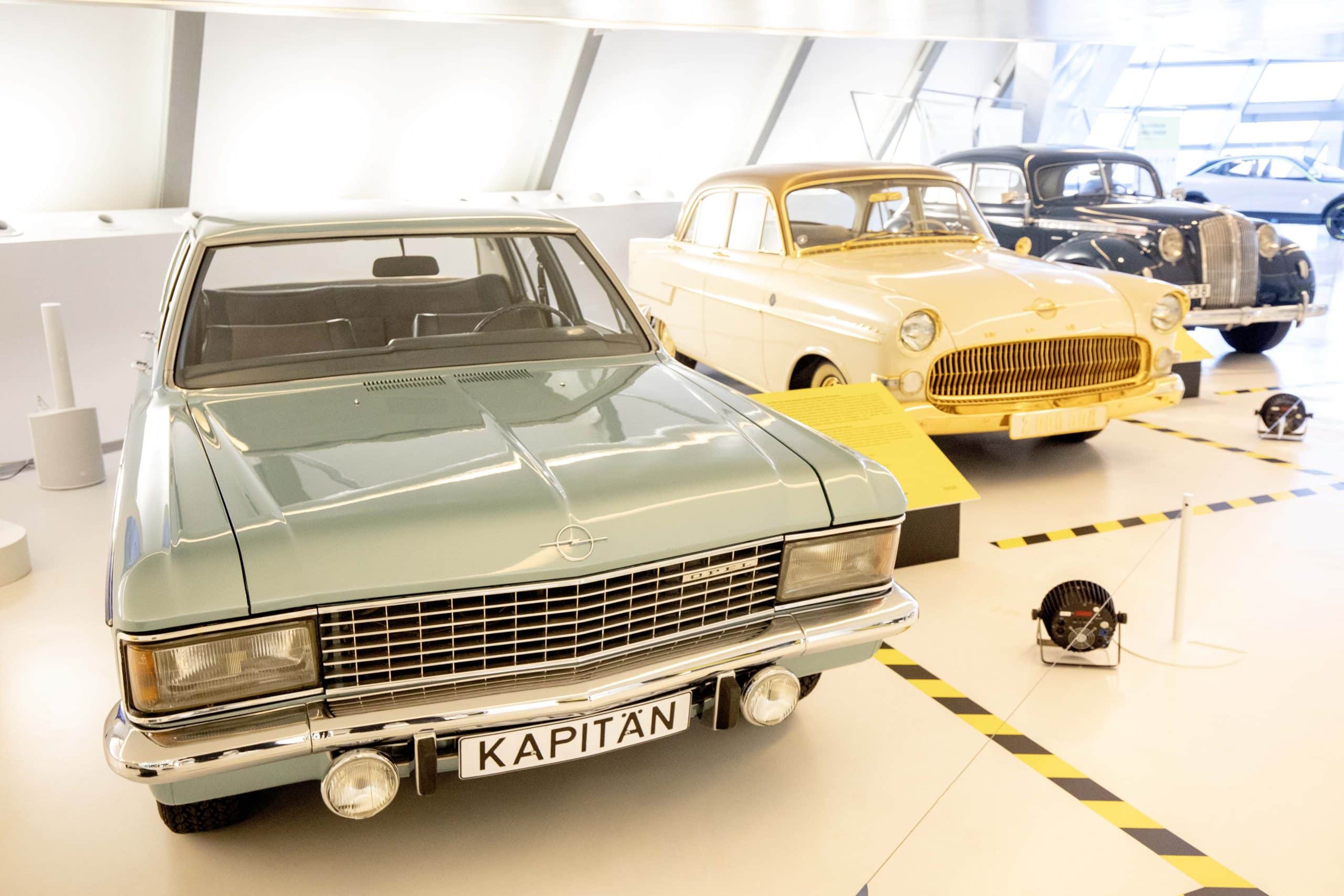
From 15 October 2024 to 8 March 2026, the Mobility City in Zaragoza hosts the “Opel Love” exhibition. These are the 25 pieces visitors will be able to enjoy.
When it comes to brands with history, Opel is clearly not to be left out. 150 years of history go a long way, and to the surprise of many who now know it only as a car manufacturer, it once also made sewing machines, motorised bicycles and even rockets. Yes, really, just as you read it.
The pieces are rarely taken out of the museum the German brand has in Rüsselsheim (Germany), except on a few occasions, as is the case here. And it has not been just any city, but Zaragoza, which is part of Opel’s DNA. It is in Figueruelas where since 1982 Opel has produced millions of cars. Currently the Corsa comes off those lines, along with its Stellantis siblings, the Peugeot 208 and the Lancia Ypsilon.
From 15 October to 8 March 2026, the Mobility City hosts the “Opel Love” exhibition. These are the 25 pieces visitors will be able to enjoy. Here are some of my favourites:
1. Opel Calibra V6 4×4 ITC (1996)
With Manuel Reuter at the wheel, Opel achieved its greatest milestone in the International Touring Car Championship thanks to this touring car, which was developed together with Cosworth and featured a 2.5-litre V6 engine producing 500 horsepower, as well as all-wheel drive and a 6-speed semi-automatic gearbox capable of completing shifts in 0.004 seconds.
2. Opel Corsa Spider (1982)
It was presented at the Geneva Motor Show as a preview of its range of small cars. The exterior of this compact roadster was designed by Hideo Kodama and the interior by Chris Bangle, and it was thoroughly revolutionary.
It was a single-seater that could be converted into a two-seater or even seat four if some elements were replaced. The head restraints with Le Mans-style rollover protection also stood out, as did a cassette player that could be removed from the vehicle and used as a Walkman. And it did not remain a concept: in 1983 the brand teamed up with Irmscher to put it into series production. Three-door Corsas left Zaragoza and were sent to Germany to be converted into convertibles. From 1984 it was marketed as the Irmscher Spider and about 1,000 units were made.
3. Opel 4/8 CV “Doktorwagen” (1909)
Ten years after starting car production, this model marked a before and after, making the car not a luxury item but something accessible. At the time it had a price of 3,950 marks, which, to better understand it, must be said was half of what the previous model cost.
It had a 4-cylinder inline engine and water cooling. This Doktorwagen reached 45 km/h and consumed 7.5 litres per 100 km. It had no doors; occupants entered by running boards and protected themselves from the freezing temperatures of European cities with a leather blanket placed over their legs. Some professionals, such as doctors, saw it as an ideal, reliable and affordable car for getting around and visiting patients, which allowed Opel to double its production in just one year.
4. Opel Kapitän “2 millones” (1956)
Three years after the launch of the first Kapitän, Opel wanted to renew the model: the wide “shark mouth” gave way to a grille-style front, the rear window was made of a single piece, and the two-tone paint available gave it an even more dynamic and special silhouette.
92,555 units were manufactured of this model, and a special unit was made that became the Opel two-millionth car to leave the factory. The parts that were usually chromed were covered in 24-carat gold, and it received special upholstery and paint. What was not touched was the mechanics, which were the same as the standard car’s.
5. Opel Maxx (1995)
The Geneva Show was the venue chosen to display this urban prototype, conceived as a modular “kit” capable of transforming into a convertible, speedster, pick-up, off-roader and even an MPV. Its structure was based on extruded aluminium profiles, which reduced not only weight but also costs. The tubular aluminium seats could rotate on themselves or be removed, increasing the versatility of the interior.
Weighing just 650 kilos and with a 1.0 Ecotec three-cylinder engine, its consumption was barely over 3 litres per 100 km. This concept never reached production, although that engine was used.
6. Opel Admiral (1939)
In 1937 Opel launched its luxury flagship, which stood out for its elegant design adaptable to saloon, Pullman or cabriolet bodywork. It had a 3.6-litre six-cylinder engine producing 75 horsepower and reached 130 km/h. In addition, its spacious and comfortable interior for three passengers in the rear seats earned it a good reputation.
Although it seems impossible today with the amount of cars on offer, this Admiral reached a 25% market share in the luxury segment, and 6,404 units were produced until 1939. That same year the Second World War began and afterwards it was not produced again due to a lack of this type of buyer. That said, in 1964 this iconic name was revived.
7. Opel RAK E (2011)
This is an electric, ultralight prototype developed together with the international agency Kiska. It measured 3 metres long, weighed 380 kg and mixed features of both car and motorcycle. Its tandem cabin is reminiscent of a glider’s, and access to it is through an app installed on the smartphone.
The bodywork is made of recyclable plastic and the chassis is monocoque, to be so light. It has a 14-horsepower electric motor (49 horsepower in 10-second peaks) that gave it a range of about 100 km and a top speed of 120 km/h. It never reached production, although at the time the brand did consider a version limited to 45 km/h that could be driven without a licence, like the Rocks-e (though it is not sold in Spain).
8. Opel Elektro GT (1971)
It can be considered the first electric car to venture into sports-car performance. This was done by Georg von Opel, grandson of the founder, who adapted a Opel GT with electric propulsion. He removed superfluous elements, optimised the car’s aerodynamics and replaced the combustion engine with two Bosch electric motors producing 120 horsepower, powered by Varta batteries that added up to 595 kilos.
This car reached a top speed of 188.86 km/h and set, at Hockenheim, no fewer than 6 world records. Its estimated price (around 300,000 marks) and the limited range (about 40 km at an average speed of 100 km/h) prevented it from going into production.
9. Opel Manta GSE Elektromod (2021)
This “restomod” combines the best of the modern and classic eras, reinterpreting the Opel Manta A from 1970. Using it as a base, they included elements such as the Pixel-Vizor digital front to display luminous messages.
The engine was replaced with an electric one producing 147 horsepower and 255 Nm, with a 31 kWh battery placed in the boot. Although undoubtedly the most unusual feature is the transmission, which, unlike all electric cars, is a 4-speed manual, a clear nod to the past. It can also be used in automatic mode.
Other pieces on display
- “Type No. 2” sewing machine (1870).
- Vibrating Shuttle sewing machine (1909).
- Quintuplet bicycle (1895).
- ZR III competition bicycle (1928).
- Women’s bicycle (1935).
- OP4V200 motorcycle (1922).
- Patent Motorcar (1899).
- Opel 4/12 CV “Laubfrosch” (1924).
- Opel RAK 2 (1928).
- Opel Kapitän B (1969).
- Opel CD Wireframe (1969).
- OSV 40 (1974).
- Opel Corsa A Cut-away (1982).
- Opel Scamp 2 (1993).
- Opel Corsa B “Moom” Showcar (1997).
- Opel GT X Experimental (2018).
Tickets can be bought here at a very affordable price or visited for free on the first Wednesday of each month.


 Kia offers an electric range of 10 models, 50 versions and 400 possible combinations
 The seven finalists for the 2027 European Car of the Year (COTY) are exclusively electric
 Peugeot E-208 GTi: a battery-powered toy that revives the spirit of the 1980s sports cars
Deja un comentario