This is HVO: the renewable diesel made from used cooking oil that you could use in your car
 Antonio Roncero @roncero_antonio
21 July 2022
4 min.
Get ready, because you are going to hear more and more about HVO diesel, a fuel from renewable sources that is an alternative to conventional diesel.
Toyota has just announced that its Toyota Land Cruiser and Toyota Hilux models will be compatible with the new HVO100 renewable diesel from 2023 onwards. Recently we also saw how Audi homologated its V6 TDI engine to run on this fuel, which since 2021 can be refuelled in the 4-cylinder diesels of the A3, Q3 and Q3, for example. Ford is testing this fuel in its Transit vans with the 2.0 Ecoblue engine, and HVO is currently being used successfully in maritime and land transport, especially in the large diesel engines of brands such as Volvo, Scania or Mercedes-Benz.
But what is HVO? Where can this fuel be refuelled? Can I already use it in my diesel car? Keep reading and you will find the answers to these and other questions related to HVO renewable diesel.
What is HVO?
HVO stands for Hydrotreated vegetable oil, which means hydrotreated vegetable oil. It is a fuel of sustainable origin obtained from recycled cooking oil, vegetable oils (mainly palm or rapeseed) and animal fats (for example fish fats), which undergo a chemical treatment using hydrogen to produce a bio-fuel similar to diesel. It can have different formulations, depending on the amount of conventional diesel it is blended with. When it contains no conventional diesel it is called HVO100.
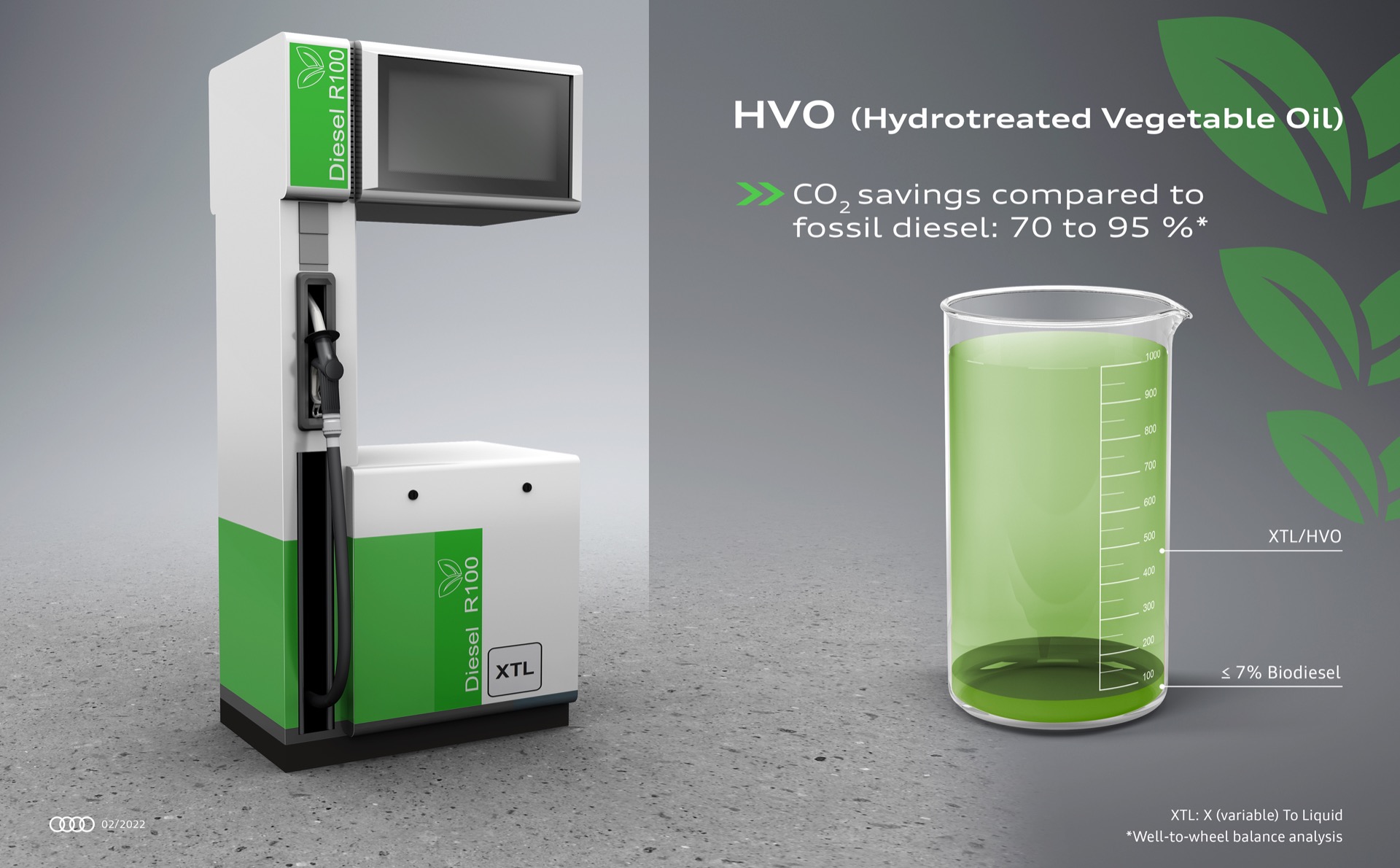
This fuel is regulated by the EN 15940 standard, which uses the term XTL (x to liquid) as a collective name for fuels of the BTL (biomass to liquid) type. That is why HVO fuel pumps are identified with this symbol. It is also common to find the XTL label on the fuel cap of models approved to run on this fuel.
Can I use HVO in any diesel engine?
To use HVO, the car must be properly approved. Since its density is lower than that of conventional diesel, the engine generally requires a series of technical modifications, mainly an adjustment of the injection system, although some brands, such as some in the Stellantis group, have certified some of their Euro 5 and Euro 6 engines to run on this fuel without the need for modification.
What is important is that a diesel engine prepared to run on HVO fuel can also run on conventional diesel interchangeably, and both fuels can even be mixed in the tank.
The advantages of HVO fuel
The main advantage of HVO is that it reduces CO2 emissions compared with fossil-based diesel. This reduction in emissions is estimated at between 70% and 95%, which is not bad at all. It also emits less carbon monoxide (NOx), since its chemical composition contains no sulphur.
In addition, having a cetane number around 30% higher than conventional diesel means that combustion is more efficient and cleaner, and cold starting is improved. It also has a lower content of sulphur and aromatic hydrocarbons, which reduces the concentration of ash in the exhaust gases.
Disadvantages of HVO renewable diesel
As you can imagine, the main disadvantage of HVO is its price, which can be up to 20 per cent more expensive than road diesel, since we are still talking about a fuel with very low production. In addition, its manufacture requires hydrogen (during the synthesis process), and we know that producing hydrogen is expensive.
HVO is currently available at around 1,000 service stations in Europe, but almost all of them are concentrated in a few countries: Norway, Sweden, Finland, the Netherlands, Belgium, Denmark, Estonia and Lithuania. The Netherlands has the greatest production capacity, well above other countries such as Sweden, France or Italy, although all of them are working to increase their production capacity with the aim of reaching 15.5 million tonnes per year by 2030, four times what is produced today.
Related information of interest


 Peugeot E-208 GTi: a battery-powered toy that revives the spirit of the 1980s sports cars
 New Lexus ES: luxury grows and goes electric
 First contact with the Dacia Sandero Hybrid 155: power and efficiency from €19,890
Deja un comentario