Audi Q6 e-tron Electric Cars ECO Tests SUV
We test the Audi Q6 e-tron, the electric SUV that once again puts Audi At the Forefront of Technology
 Antonio Roncero @roncero_antonio
13 September 2024
13 min.
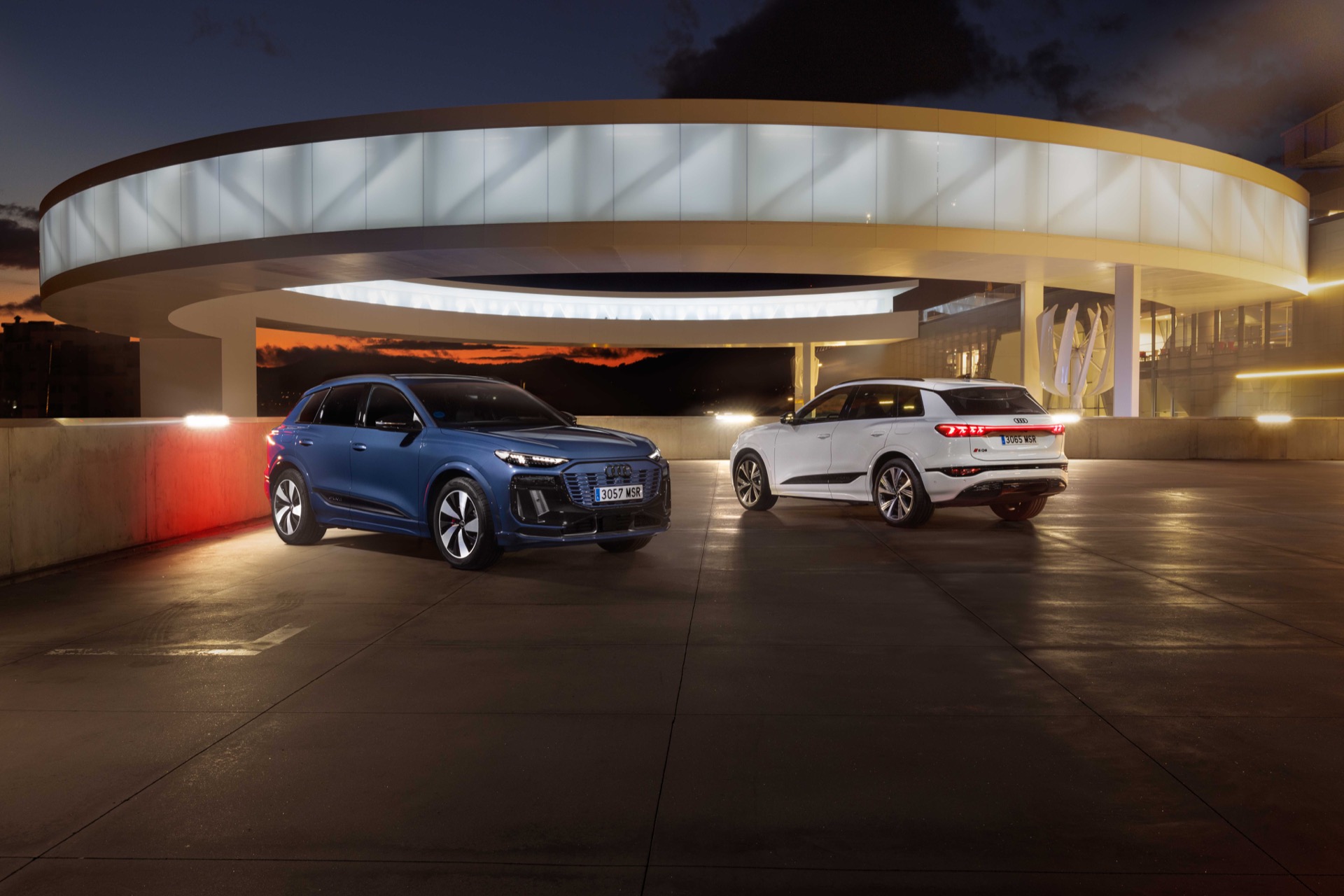
Audi began its electric era back in 2018 with the Audi e-tron, a technologically very advanced SUV at the time that, however, in less than six years, has become outdated, especially when compared with the new Audi Q6 e-tron. This isn’t something that only happens to Audi: the evolution of electric propulsion technology—and especially batteries—is causing electric cars, with a few exceptions such as Tesla, which was already a step ahead, to behave a bit like mobile phones: each new model represents such a big leap that it makes the previous one obsolete.
In this sense, the debut of the Premium Electric Platform (PPE), developed jointly with Porsche, which it already uses in the new Porsche Macan, and which Audi now debuts in the Q6 e-tron, could represent a turning point for the four-ring brand. Gone are the delays from the initial schedule for one of its most important models in recent years, largely caused by the software problems that not only the brand but the entire Volkswagen Group has had. From here on, what’s coming promises a lot. Not least, there’s the new Audi A6 e-tron, also developed on this same platform.
It is, without a doubt, the start of a new era for Audi, which got off to a good start in electrification but in recent years has been overtaken on the inside by its main rivals. Now, the four-ring brand intends to win back ground at breakneck speed, once again championing its motto “At the Forefront of Technology,” which you’ve probably heard more than once. And that is what the new Audi Q6 e-tron represents: cutting-edge technology that wins you over when you drive it, and that will finally make you look at electric cars with new eyes.
A design with plenty of personality
Audi wants the technology of the Q6 e-tron to be visible from the design itself, and to that end they drew inspiration from its “flagship,” the e-tron GT, with which the SUV shares more features than it might seem, especially the profile of the sleek front headlights, the pronounced shoulder lines above the wheel arches that the brand calls “blisters,” or the sills and lower body cladding highlighted in black, emphasizing the battery’s position beneath the floor. In terms of size, with its 4.77 metres in length, 1.64 metres in height and 1.94 metres in width, the Q6 e-tron sits between the Q4 e-tron and the Q8 e-tron. The Sportback body variant will soon join the range.
I haven’t yet seen it in the base trim, but the S line and Black line versions, and especially the SQ6 e-tron, look very sporty and powerful. I really like how Audi has given personality to the front end, although the rear seems more conventional to me. More and more brands are resorting to joining the light clusters with a luminous strip, something that, personally, is starting to wear on me a little. If from the front the Q6 is instantly recognisable as a Audi, I’d say that from behind it wouldn’t be so easy to associate it with a four-ring model, except for the brand logo, which on the Q6 can, for the first time, even be illuminated.
The exterior colour also changes the car’s character a great deal. I prefer it in lighter shades, such as Glacier White or Manhattan Grey, rather than the darker blues or black, which add an elegant touch but considerably hide the most distinctive lines of its sporty silhouette. I haven’t yet seen it in red, while Daytona Grey, which also suits it wonderfully, is reserved for the S line trims and the SQ6. The wheels also make a big difference. Standard wheels are 19-inch five-spoke designs, which become 20-inch for the S line and 21-inch for the Black line trim, with a host of Audi Sport designs to choose from.
The ability to personalise the vehicle with up to eight selectable daytime light signatures is another hallmark of the Q6 e-tron. It’s an innovation the brand is introducing across its new models. To enjoy it on the Q6, you need to fit the optional Matrix LED headlights and digital OLED rear lights. The digital light signature package can also be added after purchase through the functions on demand service. By the way, the digital OLED rear lights are already second generation, with features such as communication light, which warns other road users of possible hazards via specific symbols.
Digital stage: screens take centre stage
Audi has made a dramatic change to the interior design of its cars with the Q6 e-tron; also, it must be said, somewhat playing catch-up with rivals who had taken the lead in digitalisation. Now, the dashboard disappears as we knew it to become one large screen. Audi calls it the “Digital Stage.” And when you sit behind the wheel, it’s far more impressive than in the photos.
What looks like a single panoramic screen with a curved design is actually two: the digital instrumentation, the Audi virtual cockpit, and the MMI display for the multimedia system, measuring 11.9 and 14.5 inches respectively. They use OLED technology, which, besides extremely high resolution, stands out for how well they look when driving at night, without causing annoying contrasts. Finally, Audi decided to bet on the Android operating system, and from what I could “tinker” with, everything seems to work as expected: the touch control of the screen is easy and intuitive, the menus are well organised and the possibilities are huge. The optional augmented reality head-up display is also spectacular, projecting information onto the windscreen with very high-quality graphics and dynamic visualisation of directions, such as the arrows that guide you during navigation.
There are no buttons other than those on the steering wheel and the new module integrated into the doors. The steering wheel controls are “touch” but offer better feedback than those of the Audi Q4, although I still feel they don’t work quite like classic press or turn buttons. A panel on the door groups, next to the mirror controls, some buttons for operating the lighting system. It’s a bit jarring at first, but you get used to it quickly. You also need to get used to “talking” to the voice assistant with artificial intelligence support, which is activated with the command “Hey Audi”. It recognises more than 800 commands and allows you to control the climate, the multimedia system, navigation, choose a nearby charging station, or even open the roof or lower the window by voice alone, without having to take your hands off the wheel. Incidentally, it’s curious that the Q6 e-tron doesn’t have the advanced variable-opacity panoramic roof announced for new models such as the A6 e-tron.
There are two other elements worth highlighting inside. One is the optional third screen for the front passenger, measuring 10.9 inches, from which the occupant of that seat can help the driver with tasks such as navigation, or comfortably watch multimedia content. The other is the interaction light, part of the ambient lighting plus package. It wraps around the cabin from the door panels and across the top of the dashboard, and besides a decorative function, it can also indicate the charge level or the status of the battery charging process.
Audi has paid special attention to the choice of materials, introducing new fabrics, decorative inserts and coverings that bring the sophistication and quality the brand is known for. The result is very pleasant, both to the eye and to the touch… except in areas where piano black is overused, which always produces a lot of reflections and is hard to keep clean. As for interior space, the long wheelbase and short overhangs mean there’s no shortage of room. That said, in the rear seats, as usually happens in electric cars, the floor is somewhat higher than normal, forcing a posture with knees higher relative to the hips than in “conventional” cars. It’s not a worry, but if I had to make a long trip as a passenger, I’d prefer the seats in a Q5.
The boot capacity is 526 litres, to which you must add 64 litres of storage space under the front bonnet, which is not bad at all. It has very regular shapes, two generous compartments at the sides with dividing nets and anchor points for securing luggage, as well as controls to fold down the rear seatbacks, expanding capacity to over 1,500 litres.
Ready for travel: more than 630 km of range and super-fast charging
The new PPE platform brings electric motors that are lighter, more efficient and up to 30% more compact, 800-volt technology and new batteries with intelligent thermal management and “bank-charging”, which optimises charging when using 400-volt stations. The range has four versions: the two less powerful ones with a single motor on the rear axle, and the two more powerful ones with two motors—one on each axle—and electric quattro all-wheel drive.
- Audi Q6 e-tron: 185 kW (252 CV); 0–100 km/h in 7.0 s
- Audi Q6 e-tron performance: 225 kW (306 CV); 0–100 km/h in 6.6 s
- Audi Q6 e-tron quattro: 285 kW (388 CV); 0–100 km/h in 5.9 s
- Audi SQ6 e-tron: 360 kW (490 CV); 0–100 km/h in 4.3 s
Except for the entry version, which has an 83 kWh gross battery (75.8 net), the rest come with the larger capacity battery, 100 kWh gross (94.9 net). The longest-range model is the Q6 e-tron performance, with up to 639 km, followed by the e-tron quattro, with 622 km. The SQ6 manages 590 km, and the entry variant offers a notable 533 km of range with the smaller battery. All can charge at 11 kW with AC as standard, and the two more powerful ones can optionally do so at 22 kW. DC fast charging is up to 270 kW, except with the smaller battery, which is 225 kW.
Under ideal conditions, the Q6 e-tron could charge from 10% to 80% in just 20 minutes, or recover up to 260 km in only 10 minutes. Unfortunately, at least for now, it’s not easy to find those “ideal conditions” on the road, with charging points that operate at 800 volts and 270 kW. Even so, in terms of both range and charging times, the Q6 joins the increasingly large club of electric cars you can travel with without anxiety. Especially if you make use of the route planner, which plans the legs between stops on a journey, recommending short stops, long stops or a combination of both, always to make the trip as comfortable and quick as possible. The planner is standard equipment, as is the Plug & Charge function. The charging port covers—one on each side of the body—open electrically at the touch of a button and close automatically when the charging cable is disconnected.
Behind the wheel of the Audi Q6 e-tron: comfort and sportiness
During the press presentation I was able to drive the Q6 e-tron, only in quattro version, both on a demanding mountain stretch with narrow, very twisty road and on the motorway, and also a little in the city. And the impression is fantastic. Everything suggests this version may be the most in demand, but I wouldn’t overlook the two rear-wheel-drive variants. And here I’ll make a note about prices: the Q6 e-tron quattro starts at €79,990, compared with €76,420 for the performance, and €71,990 for the cheapest Q6 e-tron you can buy. As for the SQ6, it plays in another league: it’s the sportiest and also the most expensive version, at €104,990, at least until the RS Q6 e-tron arrives.
Even though it’s positioned below the Q8 e-tron, the Q6 e-tron has nothing to envy its bigger sibling in ride quality, refinement or even sportiness. The new PPE platform also brings advantages when configuring the suspension and steering, with a newly designed front axle that raises the bar in terms of agility and precision. A new frequency-selective damping system —standard— also improves driving dynamics, especially over poor surfaces, and makes it even harder to decide whether the adaptive air suspension with electronic damping control is worth it. In my view, with the conventional suspension and the sport chassis, which lowers the body by 20 mm and is slightly firmer without compromising comfort, the Q6 is perfect.
I also liked the new braking system, capable of blending regenerative braking with friction brakes individually for each axle without any odd sensations in the pedal, which always feels good. In addition, the ability to adjust the intensity of energy recovery—and therefore the deceleration capacity—is maintained across three levels, one of which is a “sailing” mode with the system disabled, or you can choose an automatic deceleration mode via the paddles behind the steering wheel, as well as a certain “one-pedal” function when selecting “B” on the gear selector, which is useful for city driving.
On performance there’s little to say: the Q6 e-tron, in this quattro version with 225 kW (240 kW momentarily in boost mode when activating launch control), has more than enough performance, and even stands out for a towing capacity reaching 2,400 kg. It weighs 2.2 tonnes, but it doesn’t feel like it, whether accelerating from standstill, gaining speed or, as I’ve already said, when turning, braking and linking bends. And consumption? Well, without a more thorough test I wouldn’t dare call it outstanding, but the less than 20 kWh/100 km average on the trip computer recorded during the first drive suggests real-world ranges approaching 500 km without stopping to charge. We’ll check soon enough.
Audi Q6 e-tron – Image gallery

 Kia offers an electric range of 10 models, 50 versions and 400 possible combinations
 The seven finalists for the 2027 European Car of the Year (COTY) are exclusively electric
 Peugeot E-208 GTi: a battery-powered toy that revives the spirit of the 1980s sports cars
Deja un comentario