Espace Renault Hybrid Cars Tests SUV
We test the new Renault Espace: SUV bodystyle, 7 seats and hybrid-only power
 Antonio Roncero @roncero_antonio
5 June 2023
9 min.
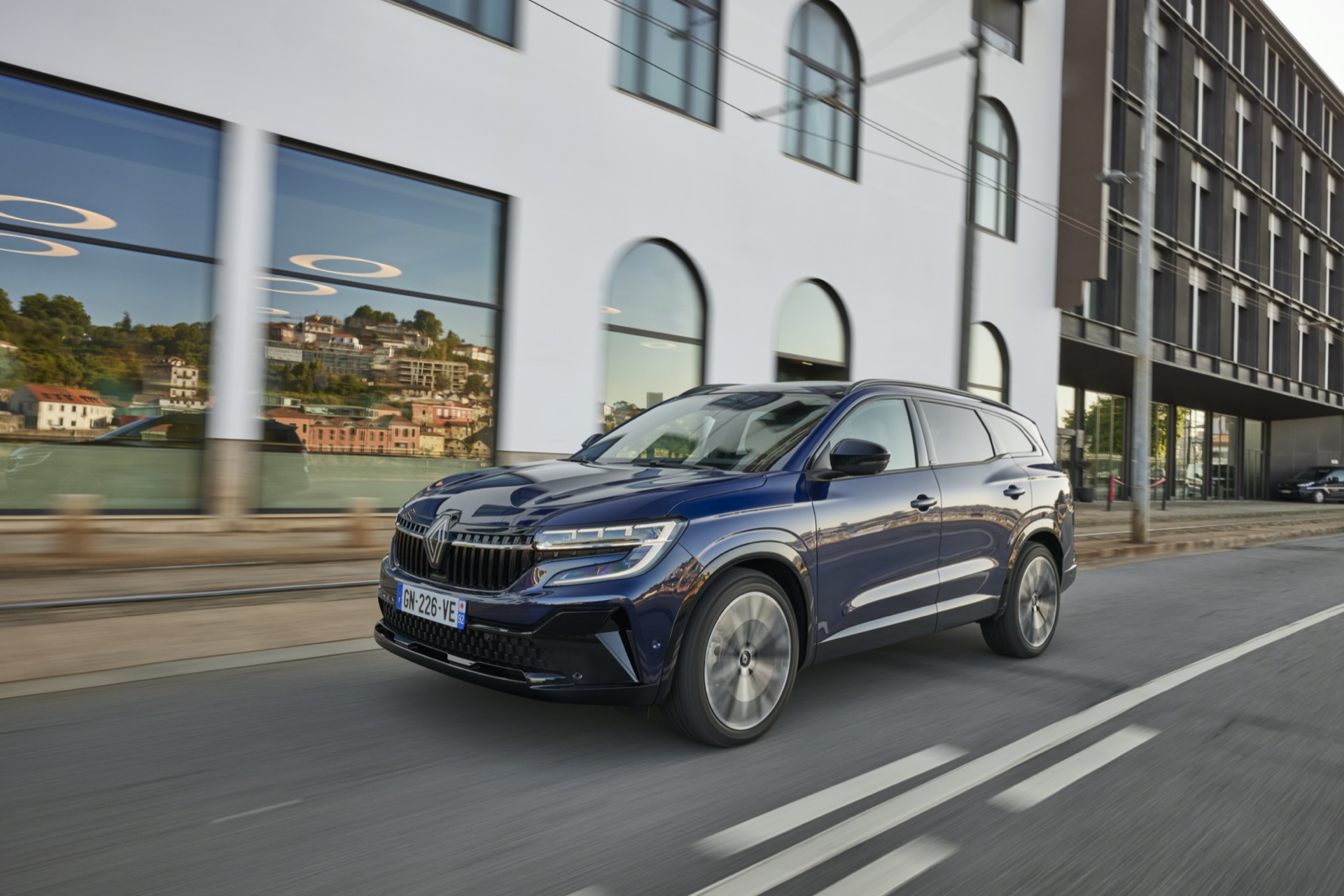
Renault revives the Espace name for the long-bodied version of the Austral, which can be specified with 5 or 7 seats and is paired with the efficient 200 CV E-TECH hybrid powertrain.
The new generation of the Renault Espace is no longer an MPV; in fact, the previous one had already taken a turn towards the crossover world. But technically, with everything that entails, this new Espace is really just the long-bodied version -21 centimetres longer, with a 7 cm increase in the wheelbase- and seven-seat variant of the Renault Austral. And this needs to be made perfectly clear, because if you think of the Espace expecting the qualities associated with the MPV bodystyle of the previous five generations, I can tell you now that you will not find them. Not in the new Espace… nor in any other SUV of a similar size that also offers seven seats.
Renault Espace range and prices
For the time being at least, Renault has decided to offer the Espace only with the 200 CV E-TECH hybrid engine. There is no sign of the 140 CV and 160 CV petrol versions with Mild Hybrid technology that the Austral gets, which are engines that would fit this Espace perfectly, especially the 160 CV one, and which also carry the ECO label. And as with the Austral, there is no plug-in hybrid version either. Renault considers that the E-TECH engine in the Austral and Espace is so efficient that offering a PHEV makes little sense, although those who need the benefits of the ZERO emissions label that this technology provides may not agree. In any case, offering “whatever we see customers demanding” has not been ruled out either, according to the brand itself. They have the technology.
That being so, the range is very simple: three trim levels, techno, esprit Alpine and Iconic, and the option of five or seven seats at no extra cost. With the same engine and trim, the Espace is around 5,000 euros more expensive than the Austral; the prices are as follows:
- Espace E-TECH Techno: 43,500 euros
- Espace E-TECH Esprit Alpine: 46,000 euros
- Espace E-TECH iconic: 48,000 euros
Beyond the differences in equipment, the different trim levels also come with different exterior and interior styling: chrome on the techno with mixed cloth/leatherette upholstery; black finishes on the grille, door frames and roof bars for the iconic, which also goes from 19 to 20-inch wheels and gets leather upholstery; and sporty accents for the esprit Alpine, combining matt black and grey in the exterior styling, with specifically designed 20-inch wheels and Alcantara upholstery.
Very complete equipment
All versions, starting with the Techno, come as standard with a rear-view camera, roof bars, dual-zone climate control, hands-free electric tailgate, adaptive LED headlights, ambient lighting system, blind spot detector, lane-keeping system, wireless phone charger, OpenR link multimedia system, interior ambient lighting and the Multi Sense driving system with four modes (eco, comfort, sport and customisable).
For 2,500 euros, the Esprit Alpine adds the 20-inch wheels, 4Control Advanced four-wheel steering, dynamic indicators and full LED 3D rear lights. On top of this trim, and for an extra 2,000 euros, the iconic adds intelligent adaptive cruise control, heated front seats, a 360-degree 3D camera, heated steering wheel, hands-free assisted parking and electric seats with lumbar massage for the driver.
Among the most interesting options, the two top trims can be fitted with Matrix LED Vision headlights for 900 euros, or a Harman Kardon sound system with 12 speakers for 950 euros. The remaining options are grouped into packs, all of them very competitively priced. For example, the driving pack for the techno gives you adaptive cruise control and a heated steering wheel for 400 euros.
Compared with its main rivals, the Renault Espace has a competitive price when set against other SUVs of its size with a non-plug-in hybrid powertrain of similar power and seven seats: it is around 2,000 euros cheaper than a Nissan X-Trail e-Power, and costs almost 3,000 euros less than the Hyundai Santa Fe HEV.
The Renault Espace inside: seven seats… with reservations
With a dashboard and front seats identical to those of the Austral, the real reason for the new Espace’s existence lies in the rear seats, the boot… and the possibility of having a third row of seats at no extra cost. The impression of good build quality and finish stands out, with a very high-tech look, largely thanks to the OpenR Link system, with a module that integrates the large 12.3-inch screen for the instrument cluster and another 12-inch screen in a vertical position for the multimedia system. Based on Android Automotive OS, I have to say that every time I get the chance to try it I like it more, for how intuitive it is to use and how well it works.
The good news is that with the increase in size and length, the second-row seats allow around 25 centimetres of longitudinal adjustment -10 cm more than in the Austral-, as well as reclining backrests. For travelling, these seats are really very comfortable, with plenty of space in their rearmost position. As you have to slide them forward to free up luggage space they are no longer as good, because the floor is high relative to the seat base and your feet do not fit very well under the front seats either.
The problem, if you choose the seven-seat configuration intending to make use of the third row, is that these seats are barely suitable for children. Access is really awkward, and it also forces you to slide the second row a long way forward to leave some space. As is the case with almost all seven-seat SUVs of this size, the floor in this area is very high and the seat base very low, which forces you into a very awkward and uncomfortable posture.
As for the boot, which could be another good reason to choose the long Austral (sorry, the Espace), it can vary between 580 and almost 780 litres (depending on the position of the second row of seats) if you choose it with five seats. With seven seats, when the third row is folded, you get a flat floor, but the boot loses 100 litres of volume, although it is still large. It should be borne in mind that the boot capacity of the hybrid Austral is 430 litres (500 litres in the versions with a combustion engine).
Behind the wheel of the Renault Espace: comfort and efficiency
Driving the Espace is not very different from driving the Austral, beyond what we could expect from a longer car with a longer wheelbase. At the international launch held in Porto we drove the top-of-the-range version, with 20-inch wheels, 235/45 tyres and the 4CONTROl Advanced four-wheel steering system.
Despite the wide, rather low-profile tyres for the concept of the car -I think something like 225/50 would suit it better- ride comfort is more than adequate, and the Espace also stands out for its excellent ride quality and for body movements that are always well controlled. It loses a little agility compared with the Austral, but the four-wheel steering is still very effective, and it shows when compared with SUVs of its size.
It is undoubtedly an element to take very much into account when choosing the equipment, since it is not only a fantastic aid for “rounding off” corners on very twisty roads, but it also makes manoeuvring much easier. In addition, in the customisable driving mode the degree of rear-wheel intervention when turning can be configured in the Multisense system. Incidentally, one detail: versions with conventional steering have 320 mm brake discs at the front axle and 292 mm at the rear, while with 4CONTROL steering they become 350 mm and 330 mm respectively.
As for the engine, the Espace’s E-TECH powertrain, as in the Austral, delivers fantastic performance, with plenty of pull and very low consumption, thanks to its ability to run in electric mode in many situations, not just at low speed. The combustion engine is a 130 CV turbocharged three-cylinder, helped by a 70 CV electric motor, capable of propelling the car on its own. A second 25 CV electric motor acts as the starter motor and is also used to change gears.
As in the Austral, there are still some situations in which, against the general smoothness of operation, small jerks occur that detract from the fluidity of the hybrid system and transmission. The most obvious case is when accelerating hard: sometimes -not always, it depends on the driving situation- it is as if the mechanism that acts as a gearbox struggles to absorb the power arriving all at once.
Remember that the gearbox here, called “multi-mode” by Renault, is not a conventional gearbox, but uses a dual mechanism with two gears for the main electric motor and four for the combustion engine. And when the system operates in hybrid mode, with the combustion engine and the electric motor combining to drive the wheels, that is when you notice that the software still needs “polishing”, something the brand’s engineers are working on. In any case, it is not something that tarnishes the overall good performance of the system enough to strike the Espace off your shortlist if you are looking for an SUV of this type.
Otherwise, the driving itself is very simple, with paddles on the steering wheel to choose between four levels of regenerative braking that in many cases -especially in town- mean you do not have to use the brake pedal to slow down. As for consumption, during the test route, at a brisk pace and alternating between the different driving modes of the Multisense system, the on-board computer recorded an average of around 6.5 l/100 km, which is not bad at all for a car of this size and with this performance.
Renault Espace – Image gallery
Technical specifications of this car


 Peugeot E-208 GTi: a battery-powered toy that revives the spirit of the 1980s sports cars
 New Lexus ES: luxury grows and goes electric
 First contact with the Dacia Sandero Hybrid 155: power and efficiency from €19,890
Deja un comentario