BAO 5 Denza Hybrid Cars ECO Review
Behind the wheel of the Denza BAO 5: much more than power to challenge the biggest names
 Antonio Roncero @roncero_antonio
28 October 2026
11 min.
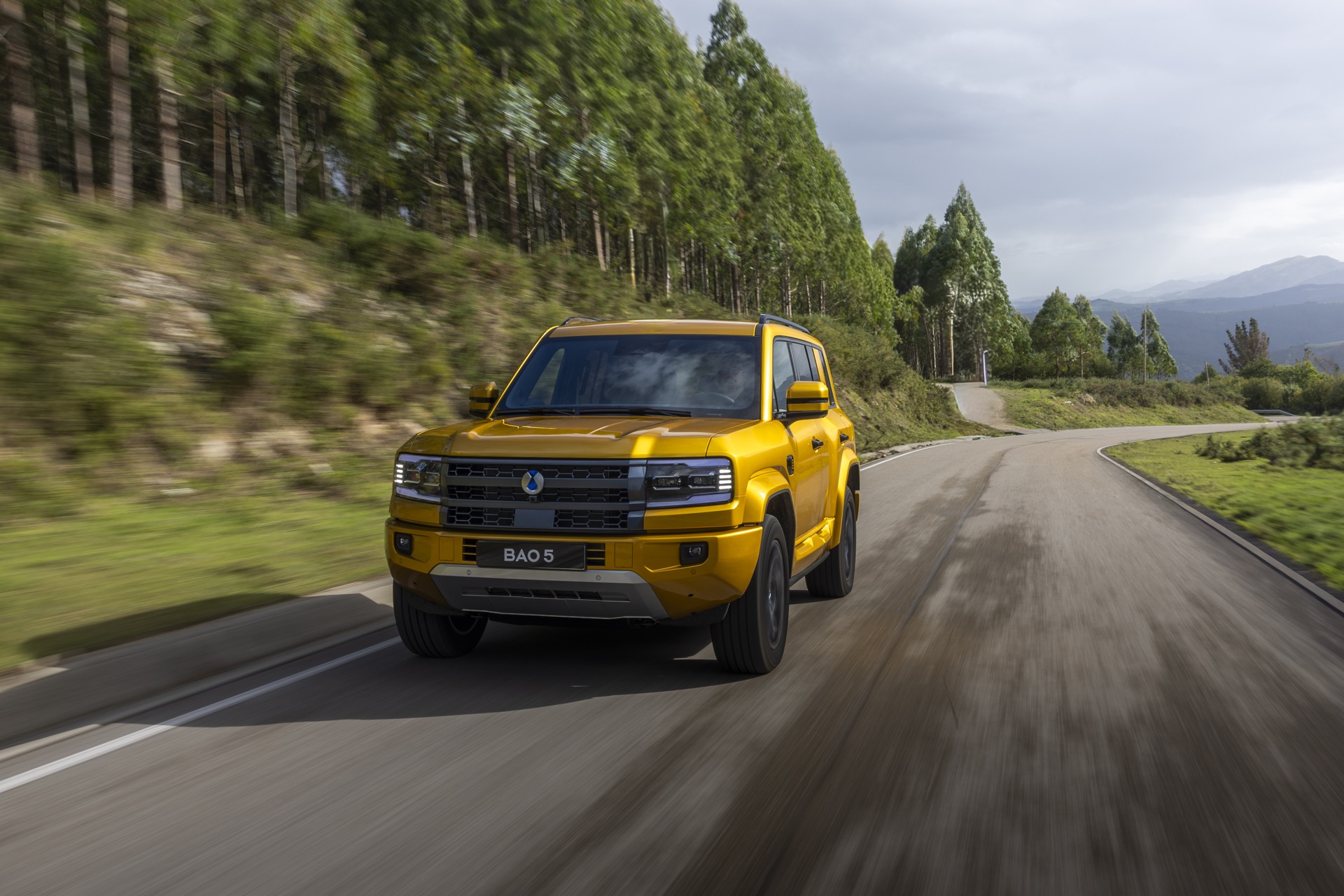
If we look at its technical specifications, its equipment and its price, the Denza BAO 5 is capable of making anyone thinking about buying vehicles of the calibre of the Toyota Land Cruiser or the Land Rover Defender hesitate: no less than 544 CV, up to 90 kilometres of electric range, differential locks and a sophisticated height-adjustable adaptive suspension.
The hard part for Denza will be convincing a potential buyer that they can trust the BAO 5 and its technology when the tarmac runs out and the complications begin. In other words: that it can compete with the big names in off-roading, combining a luxury interior with plug-in hybrid technology developed to tackle off-road terrain with confidence.
The proposition is very appealing. But it also raises an unavoidable question: are potential customers in this category of cars, where the average price exceeds 80,000 euros, ready to trust an off-roader from a newly arrived Chinese brand, loaded with electronics and electrified, the way they do with a Toyota Land Cruiser?
After driving it on the road and overcoming some obstacles on a motocross circuit adapted for the occasion, we have a first answer: the arguments are there. Earning a reputation is another matter, and we will keep a close eye on how Denza does it, as it already faces a very similar dilemma in another segment with the spectacular Denza Z9 GT, going up against brands such as the very Porsche.
A small market with very established benchmarks
With around 2,200 annual sales in Spain, the segment for this type of off-roader is small and has very well-established players, with the Land Rover Defender and the Toyota Land Cruiser as the main references.
The Denza BAO 5 arrives with a plug-in hybrid proposition, although it is not the only one that combines electric driving with off-road capability. The Defender also offers PHEV versions, while Mercedes takes electrification further with the electric G-Class.
Denza’s opportunity lies in how it brings its arguments together and in everything it offers for a starting price of 76,290 euros, which, on paper, is always more than its rivals offer: more range, more power, more equipment… But in this segment of the market, accumulated experience, after-sales service and the trust each brand inspires also matter greatly. This is where Denza still has work to do, because the product is already there.
544 CV and an electrification that can make sense
The BAO 5 uses the DMO architecture, short for Dual Mode Off-road, developed specifically for plug-in hybrid vehicles with an off-road focus. It combines a 1.5-litre turbo petrol engine producing 150 CV, mounted longitudinally, with two electric motors: a front one of 272 CV and a rear one of 388 CV. The combined output is 544 CV, with a maximum torque of 760 Nm. The individual figures do not simply add up, because each component reaches its peak under different conditions and the system has its own operating limits.
The announced performance is impressive, with 0 to 100 km/h acceleration in 4.8 seconds. More relevant for everyday use is the 31.8 kWh battery, which allows it to be homologated for up to 90 kilometres in electric mode. For those who can charge at home, this opens the possibility of covering many daily journeys without using petrol. For longer trips, the combustion engine provides flexibility and allows a claimed combined range of up to 835 kilometres with a full battery and a full tank. Note that this is a homologated figure, not a distance we should take for granted on a mountain route, while towing or driving across country.
Charging accepts up to 11 kW on AC and 100 kW on DC. Fast charging is useful for recovering electric range during a stop, although, as you know, the economic benefit of a PHEV depends above all on plugging it in frequently.
Ladder chassis and locks: more than an adventurous image
Its square styling, the external spare wheel and the body proportions convey robustness. But what matters is underneath: the BAO 5 uses a ladder chassis with cross members, with independent suspension and the battery integrated through Cell-to-Chassis technology. This layout aims to protect the battery within the structure and keep its mass low.
Traction relies on electronic differential locks on the front and rear axles, plus an intelligent central management system that coordinates power distribution between the two motors. This matters because, although the brand speaks of three locks, the operation of the central system should not be confused with that of a conventional mechanical differential. How does this benefit the driver? The system can manage the available power so that a loss of grip at certain wheels does not stop the vehicle from moving forward. The quick response and fine modulation of the electric motors can also help when crawling over obstacles.
Both versions use independent double-wishbone suspension on both axles. But the Ultimate finish adds the intelligent DiSus-P hydraulic system. It is one of the car’s most interesting elements. It uses information from more than 20 sensors to adapt its operation and allows the body height to be varied over a total range of 140 millimetres: 90 upwards and 50 downwards. Ground clearance can reach no less than 310 millimetres, with approach and departure angles of 39 and 34 degrees.
In practice, raising the car provides more clearance for overcoming obstacles without scraping the underbody and improves the ability to tackle steep entries and exits. Being able to lower the body makes getting in easier, especially with the retractable running boards that deploy automatically when the door is opened, while adjustable suspension allows its response to be tailored to different situations. It also includes an auto-levelling function when parked, which would be useful, for example, to someone who wants a roof tent like those Denza offers in its accessories catalogue, as it helps keep the body level even when the ground is not.
The package is completed by a true arsenal of driving modes, including programmes for snow, mud, sand, rocks or wading, as well as sport, normal, eco modes…
During this first contact we tackled slopes and crests on a motocross circuit prepared for the presentation. The BAO 5 handled the proposed exercises with composure, and the capabilities of the suspension, traction and locks point high. However, this experience does not yet allow us to claim that it is on the level of a Land Cruiser or a Mercedes G-Class in extreme 4×4 driving. It still needs to face difficult bridge crossings, unfavourable articulation, water crossings and low-grip surfaces. We also need to see how it responds when difficulties are chained together for a long time, far from a prepared course and under different load conditions.
The first impression is very positive, although if I had to bet right now, I think the BAO 5 would not hold up in a direct confrontation with a G-Class and its three mechanical differential locks in the toughest situations off the tarmac. However, I’m less sure if the question is travelling on the road. We will have to wait for a more thorough test. But there is one thing we cannot overlook: the cheapest G-Class costs… almost double the BAO 5!
On the road: comfortable and with plenty of push
On asphalt, the BAO 5 is relatively comfortable and conveys a clear sense of power in reserve. The performance is there: just ask for acceleration and you will see it move its considerable bulk and its more than 3 tonnes with decisiveness. You can travel in comfort, but its acceleration should not be read as an invitation to drive it like a sporty SUV, especially with that weight, although the low centre of gravity helps inspire confidence when the bends arrive.
The least favourable aspect when travelling on the road is noise. When full power is demanded by accelerating hard rather than progressively, the operation of the hybrid system makes the petrol engine more noticeable than you might expect. It is not uncomfortable in any way, but it takes away some refinement. And, as with other vehicles of this type, where aerodynamics are not exactly the best at cutting through the wind, the air becomes more noticeable as speed rises, something the BAO 5 lets you reach with astonishing ease.
As for consumption, to establish a representative real-world figure we will need a longer test. In a plug-in hybrid, both the fuel used and the electricity consumed matter, along with the state of charge at the start and end of the journey. For reference, on the test route, almost all motorway apart from the brief off-road experience on the circuit, the average was 10.5 l/100 km, a remarkable figure.
Very good finish and equipment that impresses
The interior is one of its strong points, with materials and presentation that convey quality from first contact. The equipment includes a 12.3-inch digital instrument cluster, a Head-Up Display, a 15.6-inch central screen with Google services and another screen for the front passenger. The front seats offer electric adjustment, heating, ventilation and massage, while the rear seats have adjustable backrests and heating.
The Ultimate finish adds Nappa leather and rear ventilation, among other features. The Devialet sound system can have up to 18 speakers. There are also useful solutions for getaways, such as the 4.5-litre refrigerated and heated compartment or the V2L function, which allows external devices to be powered from the car’s battery with up to 6 kW, a practical option for running certain equipment without a generator. On the other hand, the 475-litre boot is not very impressive, although its shape makes it usable and it can be extended to 1,069 litres by folding down the second row of seats. Towing capacity is up to 2,500 kg.
The Spanish range is split into two versions: the BAO 5 Elegance, priced at 76,290 euros, and the BAO 5 Ultimate, which rises to 86,420 euros.
The Elegance already offers ample equipment, but for 10,000 euros more, the Ultimate adds the DiSus-P suspension, electric running boards, Nappa leather upholstery, better brakes thanks to fixed front calipers and a few other comfort details. For this reason, especially if your interest in the car is tied to using its off-road abilities at some point, the Ultimate deserves full attention.
The announced warranty is six years or 150,000 kilometres for the vehicle, eight years or 150,000 kilometres for the propulsion system, and eight years or 250,000 kilometres for the battery.
Alternatives to the Denza BAO 5? It depends on what you’re looking for
The BAO 5 brings strong arguments, but its rivals offer weighty reasons that may outweigh the BAO 5’s strength in value for money. The decision depends on what you expect from the car and how much you value a known track record versus a new proposition.
I would choose a Toyota Land Cruiser if you want an off-roader to keep for many years, to use often in demanding conditions, and you prioritise the confidence that comes from a model family with decades of experience. Its reputation for robustness remains an important argument for anyone who sees the countryside as more than an occasional getaway. Note that I am not saying the Denza will be less reliable, only that for many buyers it probably still needs to prove its durability. And that is something that is established little by little, over time.
I would lean towards a Land Rover Defender PHEV if you want to combine off-road capability, travel comfort and everyday journeys in electric mode, and you particularly value the design, the brand image and the experience of a manufacturer established in this segment, although it must be said that in recent times the brand is losing a little of the reputation for reliability and robustness it has always prided itself on.
It is the closest alternative to the Denza’s approach, although it is worth comparing specific versions and equipment before drawing conclusions on price. A Defender 110 S PHEV starts from 85,700 euros, rising to 126,500 euros for the 110 X PHEV.
The electric Mercedes G-Class also belongs in this group for anyone who wants an electrified luxury off-roader and can fit their charging needs around trips and routes. However, its price positions it far from a direct comparison with the BAO 5: it costs more than 160,000 euros. The “cheapest” G-Class, the 450d with 367 CV, starts from 150,00 euros.
DENZA BAO 5 – Image gallery


 Kia offers an electric range of 10 models, 50 versions and 400 possible combinations
 The seven finalists for the 2027 European Car of the Year (COTY) are exclusively electric
 Peugeot E-208 GTi: a battery-powered toy that revives the spirit of the 1980s sports cars
Deja un comentario