Test drive: Mercedes-Benz GLC 300 e 4MATIC Coupé: comfort, efficiency and surprising dynamics
 Óscar Sanz
28 October 2026
17 min.
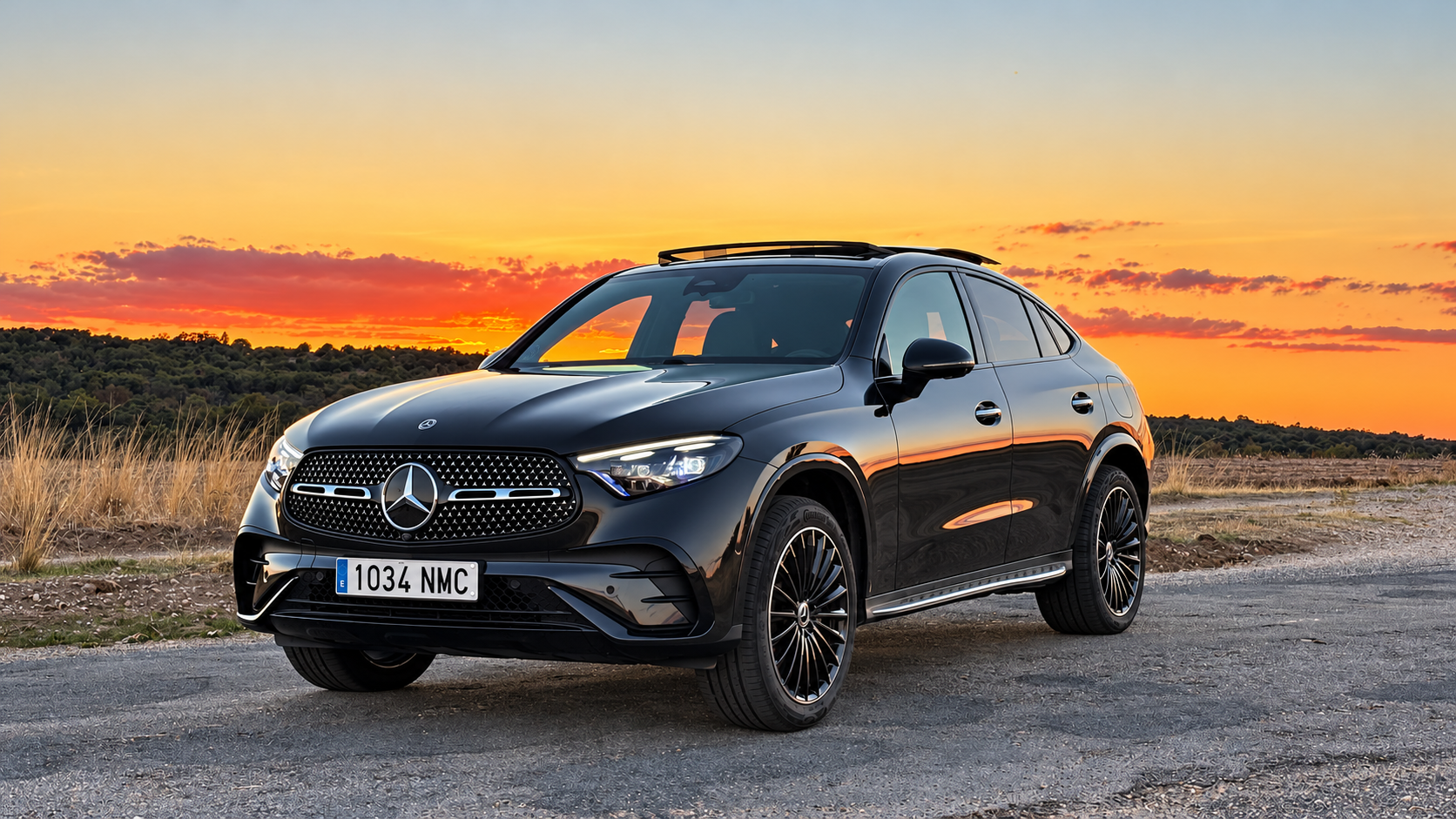
With 313 CV, 4MATIC all-wheel drive, a 31.2 kWh gross battery and a homologated 130 km of electric range, the Mercedes-Benz GLC 300 e 4MATIC Coupé starts from an especially ambitious technical base.
The market is full of plug-in hybrids that on paper seem to offer everything. High power outputs, ever-greater electric ranges, CERO emissions label and homologated consumption figures that are practically negligible have become common selling points, especially among premium SUVs. The truly difficult thing is making all that technology work as a coherent whole, and ensuring that the weight added by the battery and the hybrid system does not end up conditioning the character of the car.
After driving the Mercedes-Benz GLC 300 e 4MATIC Coupé, that is precisely the feeling that stays with you: Mercedes-Benz has not limited itself to fitting a large battery and an electric motor into one of its most important SUVs. It has managed to make the hybrid system part of the car’s personality.
There is one quality that stands out above all others from the first kilometres: comfort. The GLC is extraordinarily quiet, very well insulated, and allows long distances to be covered with an ease almost unexpected for an SUV of this size. However, reducing it to a great travelling car would not be fair either. When you leave the motorway, the pace picks up and the bends begin to appear, and its tuning reveals a second facet far more interesting than expected.
That is where this GLC begins to justify why we consider it one of the most complete plug-in hybrids we have tested.
Design and dimensions: a Coupé SUV of almost 4.8 metres
The GLC Coupé is the more sporty-cut alternative to the conventional GLC. The philosophy is well known: retain the driving position, presence and much of the practicality of an SUV, but wrap it in a body with a more sloping roofline and a visually lighter rear.
In this generation, the formula works especially well. It does not give the impression of being a conventional GLC with only the roof modified, but a body whose proportions have been worked on from the outset.
Our version measures 4,769 mm in length, 1,920 mm in width and 1,606 mm in height, with a generous wheelbase of 2,888 mm. Its road presence is considerable, although the sloping roof and fairly clean body surfaces manage to make the whole look slimmer. The drag coefficient can reach a Cx of 0.27, a particularly good figure for an SUV of this volume. Mercedes also specifically worked on the model’s aeroacoustics, with a windscreen fitted with acoustic laminated glass as standard and additional insulation measures aimed at reducing road and wind noise.
The Coupé design naturally has practical consequences. In the plug-in hybrid versions the boot offers 390 litres, expandable to 1,335 litres by folding down the rear seatbacks. The figure is clearly below the 545 litres of the non-plug-in versions, but two constraints converge here: the shape of the body itself and the space occupied by a battery of considerable dimensions. The electric EASY-PACK tailgate is part of the model’s practical approach.
It is probably one of the few areas where the GLC 300 e forces you to accept an obvious compromise.
An interior that still makes comfort a priority
Opening the door, the car’s positioning becomes clearer. Mercedes does not pursue a minimalist interior in the style of some recent electric cars, but a considerably more traditional interpretation of technological luxury: carefully chosen materials, ambient lighting, a very elaborate presentation and two large screens that organise the driving position without giving up a certain sense of opulence.
In front of the driver is a fully configurable 12.3-inch digital instrument cluster, while in the centre of the dashboard sits the large vertical display of the MBUX system, angled slightly towards the driver. Climate control is operated from this screen, a solution that looks very clean, although we still think some functions would be easier to use with physical controls. Mercedes also allows wireless integration of Apple CarPlay and Android Auto.
The perceived quality is high and, above all, there is a clear intention to create atmosphere. Mouldings, lighting and different surfaces build a cabin considerably more elaborate than that of many rivals that have opted for overly austere interiors under the excuse of minimalism.
But the most important part of the interior is not the screens. It is the seats.
The driving position is excellent and makes it easy to find a natural posture quickly. Our unit further reinforced that feeling of comfort with a particularly comprehensive specification. Mercedes offers multicontour seats with pneumatic side bolsters, lumbar adjustment and various massage programmes, plus heating and ventilation for the front seats. Heated rear seats can also be fitted.
These are elements that on an equipment list may seem like extras, but they take on a different meaning once several hundred kilometres have been covered. The GLC is designed so that the driver and passengers finish a long journey less tired than in many other SUVs of similar size.
And that is a far more important quality than any graphic effect on a screen.
MBUX, Head-up Display and a sound system to match
The MBUX system offers a great deal of information and customisation options. The digital cluster can change its presentation depending on the selected mode, and the optional Head-up Display projects speed, navigation and other information directly into the field of vision.
The integration is especially useful on long journeys because it allows important information to be checked without taking your eyes too far off the road.
The Burmester 3D Surround sound system can also be fitted, consisting of 15 speakers and 710 W of power, compatible with Dolby Atmos. It is one of those options that fits especially well with a car whose silence at speed allows a good audio system to be appreciated clearly.
Mercedes also offers features such as the AIR-BALANCE package, which combines air scenting, ionisation and filtration, as well as memory functions for the seat, steering column, mirrors and Head-up Display. These are not technologies that change the way you drive, but they contribute to the feeling of a car designed to be spent many hours in.
Rear seats: better than its silhouette might suggest
The Coupé body might lead you to think the rear seats are very compromised, but the 2,888 mm wheelbase allows a satisfactory amount of legroom.
Two adults can travel comfortably in the back and the general sense of spaciousness is good, especially when the car is fitted with the panoramic roof. Mercedes precisely increased the usable area of this roof compared with the GLC SUV in order to improve the brightness and spatial perception of the cabin.
The sloping roof is more noticeable when assessing the available headroom than the legroom, but not to the point of making the rear seats token. It remains perfectly usable as a five-seat family car, although, as with almost all models of this type, four occupants will travel with considerably more comfort than five.
The centre seat is usable, but its lesser comfort and width leave it as a mainly occasional solution.
The real uniqueness of the GLC 300 e lies beneath the cabin
Having analysed the car as an SUV, it is time to look at the part that truly sets this version apart: the plug-in hybrid system.
Mercedes combines a four-cylinder petrol engine of 1,999 cm³, turbocharged and with direct injection, delivering 204 CV and 320 Nm, with an electric motor producing 136 CV and 440 Nm.
The combined maximum power reaches 313 CV, with 550 Nm of torque, managed through a nine-speed automatic transmission and the 4MATIC all-wheel drive system.
The result is performance that is very serious for a car of this kind: 0 to 100 km/h in 6.7 seconds and a top speed of 220 km/h.
But focusing only on those figures would miss much of the technical interest of the GLC.
The electric motor provides practically instantaneous response and makes the car react with great firmness when the accelerator is pressed. On overtakes or merging, the 550 Nm arrive quickly enough that there is rarely any sense of effort, even considering the 2,360 kg that this version is rated at.
The integration between the two powertrains is also especially well achieved. In relaxed driving it is hard to identify the exact moment the combustion engine starts, and unless full power is demanded, its presence remains very well isolated from the cabin.
It does not feel like a car with two different propulsion systems. It feels like a single, very well coordinated mechanical unit.
31.2 kWh of battery: here lies one of the car’s keys
The other major difference from many plug-in hybrids lies in the battery.
We are talking about 31.2 kWh gross capacity and 23.4 kWh usable, an extraordinarily high amount of energy for a PHEV and sufficient to homologate 130 kilometres of WLTP electric range in our unit’s specification.
This figure completely changes the logic of the car.
A plug-in hybrid with 30 or 40 real kilometres of electric range forces you to charge almost daily to make the most of its system. With more than 20 usable kWh, the GLC enters another category: many users could cover most of their regular journeys without using a drop of petrol and reserve the combustion engine for longer trips.
And that is probably the use that suits it best.
The battery accepts 11 kW alternating current, able to complete a charge in around 2.5 hours, and reaches 60 kW direct current. The presence of fast charging is especially interesting because it is still uncommon in plug-in hybrids.
It is not intended to turn the GLC into an electric car for travelling exclusively using fast chargers, but it does allow much of the range to be recovered during a stop and its extraordinary electric smoothness to be enjoyed again.
Silence is one of its best qualities
After several kilometres, something ends up standing out above the specifications: how quiet this car is.
Naturally, in electric mode there is barely any mechanical noise. That is not particularly commendable in itself. What is commendable is keeping aerodynamic and road noise equally contained. Mercedes specifically worked on the aeroacoustics of the GLC Coupé, reinforcing body insulation and using an acoustic windscreen as standard. The result is clearly perceived from the cabin. Even at motorway speeds you can hold a conversation at a normal volume, and the predominant sensation is one of isolation.
When the combustion engine kicks in, that calm is barely disturbed. Only under hard acceleration does it become clearly noticeable. All of this may seem secondary to power or range figures, but it is precisely what separates a simply good car from one that is genuinely pleasant after three or four hours of driving.
AIRMATIC: comfort does not depend solely on a soft suspension
Our unit was fitted with AIRMATIC air suspension, one of the systems that most positively influenced our impression of the car.
It should be noted that not all GLC 300 e units come with this configuration. The base version’s specification may feature coil springs and no rear-axle steering; the two systems fitted to our car form part of a higher specification.
AIRMATIC does not merely soften the suspension’s response. Mercedes also uses height adjustment to optimise aerodynamics and can keep the vehicle in a lower position when driving conditions allow. It is also possible to raise the body when extra ground clearance is needed.
On the road, however, what matters is the result.
And it is magnificent.
The GLC passes over deteriorated surfaces with extraordinary serenity. Expansion joints, small potholes or changes in surface are filtered out without generating harsh jolts and, unlike other SUVs that seek comfort through excessively soft damping, there is no constant feeling of floating here.
The car filters, but it also controls.
The rear-axle steering makes 4.77 metres feel like less
The second key component of our unit was the rear-axle steering, capable of turning the rear wheels by up to 4.5 degrees.
Below 60 km/h, the rear wheels turn in the opposite direction to the front ones, virtually shortening the wheelbase and making the car far more manoeuvrable. Above that speed, they can point in the same direction as the front wheels, virtually increasing the wheelbase and improving stability. Mercedes puts the reduction in turning circle with this system at around 90 centimetres.
In an SUV of almost 4.8 metres, the difference is evident.
You notice it when entering a car park, but also on a narrow road. The car responds with an immediacy that does not match what you would expect from its size seen from the outside.
And that is where the GLC’s other great surprise begins to emerge.
Much more dynamic than its 2,360 kilos would suggest
A plug-in hybrid weighing 2,360 kg has an obvious problem: physics.
The battery adds mass, and that mass does not disappear no matter how much electronic work goes on behind the scenes. The key is preventing the driver from being constantly aware of it.
Mercedes achieves this with considerable success.
The GLC changes its grip quickly, keeps body movements under control and allows the pace to be increased without immediately feeling heavy. Naturally, when pushed to the limit, the mass becomes apparent, but in spirited road driving the behaviour is far more natural than expected.
The rear-axle steering helps, but it does not work alone. The suspension, 4MATIC traction and the instant delivery of the electric motor form an especially well-tuned combination.
Turn-in is precise, the car settles confidently and traction on exit is excellent. The 313 CV make it easy to gain speed, yet there is no impression of driving an SUV that tries to appear sporty solely through artificially heavy steering or an overly aggressive Sport mode.
The GLC remains a refined car even when driven quickly.
And that is precisely where its merit lies.
A car able to change register without changing personality
The best summary of its behaviour emerges when comparing two completely different situations.
On the motorway, the GLC 300 e can cover kilometres almost in silence, with the suspension isolating the occupants and the hybrid system managing energy without requiring any input from the driver.
On a secondary road, a few minutes later, the same suspension precisely controls body movements, the rear-axle steering makes the car enter corners quickly, and the 550 Nm provide a forceful response when the throttle is opened again. It does not suddenly become a sports car. It would be absurd to ask that of a 2,360 kg SUV PHEV. It simply shows that comfort does not have to be incompatible with good dynamic behaviour.
Efficiency: as important as the 313 CV
The third major surprise during the test was efficiency.
The homologated figure of 0.5 l/100 km and the 12 g/km of CO₂ for this version correspond to the WLTP calculation method used for plug-in hybrids and should not be interpreted as a constant consumption in real conditions. They depend directly on starting journeys with energy available in the battery.
During one of the test routes, of 101 kilometres in 57 minutes, the GLC 300 e recorded an average consumption of 4.2 l/100 km and 16.8 kWh/100 km, with 65% of the journey completed in electric mode. A particularly significant figure considering the average speed was 106 km/h, confirming the hybrid system’s ability to maintain a high share of electric driving even on fast, non-exclusively urban routes.
What we can say after driving it is that its efficiency is surprising given the size, the 313 CV and, especially, the 2,360 kg it has to move.
A PHEV that makes sense if used as a PHEV
A battery of this size also raises an important question. The GLC 300 e makes great sense for someone who can charge it regularly.
With 130 WLTP kilometres, a driver with a home charging point can cover a huge proportion of daily journeys in electric mode and still have a petrol engine available for a long trip. In that scenario, it combines many of the advantages of an electric car and eliminates much of its drawbacks. If, on the other hand, it is never plugged in, an essential part of what makes this version special is lost, and you end up carrying a large battery without using it the way it was designed. This is not a flaw of the car, but a matter of matching technology to use.
Conclusion: possibly the most complete SUV PHEV we have tested
The Mercedes-Benz GLC 300 e 4MATIC Coupé surprised us because it is hard to find a fundamental aspect of the driving experience where it is clearly unbalanced.
Its battery is enormous for a plug-in hybrid and provides a genuinely useful electric range. The 313 CV deliver more than sufficient performance, arriving with a smoothness that fits the car’s character perfectly. Acoustic insulation is outstanding and the interior offers the quality, technology and, above all, the comfort we expect from a premium SUV built to cover many kilometres.
But what ultimately elevates it above many other PHEVs becomes apparent when the chassis is analysed.
Our unit, equipped with AIRMATIC and rear-axle steering, made an SUV of 4.77 metres and 2,360 kg feel far lighter and more manageable than those numbers would suggest. And it did so without sacrificing what is probably the GLC’s best quality: its extraordinary ride comfort.
It does not have the largest boot in its class, and all this sophistication inevitably comes at a cost. Nor can it completely hide its weight when truly pushed. But these are relatively small concessions within an exceptionally complete package.
After testing numerous plug-in hybrids, few have seemed so well resolved in every area. For electric range, efficiency, silence, comfort, performance and dynamic behaviour, the Mercedes-Benz GLC 300 e 4MATIC Coupé is probably one of the best SUV PHEVs we have driven so far.
Technical data sheet Mercedes-Benz GLC 300 e 4MATIC Coupé
| Feature | Data |
|---|---|
| Body | Coupé SUV, 5 doors |
| Seats | 5 |
| Petrol engine | 4-cylinder inline, turbo, direct injection |
| Displacement | 1,999 cm³ |
| Combustion engine power | 204 CV / 150 kW at 6,100 rpm |
| Combustion engine torque | 320 Nm between 2,000 and 4,000 rpm |
| Electric motor | Synchronous, front longitudinal |
| Electric motor power | 136 CV / 100 kW |
| Electric motor torque | 440 Nm |
| Combined power | 313 CV / 230 kW |
| Maximum combined torque | 550 Nm |
| Transmission | Automatic, 9-speed |
| Drive | Full-time 4MATIC |
| 0-100 km/h | 6.7 seconds |
| Top speed | 220 km/h |
| Battery | Lithium-ion |
| Gross capacity | 31.2 kWh |
| Usable capacity | 23.4 kWh |
| WLTP electric range | 130 km |
| WLTP combined consumption | 0.5 l/100 km |
| WLTP CO₂ emissions | 12 g/km |
| DGT label | 0 Emissions |
| Maximum AC charging | 11 kW |
| Maximum DC charging | 60 kW |
| AC charging time at 11 kW | 2.5 hours |
| Length | 4,769 mm |
| Width | 1,920 mm |
| Height | 1,606 mm |
| Wheelbase | 2,888 mm |
| Weight | 2,360 kg |
| Boot | 390-1,335 litres |
| Fuel tank | 49 litres |
| Drag coefficient | Cx 0.27 |
| Ground clearance | 158 mm |
| Suspension of tested unit | AIRMATIC air suspension |
| Steering of tested unit | Rear-axle steering up to 4.5 |

 The seven finalists for the 2027 European Car of the Year (COTY) are exclusively electric
 Peugeot E-208 GTi: a battery-powered toy that revives the spirit of the 1980s sports cars
 New Lexus ES: luxury grows and goes electric
Deja un comentario