GLC Mercedes Electric Cars ECO Tests SUV
Behind the wheel of the new Mercedes GLC electric: when the on-board experience changes everything
 Antonio Roncero @roncero_antonio
19 May 2026
15 min.
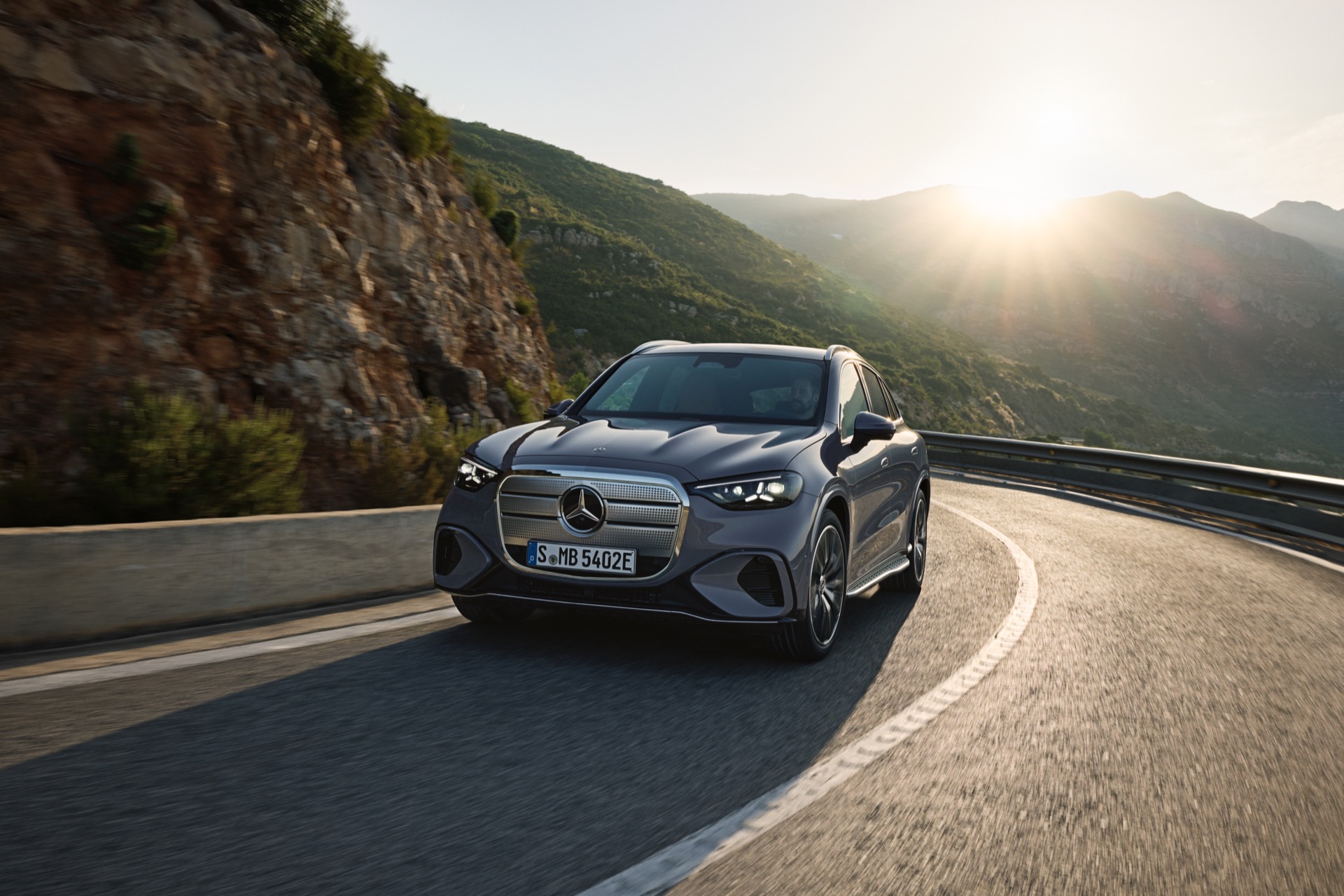
Mercedes-Benz electrifies the GLC. We have driven it in its 400 4MATIC version, with 490 CV, more than 700 km of certified range and a technological showcase that marks a before and after in the range.
Mercedes-Benz did not have it easy with the new electric GLC. First, because it was not just a matter of launching yet another premium SUV and surprising with a record-breaking range figure. The GLC has been, for years, the best-selling model of the brand, its benchmark SUV in the mid-size segment and one of those cars that many customers buy precisely because they don’t want experiments. That is why this new electric GLC is so important, and why it is presented as a model “independent” from the combustion GLC range, designed from the outset as a 100% electric vehicle, and on a dedicated platform.
This new GLC sets the course for what Mercedes understands a family, premium SUV for electric travel should be. And after a first contact, the feeling it leaves us with is clear: the brand of the star has raised the bar and has brought to market an extraordinary vehicle. The first version to arrive is the Mercedes-Benz GLC 400 4MATIC, with 360 kW of power —489 CV—, all-wheel drive, a 94 kWh usable battery, an 800-volt architecture and a certified range of up to 707 km, although the entry version starts at 666 km. Later will come “single motor” versions with rear-wheel drive.
First and foremost… and best of all: it still looks like a GLC
Mercedes has learned an important lesson after its first EQ electrics: many customers do not want the electric car to look different out of obligation, simply because it is electric. They want range, fast charging, silence and efficiency. But they also look for a distinctive SUV body without it looking like a spaceship, a good driving position, a boot that doesn’t force you to play TETRIS when it’s time to travel, quality and ease of use. That is exactly where this electric GLC seems to find its place.
The reality is that, in a way, electrification has democratised performance. Today any manufacturer can offer an electric vehicle with power figures typical of V8 engines, install a battery of around 100 kWh of capacity and announce ranges above 600 km with charging powers and times that don’t make you look the other way. There is no state-of-the-art electric vehicle, especially among premium brands, that does not offer brilliant performance on paper. But now the battle is different: what lies beyond the specification figures? And this is where the new GLC takes a step forward, offering an experience that goes beyond driving.
Its body measures 4.85 metres long and has a wheelbase of 2.97 metres, about 8 cm more than the combustion GLC. Although, unlike the latter, the electric GLC will not split into SUV and Coupé body variants. The brand says it has opted for a more coupé-like design than the combustion GLC SUV, with a slightly more sloping rear; but the reality is that, visually, the electric GLC has very little of a coupé about it. What cannot be denied is that it is a Mercedes-Benz, instantly recognisable by day… and especially at night, thanks to the huge chrome-framed grille which, optionally, is available in a version with almost 1,000 backlit points that create an animated pixel graphic.
Of course, the star of the brand also features lighting, and together with the DIGITAL LIGHT headlights with micro-LED technology, it turns locking or unlocking the car into a true ceremony. The drag coefficient, of 0.26, is excellent and has a direct effect on efficiency and ride comfort, but it is not surprising: the iX3 boasts a Cx of 0.24.
Interior: the on-board experience as a selling point
I get into the new electric GLC and the first thing that surprises is the MBUX Hyperscreen, the largest screen Mercedes has ever fitted in a car. It is not standard on all versions, but it completely defines the on-board experience. The resolution, the graphics, the animated backgrounds and the coordination with the ambient lighting create a very spectacular atmosphere, especially at night. If Mercedes-Benz wants its next models to be associated with the idea of “technological luxury”, there is no denying that the MBUX Hyperscreen achieves it, although there will always be nostalgics like me who feel that with this kind of configuration much of the personality that a dashboard provides is lost, and here there is none: the entire dashboard is a screen.
And in the GLC it is always like this. In the standard versions, the glass surface includes a 10.3-inch screen for the instrumentation and a 14-inch one for the multimedia system. The next step up is the MBUX Superscreen, which adds under the same frame a third 14-inch screen for the passenger. With the spectacular MBUX Hyperscreen the screen is a single unit, without divisions, and reaches 39.1 inches. But the important thing is that it does not stop at visual impact. The resolution is exceptional thanks to matrix backlighting with more than 1,000 individual LEDs, the wallpapers are high-detail animations customisable in eleven styles, and the whole coordinates colours with the cabin’s ambient lighting. The result is an atmosphere that, quite literally, changes according to the driver’s mood.
But the screen is only the most striking element of something deeper: the MB.OS operating system, powered by artificial intelligence, integrates for the first time in a car AI tools from both Microsoft and Google. The MBUX virtual assistant uses what the brand calls a “multi-agent approach”: ChatGPT and Bing for general knowledge queries, Google’s automotive AI engine with Gemini for navigation and points of interest, and a third agent specialised in the vehicle itself. Lacking time to live with the car and test it more thoroughly, the result is promising: you could almost say you can converse with the vehicle as you would with a passenger.
A special mention goes to another optional feature, the SKY CONTROL panoramic roof. A roof that can alternate between transparent and opaque by zones is no longer news. But optionally it can integrate 162 illuminated stars. At night or when passing through a tunnel, with the stars “lighting up the sky” and the MBUX Hyperscreen showing one of its backgrounds, the sensation is truly impressive.
The vegan leather pack, the first in the world in a series car certified by The Vegan Society, and the seats with AGR certification complete an interior that aims to set new standards in its category. Rear passengers, moreover, benefit from almost 5 cm of additional legroom compared with the combustion GLC; these are the advantages of a platform designed from scratch for electrification. As for the boot, the figures speak for themselves: 570 litres of capacity, expandable to 1,740 litres if the backrests are folded down. In addition, there is a front boot of no less than 128 litres, very useful not only for storing the cables: it can even fit a travel bag.
Dedicated electric platform
Under the body lies one of the keys to this new GLC: the MB.EA architecture, specific to electric vehicles. It integrates 800-volt technology and supports fast charging of up to 330 kW in direct current, which allows Mercedes to announce that its new model recovers up to 300 km of range in ten minutes, under “ideal” conditions, as you know. An adaptor is also included for charging at 400-volt stations, in which case the maximum power is limited to 100 kW.
The battery has 94 kWh of usable capacity, a reasonable figure for an SUV of this size and performance, which allows the GLC 400 4MATIC to announce a range of up to 707 km. It is not a figure that surprises, when the iX3 and the Volvo EX60 exceed 800 km. But to achieve this, both the German and the Swedish model use larger-capacity batteries, exceeding 100 kWh. This tells us that Mercedes has not simply sought to fit the largest possible battery, but to combine range, efficiency and charging power. And at least from what we have seen in this first contact, it achieves it.
Another interesting detail is the two-speed gearbox on the rear axle: a short first ratio to benefit acceleration and towing capacity, which reaches 2,400 kg. And a longer second ratio to seek efficiency on the motorway and at sustained speeds. In practice, depending on the driving situation, you can sometimes perceive when the change from one gear to the other occurs, especially under acceleration. But at no time does it disturb the sense of smoothness, comfort and absolute fluidity felt when driving the electric GLC, which seems to glide over the road effortlessly.
And to close the technological section, the One-Box brake system also deserves a special mention. It unifies the brake booster, brake pump and ESP in a single module, and offers a completely natural pedal feel regardless of whether braking is done by regeneration —in this situation the electric GLC can do so with up to 300 kW of power— or by friction, when the hydraulic brakes come into play. This is all the more important considering that, according to the brand, in practically 99 per cent of everyday braking, the hydraulic system does not intervene.
At the wheel: silence, thrust and great smoothness
To say the GLC 400 4MATIC is very quick is no revelation for an electric car with almost 500 CV these days. It accelerates strongly, responds immediately to the accelerator and allows overtaking with enormous ease. Its official figures are indicative of how it goes: accelerating a mass of over 2.5 tonnes to 100 km/h in 4.3 seconds is no small feat. The top speed is limited to 210 km/h. But what most convinces about the electric GLC 400 is not the acceleration, but the way it delivers that power. And for the better. Mercedes has managed to make a car that goes so fast not abrupt, nor does it force you to drive with your right foot constantly on alert. The GLC pushes very forcefully when you need it, but it does so in a filtered, silent and progressive way. It is quick, but above all it conveys refinement.
The AIRMATIC air suspension also has a large part of the credit, although it requires a visit to the cashier. With it, the car rides with great authority, insulates very well and maintains that sense of rolling that one expects from a vehicle of the star brand. Lacking a more thorough test on very broken roads, the first impression is that it is closer to the comfort of a large saloon than to the dry feel sometimes found in electric SUVs that are so large and heavy. The icing on the cake is the rear-axle steering —also optional, €3,200 in the Agility & Comfort pack, together with the AIRMATIC suspension— which helps disguise the size during manoeuvres and adds agility on winding roads. It does not turn the GLC into a sporty SUV; its natural terrain seems to be elsewhere: motorways, wide roads, long journeys and stretches where silence, stability and ease of driving matter more than the last tenth of a second through a bend.
As for consumption, runs of more than 450 km without worrying about the range indicator seem like child’s play for this Mercedes; even 500 km without stopping to recharge is a target worth considering, letting the cruise control do the work at motorway speeds. Because, although it remains to be confirmed, the electric GLC seems to use very little, judging by the average of less than 20 kWh/100 km in this first contact.
The Mercedes-Benz electric GLC versus its rivals
Among the direct rivals of the electric GLC, the most “veteran” is the Audi Q6 e-tron, which is no less advanced technologically, also with an 800-volt architecture and a dedicated platform. The range is very complete, with rear-wheel or all-wheel drive versions, a choice between SUV and Sportback bodies and even an SQ6 with 517 CV as its top-of-the-range model. The version most equivalent to the GLC 400 4MATIC would be the Q6 e-tron quattro, with 315 kW (428 CV) and a range of up to 641 km, available from €71,650 in Advanced trim, and for €79,730 in the Black Line variant. The Audi stands out for its overall balance and a very convincing setup.
The new-generation BMW iX3 is probably the most “dangerous” rival, with 345 kW (469 CV) and a certified range of up to 805 km for the version currently on sale, the 50 xDrive, which has an enormous battery with more than 108 kWh of capacity. Like the Mercedes, it is a car with a very pleasant driving feel, perhaps a notch below the Q6 in terms of comfort. Compared with the BMW, the GLC seems to bet on a different recipe: less sportiness and more comfort, silence and on-board experience.
Another interesting model that has just arrived on the market is the Volvo EX60, which will play the card of Scandinavian design, safety and efficiency. Its price places the EX60 among the most affordable in the category, but it does not fall behind in quality or interior presentation, nor in technology. The P10 AWD version dethroned the iX3 in its brief reign as the electric car with the longest range on sale in Spain, with its 810 km according to WLTP figures, although in turn the EX60 did not hold that honour for long, which now falls to the new Mercedes-Benz EQS, capable of exceeding 900 km. In return, the Volvo is one of those that can charge fastest, recovering up to 340 km in 10 minutes.
Price and equipment for Spain
The new Mercedes-Benz GLC 400 4MATIC electric starts in Spain from €77,125. As standard it includes the AVANTGARDE trim, panoramic roof, high-performance LED headlights, parking pack with rear camera, electric seats with lumbar support, automatic climate control, smartphone integration, wireless charging and the Advanced Plus pack with digital extras. Furthermore, for our market the Plug&Go pack is included, with charger and installation included; as well as the Advanced Plus pack, with the illuminated grille, panoramic roof, interior ambient lighting and the intermediate configuration of the MBUX screen. The spectacular “Hyperscreen” is part of the optional Premium pack, which adds high-end seats, 4D Burmester audio system, illuminated star pattern on the roof and digital lights.
It is not a cheap car, but neither is it outside what a premium electric SUV of this size, power and range already costs. As obvious references, it is around €9,000 more than the plug-in hybrid GLC, available in petrol and diesel versions, but with less equipment. And to position it against its main rivals, the BMW iX3 50 xDrive starts at €79,000; the Volvo EX60 P10 is priced at €68,000; and the Q6 e-tron quattro is available from €71,650. The key, as always with this type of premium-brand vehicle, lies in seeing how far the bill climbs once the customer configures the car to their taste.
First conclusion
With the new electric GLC, Mercedes-Benz aims to convince the traditional GLC customer that the leap to electric does not mean giving up what one expects from a Mercedes. And in my view, it achieves it. It is comfortable, silent, powerful, very technological and practical enough to be the one family car. The range and fast charging promise hassle-free journeys, the interior is among the most spectacular in the segment and the setup is magnificently oriented towards long-distance comfort.
In a more thorough test we will confirm real consumption, motorway range and dynamic behaviour in different conditions. But as a first impression, the electric GLC aims very high. Not because it is Mercedes’s most technological SUV, but because it could be something far more important for the brand: becoming the electric vehicle that many Mercedes customers would buy without a second thought. Because the best GLC in history has just arrived… and it doesn’t burn petrol.
Mercedes-Benz GLC 400 4MATIC – Image gallery
 The seven finalists for the 2027 European Car of the Year (COTY) are exclusively electric
 Peugeot E-208 GTi: a battery-powered toy that revives the spirit of the 1980s sports cars
 New Lexus ES: luxury grows and goes electric
Deja un comentario