Don't look any further: there is no other 7-seat SUV on the market that is more affordable and comes with as much equipment as the new EBRO S800.
 Antonio Roncero @roncero_antonio
10 March 2025
8 min.
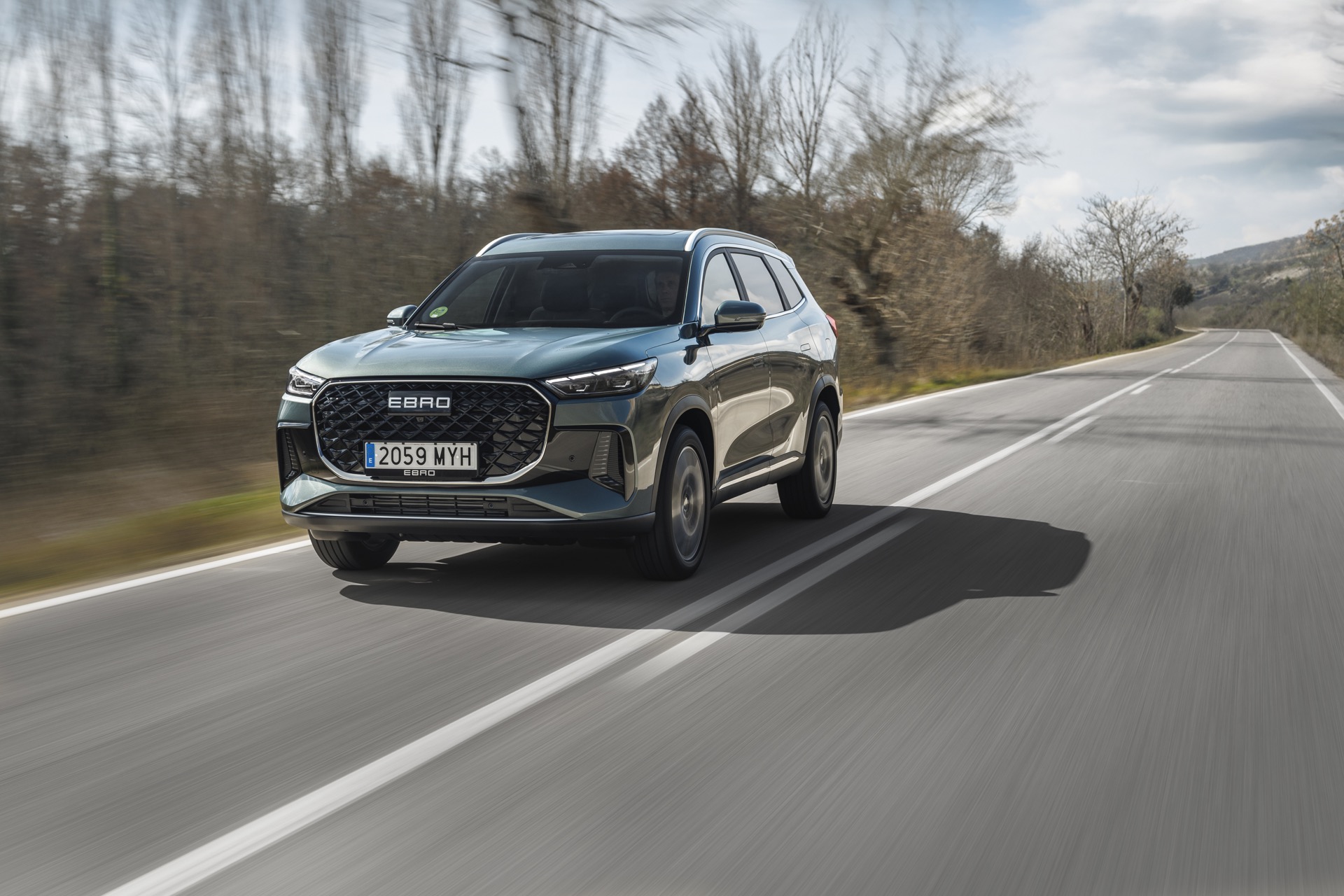
There are a few 7-seat SUVs with similar characteristics to the Ebro S800, but none with such a favourable balance between price, quality and equipment, especially with the launch promotion.
From 36,990 euros with the Premium trim, and from 38,990 euros for the top-of-the-range version, the S800 Luxury. And if these, which are the list prices without discounts of the Ebro S800, already place the new 7-seat SUV from the Spanish brand not only among the most affordable cars in its category, but also among the best value for money in terms of price and equipment, just imagine with the discount. For at least the Luxury trim, Ebro is announcing a launch campaign which, including discounts and financing, brings the final price of the Ebro S800 Luxury, the most complete and well-equipped version, down to 32,990 euros.
Simply unbeatable. And not only because of the abundant equipment — we’ll go into more detail shortly — but because the S800 is a car that, like the S700, also stands out for its roominess, good ride comfort and a finish that conveys a strong sense of quality, of a well-built car. On the downside, as with the S700, a petrol engine, the only one available for now — a very interesting plug-in hybrid version will also arrive shortly — that has no hybridisation of any kind, so it qualifies only for the C environmental label from the DGT, and it requires very “gentle” driving to keep fuel consumption from soaring. But that’s getting ahead of ourselves a little.
Let’s go point by point to learn more about the S800: what it’s like inside, its standard equipment… and how it drives.
A family SUV with 7 seats designed for travelling
On the outside the S800 looks very much like its more compact sibling, the S700, especially at the front, where the enormous grille doesn’t go unnoticed. At the rear, however, there are more changes, highlighted by the diffuser and the two dual exhaust outlets, a detail that on paper would suit the S700 better than the more family-oriented S800, but which doesn’t look out of place. It measures 4.72 metres in length (17 cm more than the S700), 1.86 metres in width and 1.70 metres in height, with a wheelbase of 2.71 metres. Another feature exclusive to the S800 is the door handles, which are flush with the bodywork and extend automatically as you approach the vehicle.
Inside there are also changes compared with the S700 that “set it apart” and make it clear that the S800 belongs to a higher category, largely justifying the price difference between the two models, which is due to more than just their size and the seven seats. To begin with, the S800 goes one step further in attention to detail, with a choice of materials and a fit and finish that convey a sense of great quality. Apart from the lower part of the dashboard, almost the entire interior is trimmed with soft, pleasant-to-the-touch materials, including the synthetic leather upholstery on the seats, which look impressive and deliver very good support and comfort.
A major difference from the S700 is the layout of the screens, which here are separate rather than one after the other, and are of different sizes. The instrument display is 10.25 inches, and the multimedia system is 15.6 inches, in the purest style of Tesla or BYD, compatible with Apple CarPlay and Android Auto wirelessly and with very high resolution, which is especially noticeable when using the 360-degree surround-view camera system with bird’s-eye view, and the 180-degree front view.
There are hardly any physical controls beyond those on the multifunction steering wheel — flattened at the bottom — and the rotary control for the drive mode selector — Eco, Normal and Sport — located on the centre console, next to the double surface for wireless charging of two smartphones, ventilated and with 50W of power. The audio system is signed by SONY, and the ambient lighting system can be synchronised either with the music being played or with the selected drive mode. The climate control includes a particulate filter and an air purification system.
As for habitability, the second-row seats are also very comfortable, and the ability to adjust the bench longitudinally lets you configure the space according to your needs. The two rear seats do offer a little more room than is usual in this category, but they share the same problem as all 7-seat SUVs: access isn’t easy, and both the height and the proximity of the bench to the floor limit their use to children. When they are not in use, these two third-row seats fold neatly away under the boot floor, which has a capacity of almost 120 litres with all seats deployed, and 890 litres in the five-seat configuration, using the loading capacity up to the roof.
First-class equipment
Before moving on to driving, it’s worth looking more closely at the equipment, because the generous standard specification also contributes greatly to the comfort of travelling in the Ebro S800, in addition to its unbeatable price-to-equipment ratio.
From the Premium trim, the following are standard: 19-inch alloy wheels — with 235/50 tyres, a very logical size for a car of this type — electric heated door mirrors, LED directional headlights, electrically adjustable front seats, the two-zone climate control and keyless entry with push-button start.
For 2,000 euros more, if we consider the list prices without discounts, the Luxury adds a panoramic sunroof that brings plenty of light into the cabin, an electrically operated tailgate, automatic folding of the exterior mirrors, heated steering wheel, an instrument cluster with a head-up display projected onto the windscreen, ventilated and memory front seats, heated second-row seats, an independent air outlet for the third row, an audio system with 12 speakers instead of eight — two in the front headrests — and rear side airbags.
Both trims include the same driver-assistance package as standard, which includes voice recognition, adaptive cruise control, front and rear collision warning, automatic emergency braking, automatic high beam, a reversing assistant, and lane departure warning and lane keeping assist. The only available option is metallic paint, which costs 300 euros. The standard body colour is white, and you can choose black, green or grey.
Behind the wheel of the Ebro S800
Behind the wheel, the Ebro S800 shows the same strengths — and there are many — and the same weaknesses — few, but it has them too — as its “little brother” the S700. Let’s remember that the two models from the Spanish brand have a lot in common with the Jaecoo 7 and Omoda 5 respectively — same platform, engine and gearbox — although the Ebros are assembled in the Barcelona free zone.
The only engine currently available is the 1.6 TGDI petrol, with 147 CV and a maximum torque of 275 Nm, coupled to a seven-speed dual-clutch gearbox by Getrag. The engine delivers sufficient thrust and runs smoothly and quietly, especially on motorways or roads where you can maintain a constant speed, where the smoothness of the suspension contributes to comfort. If it doesn’t offer more dynamism on winding roads, it’s because the gearbox response is far from what you’d expect from a dual-clutch transmission, which moreover offers no manual mode at all, as there are no paddles or lever.
This is probably also why fuel consumption isn’t the Ebro S800’s strong point, nor is it for any of the cars mentioned that use this same engine and transmission combination. It’s not that it consumes excessively, since an average consumption of between 8 and 9 l/100 km is reasonable for a car of this kind. But to stay within those figures you have to rely heavily on “Eco” mode and be very careful with your right foot. Personally I also think that the driving feel would improve with steering that filters less of what happens between the wheels and the road surface.
Overall, the S800 dynamically delivers what you’d expect from a family-oriented car: it is very comfortable thanks both to the suspension’s operation and to its noise insulation. Together with the aforementioned standard equipment, the pleasant atmosphere in the cabin and its competitive price, the 7-year or 150,000 km warranty and the 50 sales points the brand already has in Spain — plans are for it to reach 50 before the end of 2025 — are further reasons to consider it a purchase alternative that deserves serious attention.
EBRO S800 – Image gallery
Technical specifications of this car


 Peugeot E-208 GTi: a battery-powered toy that revives the spirit of the 1980s sports cars
 New Lexus ES: luxury grows and goes electric
 First contact with the Dacia Sandero Hybrid 155: power and efficiency from €19,890
Deja un comentario