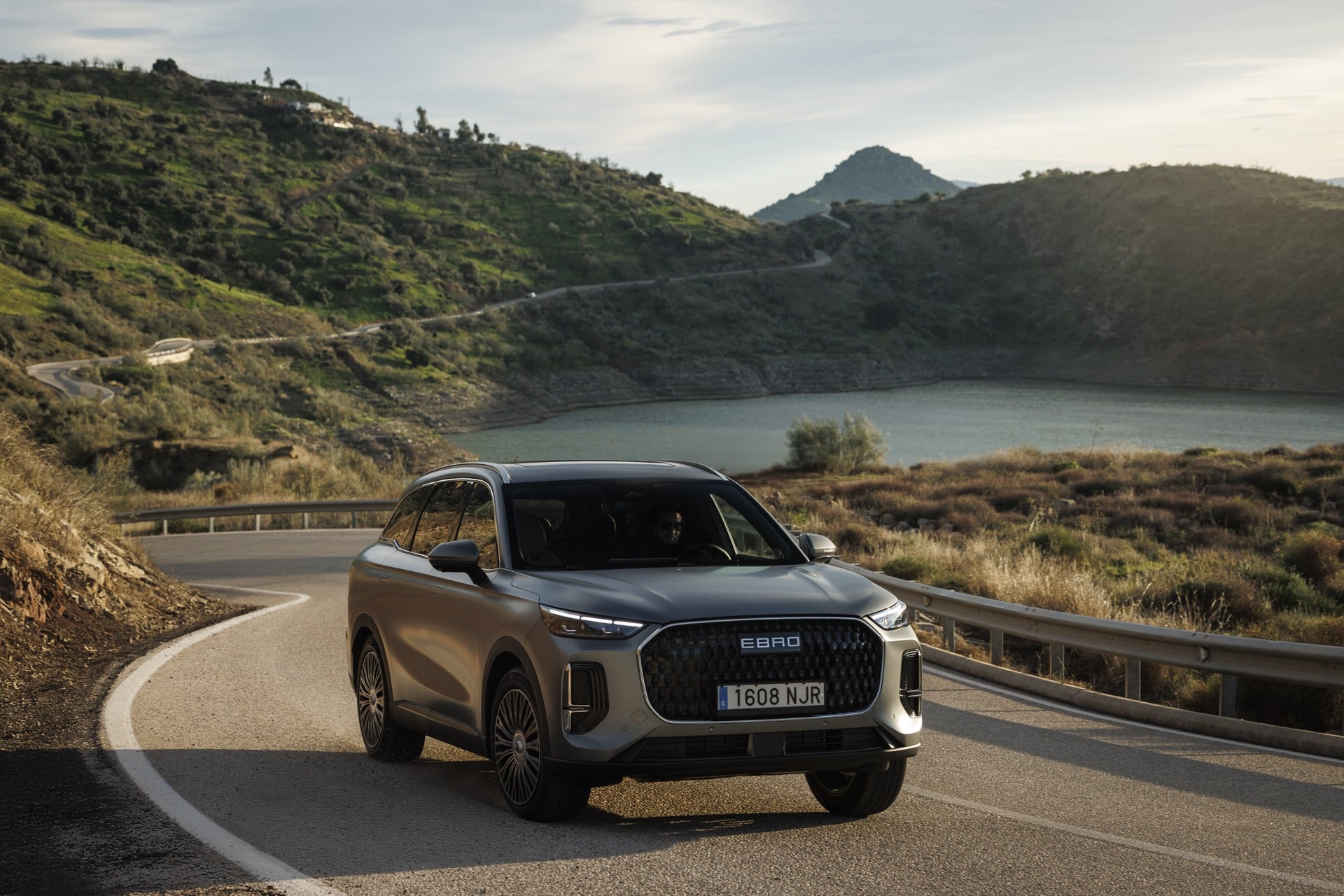
That said, before we get behind the wheel, it’s worth remembering what we have in our hands, in quick format:
-
Large 7-seat SUV, with a length (4.81 metres) that is deceptive: it is not much longer than an S800, the difference lies mostly in the width.
-
Plug-in hybrid system with four motors (one petrol and three electric) and a combined output of 425 CV.
-
Battery capable of a homologated range of up to around 140 km on 100% electric power.
-
Supports DC fast charging up to 71 kW.
- Very tight price for what it offers, closer to a well-equipped compact than to a large premium-style SUV. We’ll talk about that later, though.
On paper it sounds very good; the question is to find out how much of all this you notice when you touch it, look at it and drive it.
Design: very premium presence and plenty of stature
The first thing that wins you over with the Ebro S900 PHEV is its presence. It is one of those cars that, when you see it up close, especially with the matt paint exterior finish, looks more expensive than it is. That finish suits it beautifully and raises the feeling of a car from a mainstream brand by several points. And the reference to Audi is unavoidable, above all because of the front grille. If you took off the Ebro badge, large and clearly visible on the front, it’s easy for more than one person to think they are looking at an SUV from the German brand. The line is more conservative than that of an Omoda 9, its “cousin” and one of its most direct rivals, which opts for a more coupe-like style. But here the result works: it is robust, elegant and very “classic-premium”, in the best sense.

As I already mentioned, the initial impression is of a very large car. But in reality, if you compare it with the Ebro S800, it is not that much longer; what matters is the width, and you notice that when you see it fill the lane, not so much when parking: believe me, it manoeuvres much more easily than it looks. The 20-inch alloy wheels fitted as standard top off the car’s presence: they fill the wheel arch well and go with the muscle of the bodywork. It’s a shame that, for now, there are no other designs available apart from the spoked ones, because the car deserves a few more personalisation options beyond the colour of the bodywork.
At the back, a discreet spoiler and the light strip joining the tail lights add just the right technological touch without being excessive. It is a car that goes down very well with the eyes, especially if you like that sober, solid look that we associate with traditional premium brands.
Interior: quality you can see… and touch
The good impression continues when you open the door. The sound when closing it, the weight, the way everything fits together… are details that give you a lot of information in the first few seconds. And here the S900 immediately conveys the feeling of a very carefully crafted product. The materials have been chosen with very good taste, with surfaces that are pleasant to the touch, fit and finish that inspire confidence and a clean design that avoids cluttering the dashboard. The steering wheel has a very pleasant thickness and feel, it sits very naturally in the hands and, together with extremely comfortable seats, it fits that idea of a car that you want to use to cover many kilometres without getting tired. The impressive panoramic sunroof brings light and a sense of space, reinforcing that feeling of a bright, pleasant interior.
The upholstery, in genuine leather, is a pleasant surprise: the feel is frankly good and contributes to that premium atmosphere that the car chases from the very first minute. The large high-definition multimedia screen, which works very smoothly, serves as the command centre. It works well, responds quickly and integrates properly with the instrument cluster and the HUD, which provides useful information without overwhelming you. Details such as the seats with massage function, the HUD itself or the high-end Sony sound system (with 14 speakers, some in the headrests) make it clear that it’s serious stuff. You sit down, close the door and you could perfectly well be in an SUV from an established brand with years of track record in the segment.
If I have to put in a “but”, I miss a few more physical controls for basic functions, especially on the move. The screen centralises almost everything, and although it works very well, there are moments when a couple of dials or dedicated buttons (for climate control, for example) would make the experience even more complete. What can I say, there will be those who prefer everything uncluttered and relying on the screen or the voice assistant, which, by the way, works wonderfully. But I still prefer interacting with the car through physical controls, if they are well executed.
Space, comfort and boot: the family’s kingdom
Where the S900 proudly shows off is in roominess. In the front, driver and passenger travel with plenty of space for legs, shoulders and head, with seats that hold you well without being excessively firm. But it is from the second row onwards that you can see this car is designed for families who really use these seats. The rear bench slides, which lets you play with the space depending on whether you prioritise boot space or comfort for the occupants. The knee and head room is generous, and the seating position is comfortable even for tall people.
One of the most successful details is the access to the third row. On the side of the right-hand backrest of the second row there are electric controls that, when operated, move the seat automatically to make getting in easier. You don’t have to fight with levers or exert strange forces; you just press and the car itself “makes way”. It is a very convenient solution, especially if you are going to use those seats fairly often. The third row, within what can be asked of an SUV of this size, is among the roomiest in its category. That said, it’s best not to kid yourself: it is still not a place designed for two tall adults to make a long journey. For children or teenagers it’s perfect; for adults, better for short trips.
As for the boot, modularity rules. With all seven seats in use, the almost 150 litres of capacity let you carry some hand luggage or backpacks. With the third row folded down, the space grows a lot and we’re now talking about a very capable boot for family trips: 450 litres with five seats in use. If you also play with the sliding bench, you can find the balance between legroom and load volume. The general feeling is that the S900 offers plenty of space and plenty of everyday comfort, which in the end is what counts when you travel with five, six or seven people on board.
Behind the wheel: smoothness, silence and power to spare
We come to the important part: how this Ebro S900 PHEV drives. On paper, the figure of 425 CV of combined output, with a combustion engine supported by two electric motors (one for the front axle and another for the rear wheels; there is a fourth electric motor, which works as a generator), is impressive. In practice, the feeling is that this figure may be somewhat optimistic. It doesn’t convey the raw punch you would expect from a car with more than 400 CV “of the old school”. But don’t get me wrong: this doesn’t mean performance is lacking. Not at all. When you press the accelerator and demand thrust the car responds decisively, especially in Sport mode, and overtaking or joining a dual carriageway is a quick, stress-free matter. It is a car that moves with great ease, and you won’t feel that you need more horsepower.
The tuning and the way the powertrain works prioritise smoothness. The sound insulation is fantastic: in electric mode the silence is almost total, and when the combustion engine kicks in it does so in a well-filtered way, without noise or vibration. The transition between driving in EV mode and in hybrid mode is very well done; many times you have to look at the screen, if you have selected the mode that shows the corresponding graphic, to know exactly what the system is doing.
That said, the throttle response changes quite a lot depending on the mode. In Sport, personally I find it too “lively”: when coming out of a corner, if you don’t meter the throttle well, the car tends to push with more vigour than you might sometimes like, and it means you have to drive modulating your right foot very precisely so as not to go along in fits and starts. That’s why, in the end, you almost always use Normal or Eco mode, which already provide more than enough of everything you need in day-to-day driving, while keeping a more progressive and pleasant feel. In addition, you have specific modes such as Snow, Sand or Off-road, designed for particular situations of low grip or driving off the tarmac.
The suspension filters beautifully. Potholes, expansion joints or uneven surfaces are digested with an ease that fits the philosophy of a great family long-distance cruiser. Only when you raise the pace a lot on very twisty roads do you miss a steering that is a little more communicative and less filtered. It is not a car designed to attack corners; its natural territory is wide roads, dual carriageways and fast roads, where it feels in its element. The brake feel requires a bit more getting used to than in other PHEVs, especially at the beginning. The transition between regenerative and hydraulic braking is well resolved, but you notice that the pedal has its own personality. Even so, it doesn’t become annoying: within a few kilometres you get used to it and stop thinking about it.
Day to day: real-world efficiency and details that matter
Beyond performance and comfort, the S900 PHEV has some very interesting cards to play for daily use. The first is the ability to drive in electric mode. It has a homologated EV range of around 140 km, and in real conditions, without obsessing over it, it is relatively easy to exceed 100 km on battery alone if you manage the route well. You know the drill: anticipation and smoothness is the best way to get the most out of these cars. For many users, this means being able to do most daily journeys without using a drop of petrol. Another point in its favour is that it supports fast charging up to 71 kW on direct current. It is not a figure for a pure electric car, but for a PHEV it is a clear advantage: you can recover electric range quickly during a short stop, something very uncommon in this type of vehicle.
When you head out on the road and make combined use of the hybrid system, the consumption figures are very reasonable considering the size and weight of the car. On a real trip, at legal speeds and without obsessing over it, it is perfectly possible to get around 8 l/100 km once the electric part is depleted, which is a very good figure for a large, powerful SUV with seven seats.
There are also small details in use that remind you that this is a modern car designed with comfort in mind. One of the ones that stands out most is the way of “starting”: all you have to do is get in, fasten your seatbelt and select D. There’s no need to use the key at all, nor to press any button; the car wakes up and gets ready to go almost as if it were just another gadget in your day-to-day life. It is a simple gesture, but it reinforces that feeling of a well-thought-out product. Ebro uses this system in other cars in its range.
Conclusions of the first drive
Pending a more in-depth test with more kilometres in all kinds of scenarios, the feeling this Ebro S900 PHEV leaves is that of a very convincing car. The interior conveys great perceived quality, the driving position is comfortable and easy to understand, and despite its size, it is easy to handle and to place in town or in car parks thanks to the driver aids and good visibility.
On the road it is comfortable, very quiet and especially pleasant on wide roads, where it combines smoothness, composure and a power reserve that is more than sufficient. And, above all, it offers a combination that is very hard to find: seven usable seats, plenty of electric range, good efficiency and a price that, considering everything it includes, feels very competitive.
And it’s time to talk about price. The Ebro S900 PHEV, available only in Luxury trim with everything you could put on a standard-equipment list -except the matt paint- costs 46,990 euros including promotional discounts and financing the purchase, not including possible grants for the purchase of electric and plug-in hybrid cars. And here, I’d like to make several points.
The first: there is no other SUV on the market with a comparable price-to-product ratio… except the Omoda 9 SHS, which is very close on the S900 PHEV’s heels, sharing its platform and powertrain, although not its approach, as the Omoda has a more “daring” design and five seats instead of seven.
The second: if you are looking for a 7-seat SUV and have ended up looking at Ebro’s catalogue and thinking about the S800 PHEV, watch out for the S900. The price difference is trivial for everything extra the S900 offers, and the size shouldn’t scare you: I’ve already said, and I repeat, that on the move the S900 doesn’t feel any less agile or manoeuvrable than the S800. At current prices, without a doubt, the “enemy number 1” of the Ebro S800 is in its own house.
And thirdly, I should mention some alternatives among large 7-seat plug-in hybrid SUVs, among which we have the Mazda CX-80 PHEV, which starts from around 58,500 euros; the Hyundai Santa Fe PHEV, available from almost 61,000 euros; or the Volvo XC90 T8, which goes all the way up to 91,000 euros.

 Kia offers an electric range of 10 models, 50 versions and 400 possible combinations
 The seven finalists for the 2027 European Car of the Year (COTY) are exclusively electric
 Peugeot E-208 GTi: a battery-powered toy that revives the spirit of the 1980s sports cars