Ford Escort RS Cosworth, one of the greatest sports compacts in history
 Mónica Redondo @MonicaRedondoD
18 February 2021
4 min.
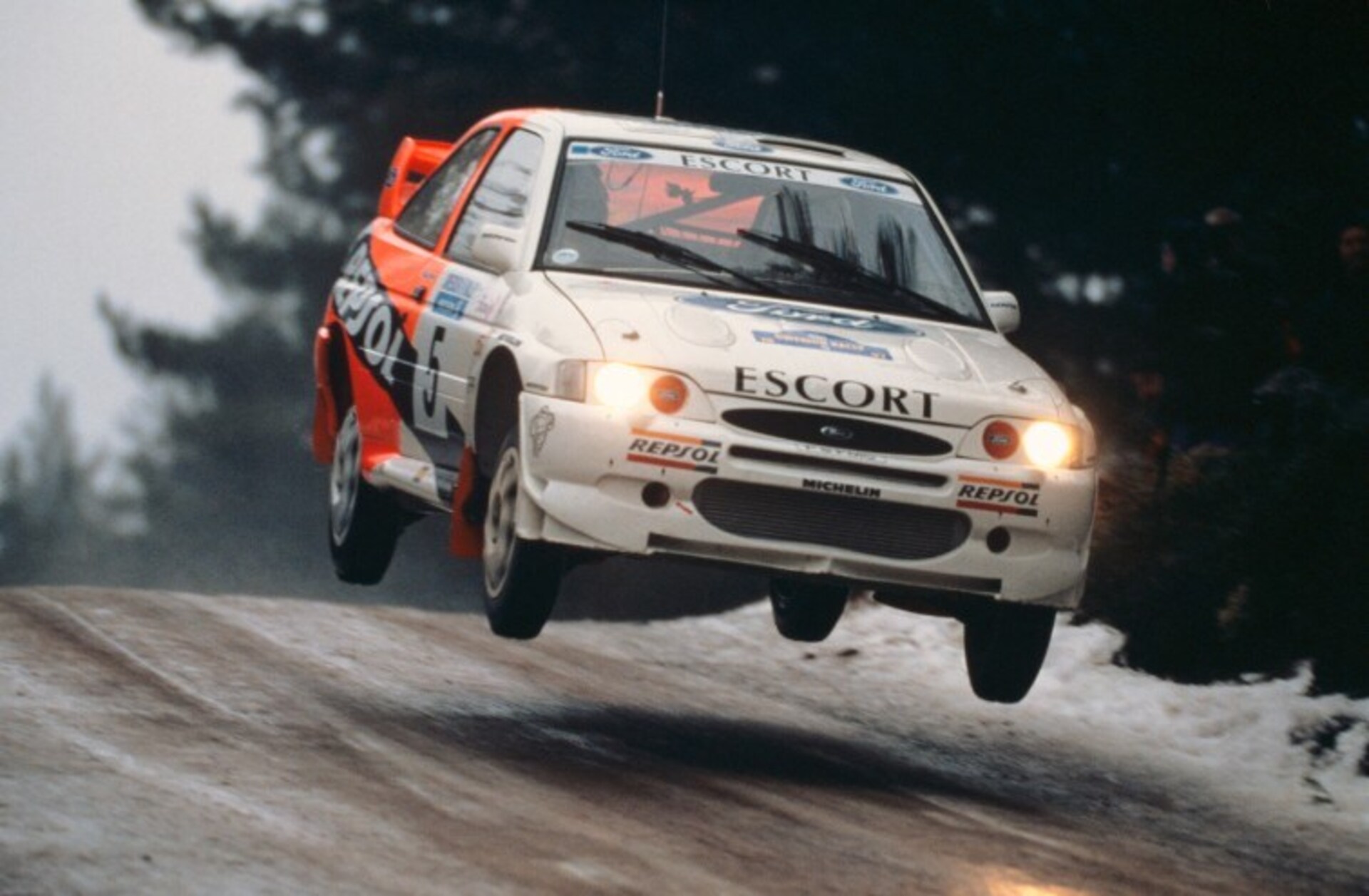
The Ford Escort RS Cosworth has become one of the greatest sports compacts in automotive history. Shall we look at some of its secrets?
The Ford Escort RS Cosworth was born in 1992 and very soon became one of the most legendary competition cars of the oval-badged brand, and it is also one of its most sought-after models on the market. It was built between February 1992 and January 1996.
The oval-badged brand began working years earlier on what we now know as the Ford Escort RS Cosworth, but it was not until 1992 that Karmann began assembling this legendary car, since it could not be produced alongside the rest of the Escort range. In 1993 it was homologated for Group A. A unique car had been born, the kind that turns heads whenever you see it pass by. The Ford Escort RS Cosworth was based on the shortened platform of the Ford Sierra RS500 Cosworth.
Ford Escort RS Cosworth, a jewel worthy of admiration
Over the four years the model was available, 7,145 units were sold. It was powered by a Cosworth YBT block, a 2.0-litre four-cylinder with Weber Marelli electronic injection, a V-shaped 45º cylinder head with four valves per cylinder, overboost, air-to-air intercooler, a compression ratio of 8 to 1, and a Garrett T35 turbo whose diameter was 70 mm larger than the one fitted to the Ford Sierra. This gained 7 CV of power. This sports compact delivered 227 CV at 6,250 rpm and a maximum torque of 298 Nm at 3,500 rpm. Its top speed was 230 km/h without the iconic three-piece spoiler. With the spoiler fitted, the top speed was 225 km/h. This impressive spoiler served a clear purpose: the Ford Escort RS Cosworth became the first production car with negative lift coefficients on both axles.
The powertrain was linked to a five-speed manual gearbox that sent power to all four wheels thanks to a central and rear viscous-coupling differential, with a torque split of 34% to the front axle and 66% to the rear. The suspension layouts were typical of rear-wheel drive, and it featured independent suspension of the MacPherson type with internal torsion arms at the front and a trailing arm with an oblique axle at the rear. The novelties don’t end there: the Escort RS also came with gas-filled dampers, anti-roll bars on both axles, and ventilated discs measuring 278 mm at the front and 273 mm at the rear. The whole package weighed 1,230 kg. The price of the Ford Escort RS Cosworth in 1992 was 4,125,000 pesetas.
The interior contrasted with the exterior design, as it was identical to that of the standard Escort. The only differences between the models were the seats, the pedals, and the gauges for turbo pressure, oil pressure, and battery voltage. Interior space was somewhat more limited than in a standard Escort, due to the four-wheel-drive system and the spare wheel. In Spain, the Ford Escort RS Cosworth was sold in two trim levels: Motorsport and Luxury. The first trim was fairly scarce and only came with power steering and ABS, while the second featured air conditioning, electric windows, airbags, and a CD radio.
As for the design, the Ford Escort RS Cosworth stood out thanks to its specific bumpers, with an adjustable front splitter, widened wheel arches, and of course the spoiler, along with 16-inch alloy wheels fitted with 225/45 R16 tyres.
In 1994, Ford introduced some improvements to both the mechanics and the styling. The spoiler was reduced in size, the drag coefficient dropped to 0.34, and it received the new Garrett T25 turbo, which was smaller and had 60% less rotor inertia. Power was reduced to 220 CV and torque to 290 Nm. The cylinder head was also redesigned and the electronics were readapted, while a coil per spark plug was introduced. In addition, the chassis was reinforced, adding 40 kg to the bodyshell. This second version was available until 1996, the year in which Carlos Sainz took part in the World Rally Championship in Group A. In 1997 and 1998, Sainz also raced in the WRC even though the model did not meet the production requirements of 20 units during the season or 25,000 units built.
Putting all these ingredients together, we get a road-legal rally car, which is why it has become a highly sought-after sports compact.


 Peugeot E-208 GTi: a battery-powered toy that revives the spirit of the 1980s sports cars
 New Lexus ES: luxury grows and goes electric
 First contact with the Dacia Sandero Hybrid 155: power and efficiency from €19,890
Deja un comentario