Geely Starray Hybrid Cars Tests SUV
Geely Starray EM-i test drive: Madrid to Cuenca in a plug-in hybrid SUV that impresses with space, efficiency and handling
 Óscar Sanz
30 July 2026
10 min.
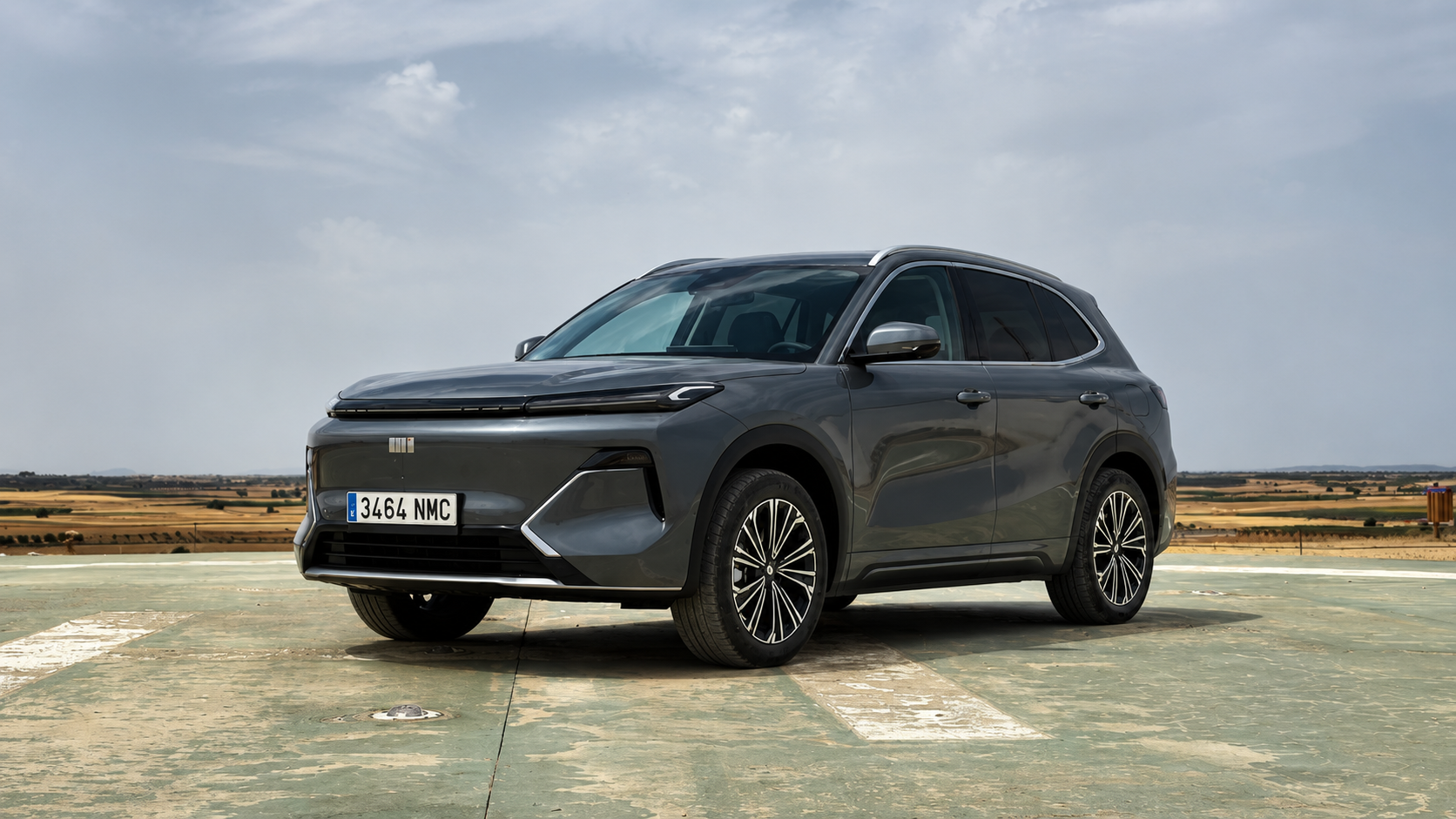
We tested the new Geely Starray EM-i on a route between Madrid and Villamayor de Santiago to find out whether this plug-in hybrid SUV is as complete as it promises to be
The new Geely Starray EM-i is presented as a plug-in hybrid SUV aimed at those who want space, range and technology without giving up an enjoyable drive. To check how far it lives up to that promise, we made a round trip between Madrid and Villamayor de Santiago, in the province of Cuenca, combining urban traffic, motorway and secondary roads.
In the heart of the Mancha conquense, the destination of the route lies in a territory inevitably associated with the landscape and imagery of Don Quixote. Its history is closely tied to the Order of Santiago, of which it was an important town, as its manor houses, religious buildings and the historic layout of its streets still show, surrounded by cereal fields, vineyards and wide La Mancha horizons.
The route allowed us to analyse the Starray EM-i in a varied enough setting to assess both the efficiency of its hybrid system and the comfort, noise insulation and behaviour of the chassis. The overall balance was positive, especially thanks to a dynamic setup more refined than one might initially expect from a family SUV of this size.
A 4.74-metre SUV with a solid presence
The Geely Starray EM-i measures 4,740 mm in length, 1,905 mm in width and 1,685 mm in height, with a wheelbase of 2,755 mm. These dimensions place it at the upper end of the C-SUV segment and account for much of the room available inside.
Its exterior design favours clean surfaces, balanced proportions and an almost closed front end, visually closer to an electric car than to a conventional hybrid, conveying a modern and technological image.
The bodywork has also been developed with function in mind. The Starray EM-i claims a drag coefficient of 0.288, achieved after more than 2,000 computer simulations and 150 hours of wind tunnel work. Geely notes that the design incorporates up to 62 measures aimed at optimising airflow, reducing consumption and improving acoustic comfort.
Among its most recognisable features are the front light units with 264 LED diodes, capable of projecting the beam more than 180 metres, and the rear lights formed by 368 LEDs. The result is a carefully finished vehicle with a presence in keeping with the technological positioning Geely wants to project in Europe.
A spacious, technological and well-used interior
The cabin is one of the most convincing aspects of the Starray EM-i. The overall sensation is of spaciousness, especially in the rear seats, where the completely flat floor allows three occupants to travel more comfortably.
Geely quotes 125 mm of knee room, a rear interior height of 1.2 metres and a width of 1,449 mm at shoulder height. Beyond the figures, the test highlighted the space available for both legs and heads, as well as good accessibility thanks to the wide opening angle of the doors.
Perceived quality is also satisfactory. There are soft-touch surfaces in the most visible areas, the fittings feel solid and the horizontal design of the dashboard helps visually widen the cabin. The seats offer comfortable padding and adequate support for travelling, although their set-up is clearly geared towards comfort rather than sporty driving.
The 15.4-inch central screen dominates the dashboard. It has a 2.5K resolution and brings together infotainment, climate control, navigation and vehicle settings. It is complemented by a 10.2-inch digital instrument cluster and, on the MAX+ trim, a 13.8-inch head-up display projected onto the windscreen.
The Flyme Auto system offers a well-designed graphic presentation and generally smooth operation. It also features Apple CarPlay, Android Auto, 4G connectivity, Wi-Fi, over-the-air remote updates and voice control via the “Hi Geely” command.
There are also two comfort features that particularly surprised us. The first is the premium Flyme Sound audio system, with 16 speakers and 1,000 watts of power. Its performance is clearly above the norm for this segment, with a wide soundstage, punchy bass and good definition even at high volume. In our experience, it delivers a far more convincing result than the Sony systems fitted to some models from brands linked to the Group, both in clarity and sound power.
The second great discovery was the front seats of the MAX+ trim, equipped with ventilation, memory and massage function. This is not a token feature: the intensity, pressure and range of movements make it one of the best massage systems we have tested in a car. It may be surprising, but its operation is on a par with the best systems we have found in some Stellantis Group models, which until now were among our main references in this area.
The boot offers 528 litres, a competitive figure for a plug-in hybrid SUV in its class, and can be expanded to 2,065 litres by folding down the rear seatbacks. It also has 100 litres of storage under the floor, a particularly useful solution for keeping charging cables out of the main space. The tailgate opening measures 1,122 mm wide and the loading lip sits 761 mm from the ground, making it easier to load bulky items.
In addition, there are more than 30 storage spaces spread throughout the cabin. The overall package clearly points to a family orientation, not only because of its total volume but also because of the usable shape of the boot and the absence of elements that hinder the stowing of luggage.
A 262 CV plug-in hybrid system
The Geely Starray EM-i uses the EM-i Super Hybrid powertrain, consisting of a 1.5-litre naturally aspirated four-cylinder petrol engine, a dedicated hybrid transmission and a synchronous electric motor with permanent magnets.
The combustion engine delivers 100 CV and 125 Nm, while the electric motor provides 218 CV and 262 Nm. Combined maximum power reaches 262 CV, transmitted exclusively to the front axle.
The vehicle starts simply by engaging the gear selector. By default, the system activates Hybrid mode, which automatically manages the contribution of the electric motor and the petrol engine according to available charge, power demand and driving conditions.
There is also an EV mode, designed to drive exclusively on electricity as long as sufficient energy remains in the battery, and a Power mode, which combines both motors for maximum response. The latter makes the most of the system’s 262 CV and provides strong acceleration when overtaking or pulling away quickly.
The range features two LFP batteries. The PRO version uses an 18.4 kWh unit, while the PRO+ and MAX+ trims use a 29.8 kWh battery. The first is homologated for 83 km of combined electric range and 112 km in the urban cycle; the second reaches 136 km combined and up to 184 km in the city.
Total homologated range is 1,002 km with the smaller battery and 1,055 km with the larger capacity unit. AC charging accepts up to 6.6 kW, while DC fast charging reaches 30 or 60 kW, depending on the battery. In the 29.8 kWh version, Geely quotes a recharge from 30 to 80% in 16 minutes.
Performance is sufficient for a family-oriented vehicle. It accelerates from 0 to 100 km/h in 8 seconds with the smaller battery and in 8.2 seconds with the larger one, while top speed is limited to 170 km/h.
Better dynamic behaviour than expected
The dynamic side was one of the main surprises of the test. Despite its dimensions and a kerb weight of between 1,730 and 1,815 kg, the Starray EM-i moves with ease and conveys a greater sense of control than expected.
The suspension strikes a good balance between comfort and body control. It absorbs road irregularities well, yet prevents excessive body roll on secondary roads. The independent four-link rear suspension helps the rear axle respond progressively and maintain good stability through prolonged bends.
Geely notes that the chassis set-up was carried out together with the engineering teams of Lotus at its test centre in Frankfurt. During our test, this work was especially noticeable in the precision with which the car holds its line and the naturalness of its reactions. It is not a sports SUV, but it allows brisk progress without feeling clumsy or causing uncomfortable body movements.
The electric steering allows its level of assistance to be adjusted between Comfort, Standard and Sport settings. It can also be linked automatically to the driving mode, so that firmness increases when a sportier configuration is selected. The change does not completely transform the feel, but it does allow steering effort to be tailored to the driver’s preferences.
In Hybrid mode, the response is smooth and progressive. The electric motor takes on much of the work and provides immediate pull from a standstill. The combustion engine usually joins in without abruptness, and the system decides wisely when to use each power source.
Power mode clearly changes the car’s character. Throttle response becomes more immediate and acceleration is rapid, although it is precisely in these situations that one of its main weaknesses appears.
At the end of the Madrid to Villamayor de Santiago route, the on-board computer recorded consumption of 5.1 kWh/100 km of electricity and 4.6 l/100 km of petrol. These figures were obtained in real-world use, combining different types of road and without a driving style specifically aimed at minimising consumption.
The Geely Starray EM-i is available from €25,215 in its PRO version, a price that includes commercial campaigns, financing and the advance of the Plan Auto+ scheme. At the other end of the range, the most complete trim, MAX+, starts from €31,215, incorporating virtually premium-segment equipment. With this price range, Geely’s plug-in hybrid SUV positions itself as one of the most competitive options in its category, combining 262 CV, up to 1,055 kilometres of combined range, a high level of technology and one of the most attractive equipment-to-price ratios on the market.
TECHNICAL SPECIFICATIONS
| PRO | PRO+ | MAX+ | |||
| DIMENSIONS AND WEIGHT | |||||
| Length / Width / Height (mm) | 4,740 / 1,905 / 1,685 | ||||
| Wheelbase (mm) | 2,755 | ||||
| Front/rear overhangs (mm) | 968 / 1,017 | ||||
| Number of seats | 5 | ||||
| Boot capacity (l) | 528 / 2,065 | ||||
| Fuel tank capacity (l) | 51 | ||||
| Kerb weight (kg) | 1,730 | 1,815 | 1,815 | ||
| POWERTRAIN | |||||
| Powertrain type / drive | Plug-in hybrid (PHEV) / Front-wheel drive | ||||
| Combustion engine | 4-cylinder petrol, 1.5 litres | ||||
| Maximum combustion engine power (kW/CV) | 73 / 100 | ||||
| Maximum combustion engine torque (Nm) | 125 | ||||
| Emissions standard | Euro 6e | ||||
| Electric motor type | Synchronous with permanent magnets | ||||
| Maximum electric motor power (kW/CV) | 160 / 218 | ||||
| Maximum electric motor torque (Nm) | 262 | ||||
| Maximum combined system power (kW/CV) | 192 / 262 | ||||
| BATTERY AND CHARGING | |||||
| Battery capacity (kWh) | 18.4 | 29.8 | |||
| Battery type | Lithium-ion (LFP) | ||||
| Maximum AC charging power (kW) | 6.6 | ||||
| AC charging time – SOC 25% – 100% (h)* | 3 | 4.6 | |||
| Maximum DC fast charging power (kW) | 30 | 60 | |||
| DC fast charging time – SOC 30% – 80% (min)* | 20 | 16 | |||
| PERFORMANCE AND RANGE | |||||
| WLTP CO2 emissions, combined cycle (g/km) | 54 | 32 | |||
| WLTP range, combined cycle (km) | 1,002 | 1,055 | |||
| WLTP fuel consumption, combined cycle (l/100 km) | 6.2 | ||||
| WLTP weighted fuel consumption (l/100 km) | 2.4 | 1.4 | |||
| WLTP electric range, combined cycle (km) | 83 | 136 | |||
| WLTP electric consumption, combined cycle (l/100 km) | 20.9 | 21.9 | |||
| WLTP electric range, urban cycle (l/100 km) | 112 | 184 | |||
| WLTP electric consumption, urban cycle (kWh/100 km) | 14.6 | 15.4 | |||
| Top speed (km/h) | 170 | ||||
| 0-100 km/h acceleration (s) | 8 | 8.2 | |||
Technical specifications of this car


 Peugeot E-208 GTi: a battery-powered toy that revives the spirit of the 1980s sports cars
 New Lexus ES: luxury grows and goes electric
 First contact with the Dacia Sandero Hybrid 155: power and efficiency from €19,890
Deja un comentario