Hyundai Staria Electric: up to nine seats and 430 km of range for travelling in style
 Antonio Roncero @roncero_antonio
29 October 2026
9 min.
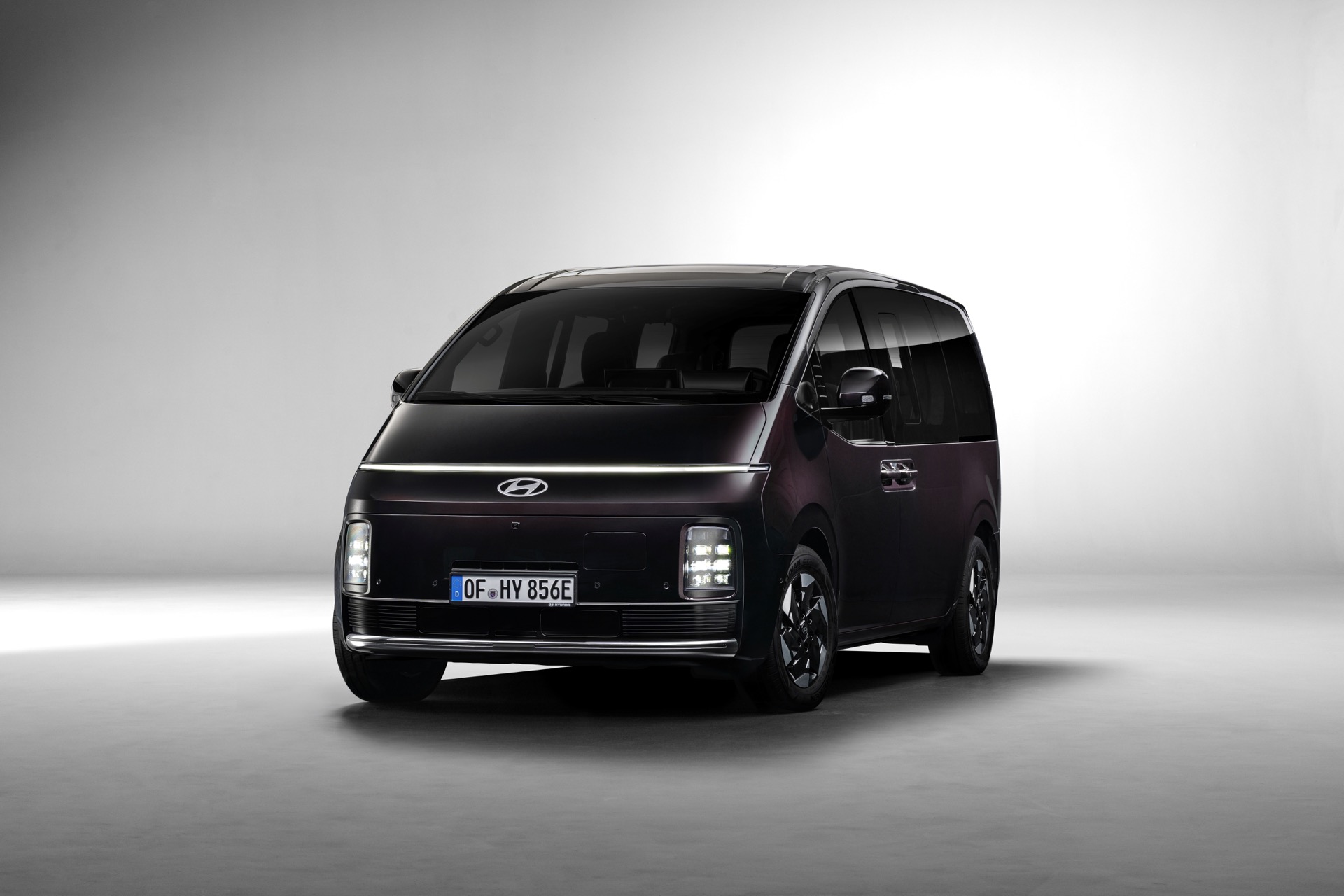
The Hyundai Staria features an electric version with 218 CV, an 84 kWh battery and fast charging in about 20 minutes. Its proposition combines space for seven or nine occupants with equipment designed to look after all passengers.
Travelling with more than five people and carrying everyone’s luggage remains one of the best reasons to choose a large MPV. The Hyundai Staria Electric takes that formula into zero-local-emissions mobility with arguments that go beyond swapping a combustion engine for an electric one: it offers up to nine seats, an 84 kWh battery and an 800-volt architecture that allows recovering 10 to 80 % of the charge in roughly 20 minutes.
By size and approach, it is aimed both at families who need a lot of space and at passenger transport services, hotels or leisure activity companies. And, with its 5.25-metre body, it sits among the large electric vehicles for group travel, where the seats available matter as much as comfort, boot space and the time spent on recharging.
The electric version thus extends the family that was introduced with the 2.2 CRDi diesel engine, which was succeeded by the interesting Staria hybrid, combining a 1.6 T-GDi petrol engine with an electric motor and a six-speed automatic transmission; its battery recharges while driving and does not require a plug connection. It is the alternative for those who need this format and prefer to keep conventional refuelling.
The Staria Electric fits especially well when regular charging is available and journeys can be organised around it. For example, in daily family trips, shuttle services or predictable professional routes, without ruling out long journeys thanks to fast charging. The new electric offer also includes a Van version for goods, although the passenger proposal has its own identity thanks to its configurations and comfort equipment.
A different design that also makes sense inside
The Staria keeps the silhouette that sets it apart from more conventional passenger vans. The short front end, the raked windscreen and the continuous line from bonnet to roof shape a body with a futuristic look. The electric version reinforces that image with a closed front and a continuous horizontal light bar.
But much of its personality has a practical explanation.
The low waistline and the large glazed surfaces allow a bright cabin and good outward visibility, something passengers in the last rows also appreciate. The two sliding side doors ease access in car parks where a conventional door would need more room to open.
The 17-inch wheels also respond to a functional criterion: in a vehicle of this kind it makes sense to prioritise comfort, efficiency and load capacity. That said, their dimensions mean checking the space available in the garage and the height limits of usual car parks.
Seven or nine seats: two ways of using the space
The passenger offer includes
seven- and nine-seat configurations, with different approaches. The nine-seat version seeks to make the most of transport capacity; the seven-seat one gives more prominence to individual comfort. Three trims are offered, Select, Trend and Prime for the nine-seater, while the VIP and Lux versions are reserved for the seven-seat configuration. Therefore, the step between versions affects both equipment and the way the cabin is understood.
In the seven-seat variants, the second-row seats feature a reclining function, and the equipment includes Nappa leather upholstery, heating and ventilation on the front and second-row seats. It is a configuration that can suit a family that travels often, but also a transport service that wants to offer something more than space.
The nine-seater, for its part, is especially interesting for large families and group travel. Hyundai quotes for this configuration up to 1,303 litres of boot space behind the third row, with the volume available conditioned by the position of the seats. These slide, allowing the space to be shared between occupants and their bags. The ability to carry people with their luggage is one of the central arguments of the Staria: when all seats are in use, the boot becomes as important as seat room.
218 CV motor and up to 430 km of range
The propulsion system combines an
electric motor of 160 kW — 218 CV — and 350 Nm with front-wheel drive and an 84 kWh lithium-ion battery. The data sheet quotes 0 to 100 km/h in 9.5 seconds for the passenger version and a top speed of 184 km/h. These performance figures are sufficient for the intended use, although its main appeal lies in the qualities electric propulsion brings to passenger transport: no gear changes and operation without the noise and vibration typical of a combustion engine. To this is added an independent multi-link rear suspension.
The quoted range reaches 430 kilometres on the WLTP combined cycle, subject to the final specification and homologation of each version. The data sheet also lists up to 578 kilometres in the urban cycle, an environment that favours recovering energy during deceleration. These figures should be put in context: motorway driving with all seats occupied, luggage and air conditioning requires more energy than urban driving. To assess its suitability for frequent journeys, both the range under those conditions and the charging options along the route must be considered.
The 800-volt charging, one of its best arguments
In a vehicle designed to carry several people, reducing stops has a special value. Here one of the most interesting features of the Staria Electric appears: its
800-volt architecture. Hyundai quotes charging from 10 to 80 % in about 20 minutes, under suitable conditions and when connected to a compatible high-power point. The data sheet uses a 350 kW charger as the reference for that time; this does not mean the vehicle constantly draws that power.
The difference depending on the point used is considerable: at a 50 kW station, the same 10 to 80 % interval requires about 81 minutes. Therefore, to make the most of its capabilities on a long journey, it is worth choosing stops carefully. For regular charging it has an 11 kW on-board AC charger, with a quoted time of 7 hours and 35 minutes to go from 10 to 100 %. An adequate solution for recovering the battery overnight at home or at a company’s base.
In addition, the equipment includes heat pump and battery heating system as standard across all trims. These are two relevant elements in an electric vehicle with such a spacious cabin, especially when temperatures drop.
Technology useful for both drivers and those travelling behind
The driver’s position features
two 12.3-inch screens
, one for the instrumentation and another for the multimedia system. Hyundai keeps physical controls for frequently used functions, a sound decision for handling air conditioning and other everyday settings with ease. Connectivity includes wireless Apple CarPlay and Android Auto, Bluelink services and remote software updates. But some of the most interesting solutions relate to the use of the rear seats.
The VIP and Lux versions incorporate a camera and microphone for the rear area. The system allows passengers to be viewed on the central screen and amplifies the driver’s voice through the rear speakers. In a cabin of this size, being able to speak to those in the last row without raising your voice is clearly useful. From the Trend trim onwards, the equipment includes hands-free automatic opening of the tailgate and side doors. Higher levels add elements such as the Bose sound system or the digital key, depending on the version.
It also has a V2L function to power electrical devices, with an adapter included in the Prime, VIP and Lux trims. It can be used to connect leisure equipment, a laptop or small appliances during an outing. Added to this is a towing capacity of up to 2,000 kg with brakes, which extends its possibilities for carrying sports or leisure equipment.
For safety, the equipment includes automatic emergency braking with detection of vehicles, pedestrians and cyclists, adaptive cruise control with Stop & Go function, lane-keeping assistance and blind-spot monitoring with rear traffic alert. The higher trims add a 360-degree camera and a highway driving assistant.
Its alternatives: Volkswagen ID. Buzz, Mercedes EQV and Peugeot E-Traveller
The Staria Electric enters a market with several high-capacity proposals, although each puts the emphasis on different aspects.
The
Volkswagen ID. Buzz
is an especially attractive alternative for those seeking a family electric vehicle with distinctive design and up to seven seats. Its range offers different configurations, including the long-wheelbase body. The Staria extends the choice to nine occupants, a decisive difference for certain users.
The
- Mercedes-Benz EQV
- is another reference for those who prioritise comfort and the cabin configuration possibilities. Available with up to eight seats, it offers different seat combinations and a clear orientation toward family and professional passenger transport. The more fully equipped seven-seat versions of the Hyundai point to a similar type of use.
For its part, the Peugeot E-Traveller offers different lengths and configurations of up to nine seats, with a quoted range of up to 348 kilometres WLTP depending on the version. Compared with it, the Hyundai presents two relevant arguments on paper: the up to 430 kilometres quoted and its 800-volt charging system.
Pending the official price, the Staria Electric’s proposition is convincing:
- . For those who frequently need to carry more than five people, these are considerably more important features than a high power figure or large wheels.
Hyundai Staria Electric – Image gallery
plenty of space, a choice between capacity and comfort, and charging technology that can make journeys easier
 Kia offers an electric range of 10 models, 50 versions and 400 possible combinations
 The seven finalists for the 2027 European Car of the Year (COTY) are exclusively electric
 Peugeot E-208 GTi: a battery-powered toy that revives the spirit of the 1980s sports cars
Deja un comentario