RAV4 Toyota Hybrid Cars Tests SUV
Review and opinion: Toyota Rav4 Hybrid Adventure, a family SUV that is very "crossover"
 Antonio Roncero @roncero_antonio
23 June 2023
9 min.
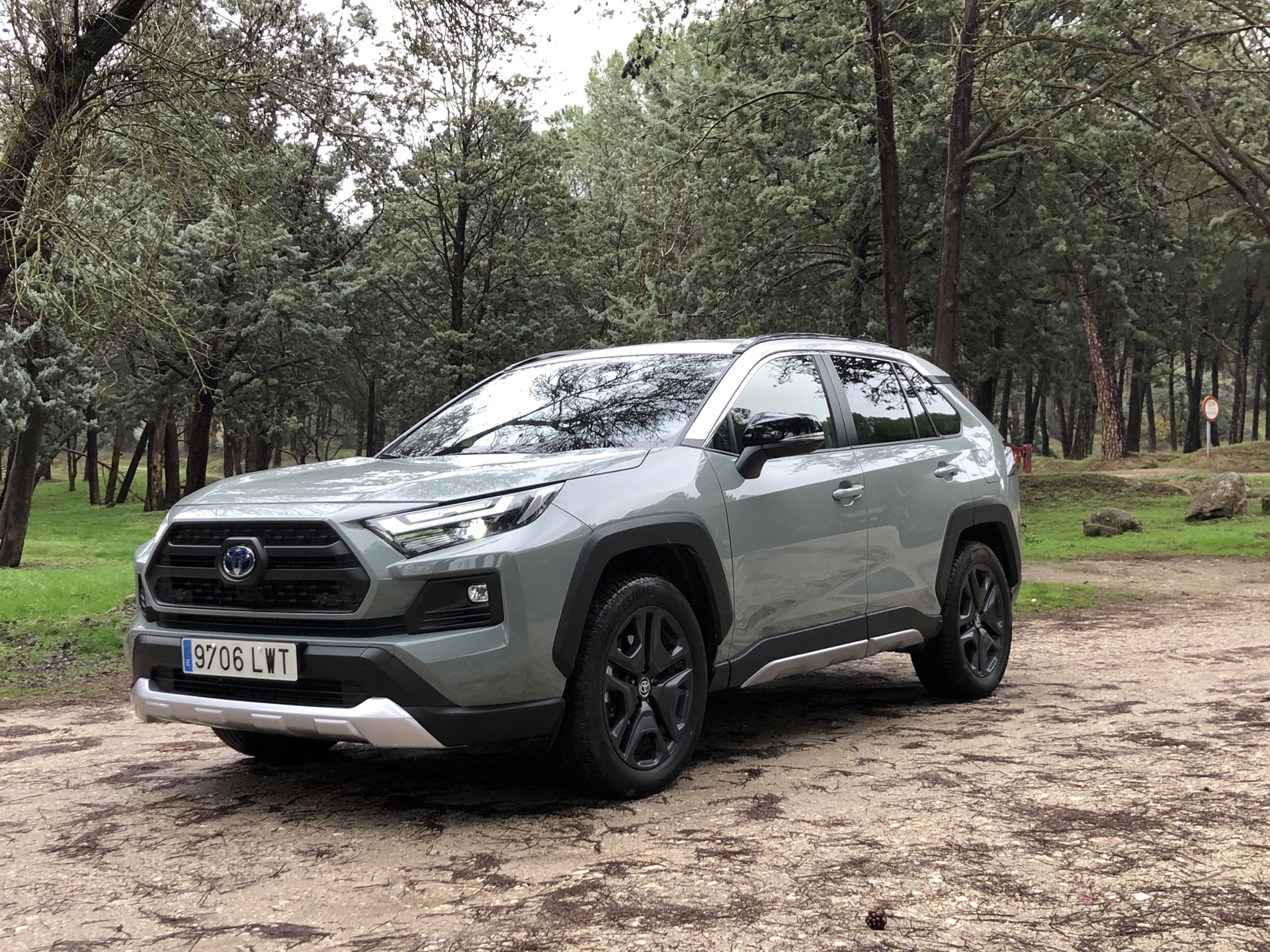
The Adventure version of the Toyota Rav4 combines some magnificent qualities for use as a family vehicle and adds a plus when leaving the asphalt thanks to all-wheel drive and its greater ground clearance.
Toyota is following a very sound strategy to keep the fifth generation of the Rav4, which reached the market at the end of 2018, up to date. To do so, it has carried out several updates, the main ones for the multimedia system and other equipment details. In addition, interesting versions were added to the range, such as the Adventure trim, aimed at those looking for a more “rugged” look; or, more recently, the GR Sport, the sportiest trim.
On this occasion we are going to focus on the Rav4 Adventure, a trim that fits the philosophy of an SUV like the Rav-4 much better than the GR Sport. Both have the same price: 50,800 euros. That is also the same price as the Luxury trim if we choose 4×4 transmission.
When talking about prices and comparing trim levels, it is important to highlight the transmission, because the Rav4 Adventure and the GR Sport are only offered with 4×4 traction. For now, keep in mind that on versions where you can choose between 4×2 and 4×4, such as the aforementioned Luxury, the premium is 2,000 euros.
These are the prices of the current Rav4 range, according to the brand’s configurator:
- Rav4 Advance 220H 4×2: 40,500 euros
- Rav4 Style 220H 4×2: 44,150 euros
- Rav4 Luxury 220H 4×2: 48,800 euros
- Rav4 Adventure Plus 220H 4×4: 50,800 euros
- Rav4 GR Sport 220H 4×4: 50,800 euros
Among its possible rivals we find hybrid-powered SUVs for all tastes. On price, one alternative is the Ford Kuga HEV, without losing sight of the Kia Sportage HEV, the Hyundai Tucson HEV or the new Renault Austral. If you are looking for an SUV of this type for family use, I would highlight the Honda CR-V. Meanwhile, sharing technology with the Toyota but with a touch more sophistication, which is also noticeable in its higher price, we have the Lexus NX.
What does the Toyota Rav4 Adventure include?
In addition to the aforementioned standard all-wheel drive, the Toyota Rav4 Adventure stands out mainly for design elements that give it a more robust and rugged look. It features a specific grille and headlights, as well as a lower protector, 19-inch alloy wheels in satin black and orange detailing on the upholstery. On the other hand, the suspension is raised to gain 10 mm of ground clearance, and the interior adds attractive orange touches to the upholstery.
Initially, the Rav4 Adventure had a lower starting price and allowed you to choose an optional package called Adventure Plus, which includes the premium JBL sound system, the panoramic roof and the GO navigation system. Currently, Toyota only sells the Adventure Plus version, which includes these elements as standard, in addition to the two-tone Urban Khaki paint, with no possibility of choosing other colours.
Other standard equipment includes keyless entry and start, the rear tailgate with automatic opening, parking sensors, the rear camera, synthetic leather upholstery, intelligent adaptive cruise control, LED headlights, dual-zone climate control, electric heated front seats, the multimedia system compatible with Apple CarPlay and Android Auto, and the comprehensive Toyota Safety Sense safety package.
Notable options include side steps (745 euros), roof crossbars (235 euros), various systems to organise cargo in the boot or to transport pets, and even a small cool box.
The interior of the Toyota Rav4
Spaciousness and quality are the two defining characteristics of the Rav4’s interior. Not surprising: we are dealing with a large car – 4.6 metres long – and with a price that exceeds 50,000 euros.
The seats are, to a large extent, responsible for the good driving position. Not only do they look magnificent, but they also hold the body well and ensure that the kilometres do not take their toll. I found them very comfortable. I also like the sense of quality conveyed by the materials and their fit on the dashboard, centre console and door panels, with many elements upholstered in the same synthetic leather used for the seats.
The touchscreen of the multimedia system is not very large – 8 inches – compared with the new trends we are starting to see, especially in electric cars. Nor does it stand out for its resolution or fluidity. On the plus side, its elevated position makes it easy to view, and some independent controls make it easier to operate. There is also a group of independent controls for the climate control, with large rotary knobs that are much more comfortable to use than having to resort to the touchscreen. By the way, the climate control works wonderfully.
The rear seats are very good in terms of space and comfort. And that is despite the Rav4 not having a longitudinal adjustment system moving the bench, which is fixed. Even so, there is plenty of legroom, a magnificent amount of width and height, and the seatbacks can be reclined slightly for more comfortable travel. Furthermore, as the small battery that powers the electric motors (or stores the energy recovered during braking or deceleration) sits between the seats and the rear axle, the floor is not raised, which favours foot placement in relation to the height of the bench.
The boot offers 580 litres of capacity, in line with the best among SUVs of its size. And it has very regular shapes, with wheel arches that do not intrude too much. Its strong points include the ease of loading luggage thanks to the large tailgate and a low loading edge, as well as a retractable parcel shelf that does its job well. On the downside, there is little versatility for securing cargo unless you opt for the accessories, the lighting is somewhat poor, and the electrically operated tailgate is very slow.
The hybrid system of the Toyota Rav4
In its latest technical update, the Rav4’s hybrid system received significant improvements to gain power and improve consumption, with a new petrol engine, lighter electric motors and new control software for the hybrid system.
The 220H front-wheel-drive versions use two motors: a 2.5-litre naturally aspirated direct-injection petrol engine coupled to a 120 hp electric motor, for a system output of 218 hp. On Rav4s with all-wheel drive a second 54 hp electric motor is added that drives the rear axle wheels, although total system power barely rises by 4 hp, to 222 hp.
Toyota remains faithful to its epicyclic gear system that acts as the gearbox, with an operation that slightly affects the feel at the wheel in certain driving situations, as we will see later. In return, it surely has a lot to do with the spectacular consumption figures the Rav4 achieves, as we will see later.
The paddle shifters on the steering wheel allow you to “simulate” the effect of changing gears, but only on engine braking; in reality, when accelerating, it does not matter which position you have chosen with the paddles. As for the all-wheel-drive system, it adds an additional driving mode called Trail, to adjust traction control according to grip conditions. But do not be fooled. Although this system brings undeniable advantages over 4×2 Rav4s, if you really want to get into adventures you should choose your tyres carefully and opt for all-terrain ones.
Behind the wheel of the Toyota Rav4 Hybrid
The second generation of the hybrid system greatly improved the Rav4, mainly because the “grinder effect” I describe no longer occurs so noticeably. Engine noise remains its only weak point. And this is not a question of poor insulation; it is due to how the transmission works.
With this mechanism there is no direct relationship between how much the engine revs rise and the gain in speed when accelerating. Therefore, on very winding roads, when overtaking or when facing changes in gradient, that is, in situations where you have to accelerate and decelerate frequently, mechanical noise slightly undermines the comfort of the drive. Not as much as in Rav4s with the first-generation hybrid system, but that “grinder effect” is still there, and you have to get used to it.
However, when the hybrid system runs with the petrol engine switched off, or when you can maintain a steady speed with little pressure on the accelerator, noise or vibration is conspicuous by its absence and the Rav4 is a very pleasant car.
Performance is also good, with good responsiveness in “Normal” driving mode, and an extra boost that you notice if you select “Sport” mode.
But what is truly remarkable about the Rav4 is how little it consumes, both in absolute terms and relative to its power and performance. And to achieve this you do not always need to drive in “Eco” mode. Maintaining an average consumption of around 6.5-7 l/100 km on the on-board computer is very easy, without needing to drive in “Eco” mode or make a great effort at efficient driving. And that figure even drops as the proportion of kilometres driven in town increases, where the Rav4 is almost unbeatable.
As for the feel at the wheel, I would single out the overall comfort, the precision of the steering and the good feel of the brakes, with a transition between regenerative braking and hydraulic braking that is very well concealed. Overall it is a stable, comfortable and easy-to-drive car, although it has one area for improvement: its reactions when you want to drive quickly on very winding roads.
In these situations the Rav4 shows strong understeer – it tends to push wide with ease – causing the driver assistance systems to intervene frequently and in a somewhat intrusive way, which detracts from agility. But for those who put agility on twisty roads ahead of the adventurous styling, there is the GR Sport.
Toyota Rav4 Hybrid Adventure – Image gallery
Technical specifications of this car


 Kia offers an electric range of 10 models, 50 versions and 400 possible combinations
 The seven finalists for the 2027 European Car of the Year (COTY) are exclusively electric
 Peugeot E-208 GTi: a battery-powered toy that revives the spirit of the 1980s sports cars
Deja un comentario