Tesla publishes the official specifications sheet for its Semi truck
 Javier Cantagalli
11 February 2026
3 min.
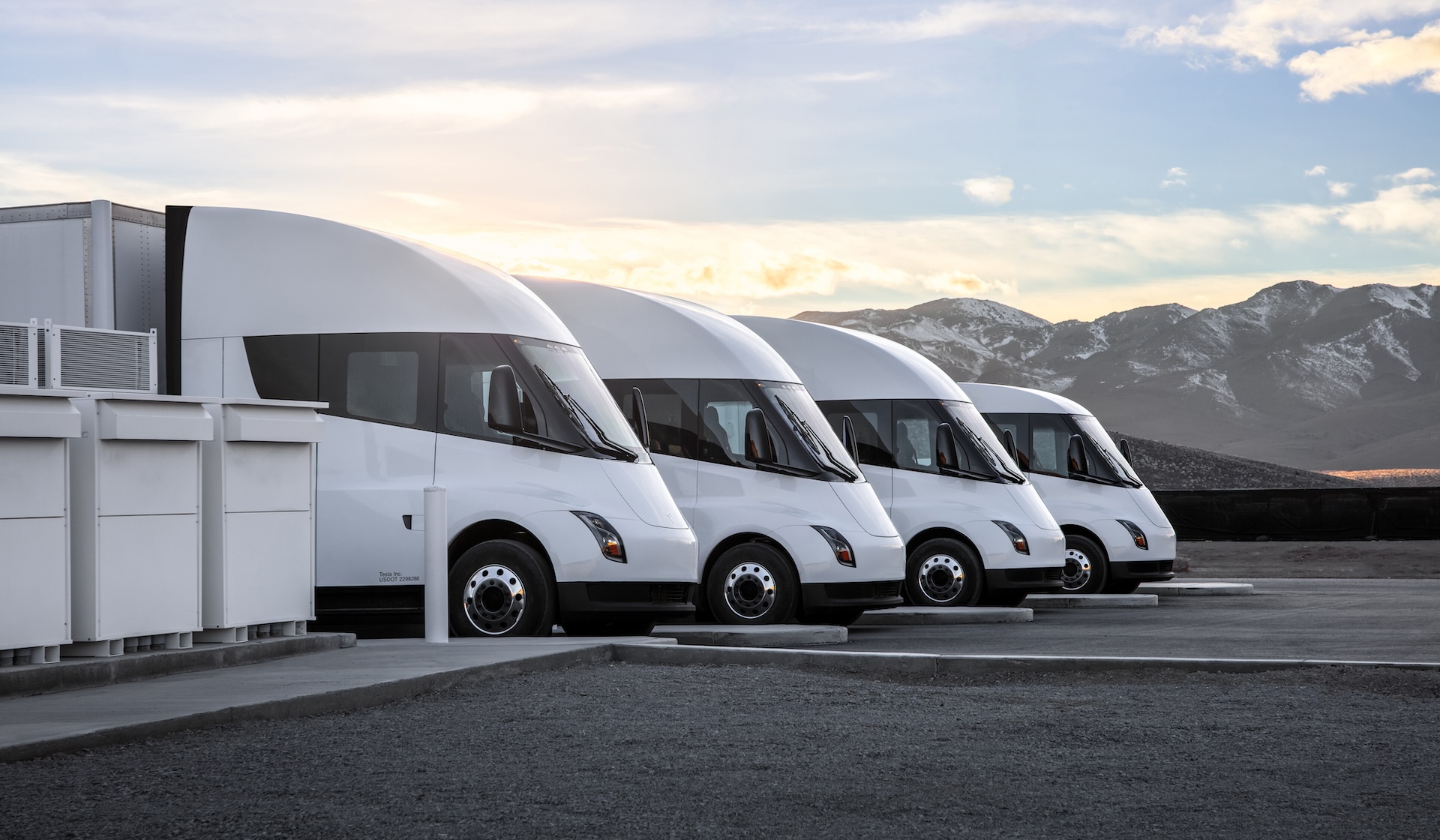
With the presentation of the Semi’s final specifications and the imminent start of its production, Tesla makes it clear that its electric truck is ready to compete in the demanding heavy transport sector.
Tesla has recently updated the section of its US website dedicated to the Semi electric truck, adding the main specifications of the production version. The Semi will be available in two distinct versions, Standard Range and Long Range, both equipped with three rear-axle motors capable of jointly delivering 800 kW of power.
Regarding range, with the Standard Range version it is possible to travel, according to the manufacturer, up to 325 miles on a single charge. That amounts to roughly 525 km. Its combined gross weight is 82,000 pounds, just over 37 tonnes. Unladen, the manufacturer claims its weight is below 20,000 pounds, a little over 9 tonnes. Likewise, the Long Range version promises a range of 500 miles, or 805 km, with an unladen weight of 23,000 pounds, nearly 10.5 tonnes.
Tesla states an energy consumption for both versions of 1.7 kWh per mile, which amounts to approximately 1.1 kWh per kilometre travelled. The Semi is compatible with the MCS high-power charging standard and, according to the manufacturer, is capable of reaching 60 percent charge in around half an hour in both versions.
Now Tesla is finally getting serious about the Semi
Large-scale serial production of the Semi will finally begin this same year, after multiple delays since its unveiling in 2017, at a new plant dedicated to its assembly located in the state of Nevada. First deliveries to customers will also take place this same year, as Elon Musk himself has promised. So far, as we have been telling you here at HighMotor, only a limited number of units have been produced, mainly for internal testing and very specific customers, such as PepsiCo, which operates around 36 Semi units in California for its distribution tasks.
Although Tesla has not officially disclosed the battery capacity, we can estimate it based on the announced energy consumption and range: it should be around 900 kWh in the longer-range version. Regarding payload capacity, in the United States, where electric trucks can exceed the standard 80,000-pound limit by 2,000 pounds, a net payload of roughly 21 tonnes is calculated after deducting the weight of the truck itself with a standard semi-trailer. This places it at competitive levels with European models such as the Mercedes eActros 600 or the Renault E-Tech T, which carry around 22 tonnes in configurations of up to 44 tonnes gross weight.
Tesla plans to sell the Semi in Europe as well, where it already showcased it during the 2024 IAA Transportation. In the European Union, the maximum permitted weight is currently 40 tonnes for diesel trucks, but the European Commission is already studying raising this limit for electric models to 44 tonnes.
Finally, it should be noted that the price of the Semi has not yet been confirmed by Tesla. Although in 2017 a selling price of around 150,000 dollars for the base model and 180,000 dollars for the extended-range model was initially suggested, some recent reports published in US specialist media now point to a price of around 260,000 dollars for the Standard Range version and nearly 300,000 dollars for the Long Range version. In any case, as we have said, these figures are not confirmed and are pure speculation.


 Peugeot E-208 GTi: a battery-powered toy that revives the spirit of the 1980s sports cars
 New Lexus ES: luxury grows and goes electric
 First contact with the Dacia Sandero Hybrid 155: power and efficiency from €19,890
Deja un comentario