Explorer Ford Electric Cars Tests SUV
Test drive Ford Explorer AWD: What makes it an Explorer? American soul with German precision
 Óscar Sanz
8 October 2025
9 min.
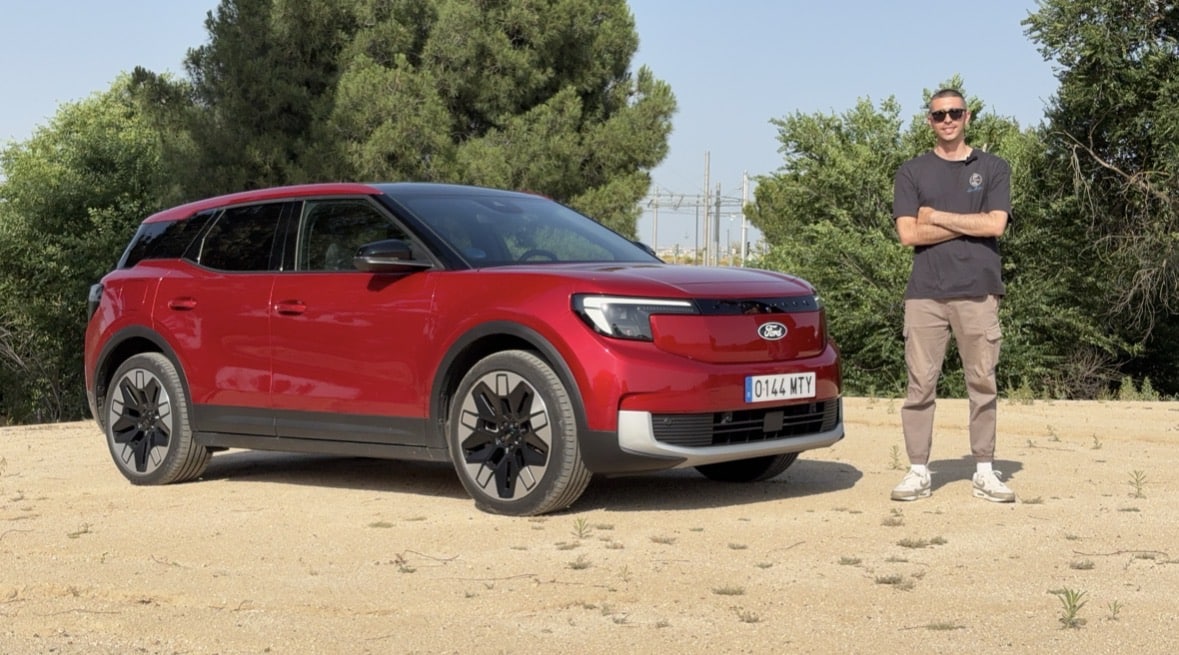
Bold design, high-tech interior and American soul… but does it keep the adventurous spirit that made its predecessors great, or has it become too European? We tell you how it measures up and we want to know: is it still a true Explorer?
It keeps the name of another legendary model from the oval brand, but in reality it has very little to do with it, since its dimensions are considerably more modest and its propulsion system is exclusively electric. It was designed in Europe and built in Cologne, promises more than 600 km of range and announces charging power of up to 185 kW.
This new edition is based on the MEB platform of the Volkswagen group, with which it shares many mechanical and electrical components. Its dimensions are 4.47 metres long, 1.87 metres wide and 1.63 metres high, with a wheelbase of 2,770 mm.
https://youtu.be/NzPCXmBTzm8
The Ford Explorer is back… but not as you remember it
Design is one of the things that attracts me to the Explorer. I think it brings originality and freshness, especially in colours such as blue or red, since in darker colours that adventurous spirit doesn’t stand out as much. We have a faired grille due to the electric drivetrain, the model name placed on a black moulding that connects the light clusters, which are very stylised and boomerang-shaped. On the side we have wheel arches trimmed in this black plastic and just below them the wheels, which are 19 inches as standard with the base trim, and 20 inches with the Premium trim, with tyres of different sizes on the front and rear axles. There are optional 21-inch wheels which, at 1,200 euros on the base version and 600 euros on the Premium, are quite a temptation, given how good they look.
We have a ground clearance of 20 cm which, if you have the all-wheel-drive version, will come in very handy for off-road excursions. And finally, a decorative moulding on the C-pillar. At the rear we find the same pattern as at the front: a small black moulding joining the light clusters, which try to mimic the front design with a vertical layout.
The advertised boot capacity is 470 litres (1,460 with the rear seatbacks folded down), and the weight difference between the rear-wheel-drive and all-wheel-drive versions is not very striking: 77 kg. 2,090 kg for the RWD version and 2,167 kg for the AWD.
Big, powerful, and with a surprisingly moderate appetite
As you can see, there is no “frunk” at the front. The rear-wheel-drive configuration has a 77 kWh lithium-ion battery, delivering 286 CV and 545 Nm of maximum torque with up to 572 km of range, while the all-wheel-drive variants feature a 79 kWh battery (with a different cell configuration), power of 340 CV and 545 Nm of torque for the rear motor and 134 Nm for the front one, with a range of up to 532 km.
There is also a single-motor rear-wheel-drive version with a smaller battery, of 52 kWh capacity, with 170 CV of power and around 357 km of electric range. All versions accept three-phase AC charging of up to 11 kW. In this way, the maximum WLTP ranges are put at 602 km for the rear-wheel-drive unit and 566 km for the most powerful, largest-battery version.
But one of the things I don’t like, and which happens to me more and more with the new electric cars being presented, is precisely that: that they are only electric and there is no option for other powertrain variants. Fine, electrification is here to stay. But that we are still lagging behind, especially in Spain, is not up for debate; it is a fact.
And I am convinced that the Explorer would sell like hotcakes if it had hybrid versions or, at least, petrol engines with partial hybridisation.
Where there is a difference is in the maximum DC charging power, since the small battery accepts peaks of up to 135 kW, whereas in the 79 kWh one this power increases up to 185 kW, which, in theory, would allow charging from 10 to 80% in 26 minutes.
American soul with German precision
The design of the cabin is very well executed, with good finishes and excellent fit quality. The space is particularly generous, and it offers approximately 470 litres of combined storage – including the 17-litre MegaConsole. Some items come as standard, such as the heated steering wheel and front seats, the driver’s seat with massage function and wireless phone charging, which carry no extra cost. The seats are very comfortable, certified AGR, with electric adjustment, massage and memory functions, available for both trims, and cost 610 euros.
All Explorers incorporate the connected SYNC Move 2 infotainment system with an adjustable central touchscreen of 14.6 inches that can be raised and lowered through an arc of more than 30 degrees to avoid glare, which also includes a small storage compartment they call My Private Locker. We are not convinced by the side window operating system, inherited from the Volkswagen group, with only two buttons for the four windows (you have to activate a switch that selects the front or rear ones).
The Premium trim versions add a 10-speaker B&O sound system and ambient interior lighting, and finally, the heat pump, available in both trims for 1,300 euros.
The optional extras are limited to a panoramic roof with more than 1 square metre of glazed surface, available only on the Premium version at a cost of 1,240 euros, and a driver assistance package that includes hands-free tailgate, head-up display, 360-degree camera and system.. etc
However, the Ford Explorer inherits some elements from the Volkswagen group that don’t entirely convince. For example, it has only two controls for all the windows, so you have to switch between the front and rear ones with an additional button. Moreover, it lacks paddles to adjust regenerative braking, which forces you to manually switch between the “D” and “B” modes with an impractical lever. And finally, a larger, configurable instrument display is also missing, since the current screen is just 5.3 inches.
European electric power, but no thermal options
The performance of the new Explorer is striking: it can accelerate faster than a Ford Performance Focus ST with 340 CV, which means the Explorer AWD can reach 100 km/h in 5.3 seconds and also has a towing capacity of up to 1,200 kg. The lower-powered variant reaches 0 to 100 km/h in 6.4 seconds and allows a top speed of 180 km/h, as do the all-wheel-drive versions.
Like most fully electric models, smoothness, silence and the absence of vibrations are the most notable characteristics when driving. In the case of the Explorer these qualities are enhanced, as it is quieter than other competing models. The sealing work on the weatherstripping seems to have been more meticulous, as no wind noise from the bodywork or road noise can be perceived.
The driving modes Eco, Normal, Sport, Individual and Traction modify several parameters to adapt to the driver’s needs. The Traction programme is exclusive to the Explorer AWD and serves to improve grip on slippery surfaces. A negative point is that there are no paddles behind the steering wheel for managing energy and the intensity of regenerative braking; there is only the B or Brake mode on the same gear lever.
The car feels very stable, without abrupt body movements, and the steering conveys good feedback when driving. However, not everything is so satisfactory: the brake pedal has an excessively long and spongy travel before effective deceleration is felt. And again, the absence of paddles removes options for those seeking a more dynamic or even fun driving experience.
The homologated consumption figures are very striking for a model of these dimensions, power and weight: the single-motor, rear-wheel-drive version promises a consumption of 13.9 kWh/100 km, while the more powerful all-wheel-drive variant raises energy consumption to 15.7 kWh/100 km.
An Explorer for every budget… if you choose the right version
In the single rear-motor version, its price with discounts – not counting financing or the MOVES Plan – starts from 46,550 euros in base trim, and 3,000 euros more if you choose the Premium version.
But this Explorer version, with two motors and all-wheel drive delivering 340 CV and a battery with almost the same capacity, 79 kWh, has a range of between 532 and 566 km. However, it costs almost 9,000 euros more than the rear-wheel-drive one… and it does not qualify for the MOVES Plan. With all the discounts and MOVES aid, you can have a rear-wheel-drive Explorer with a large battery from 39,550. That is 15,000 euros less than the two-motor Explorer. Given how good the 286 CV version is, I can tell you it is not worth making the jump. And on top of that you lose range.
There is also a version of the Explorer range with rear-wheel drive, a 170 CV motor and a smaller battery, 52 kWh. The range in this case is between 357 and 378 km, depending on the trim. This allows an Explorer to be offered from 41,800 euros, which drops to 34,800 with the maximum MOVES Plan aid. That is 4,750 euros less than the extended-range version. It is also a big jump, but if you choose an Explorer as your only car and want to use it for long trips too, then the investment pays off, not only for the greater range but also for the performance.

 Peugeot E-208 GTi: a battery-powered toy that revives the spirit of the 1980s sports cars
 New Lexus ES: luxury grows and goes electric
 First contact with the Dacia Sandero Hybrid 155: power and efficiency from €19,890
Deja un comentario