Three reasons why I would buy this premium SUV... and one reason why I would rule it out without a second thought.
 Antonio Roncero @roncero_antonio
14 August 2024
14 min.
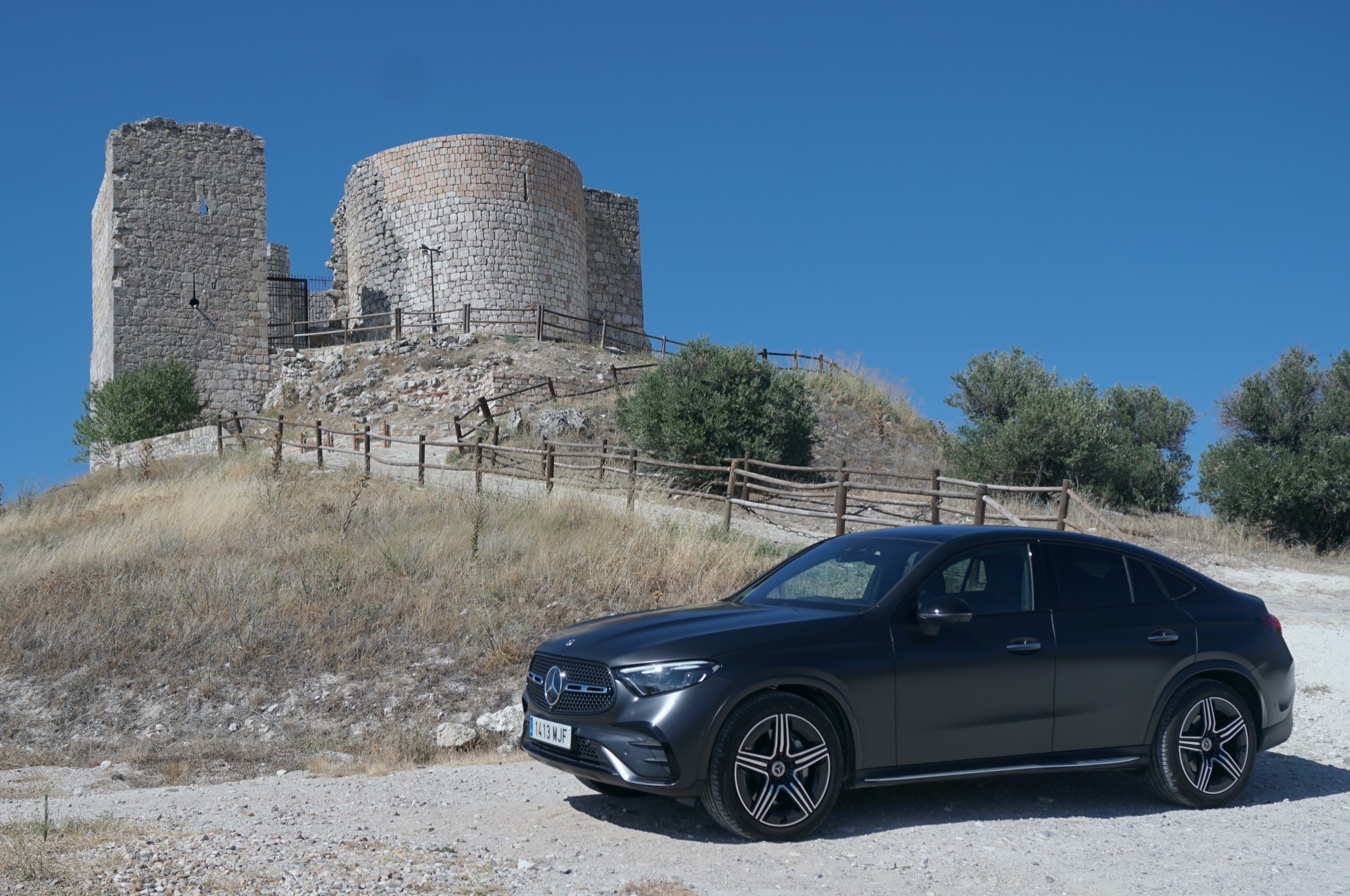
With the 197 hp turbodiesel engine and the DGT ECO label, the GLC 220 d Coupé 4MATIC is the premium SUV in this category that I used to recommend buying… until the star brand decided to lower the price of the plug-in hybrid version.
Since the first generation was launched in 2016 -which later received a slight facelift in 2019-, the Mercedes-Benz GLC Coupé has not stopped bringing joy to the star brand… and satisfaction to its buyers. In fact, it is a model that is very sought after in the used market.
The second generation, on sale since early 2023, remains one of the best-selling SUVs in its category, where the GLC Coupé competes with cars such as the Audi Q5 Sportback and the BMW X4. A generation that still showcases all the attributes that have turned the GLC Coupé into a successful model. That is why the brand decided to keep, with minimal changes, the master lines of its exterior design, one of its main selling points, and to focus on perfecting everything else: from the engine range to the equipment options, especially in the multimedia area.
The entry version of the range is the GLC Coupé 200 4MATIC, with a 204 hp petrol engine and a price from 65,200 euros. Just above it is the 220 d 4MATIC, with the 197 hp turbodiesel engine, which is the one we tested. Above that there are more powerful petrol and diesel versions, plug-in hybrid variants, and the very special models signed by AMG, the GLC 43 4MATIC and the GLC 63 S E Performance.
As I mentioned in the headline, I am going to give you three reasons why this specific version, the GLC Coupé 220 d 4MATIC, seems to me one of the best options in its class, and I will save for the end a reason why I would not buy it myself.
1.- For its design, quality and customisation possibilities
It is around 5,000 euros more than the SUV version, the Mercedes-Benz GLC, which has a more family-oriented approach. But the silhouette of the GLC Coupé, and above all that rear end, still catch the eye. I admit that I am more of a saloon person; specifically, saloons with estate bodywork. But there are some SUVs that make me swoon, and the GLC Coupé has always been one of them.
Specifically, our test unit features some details that make it even more spectacular, such as the matt paint, the side steps or the 20-inch wheels, although as you know, that means paying extra… and noticeably raises the final bill. The possibilities are immense, both when configuring the car with individual options and if you opt for packages. Specifically, there are four AMG packs, called Advanced, Advanced Plus, Premium and Premium Plus, with prices ranging from 5,000 euros to over 14,000 euros.
And this last one, the most expensive, is precisely the one fitted to the model you see in the images. A fortune, but at the same time quite a temptation, with which your GLC 220 d turbodiesel could perfectly pass for one of the top-of-the-range AMG versions. Among other things, the pack includes a 360-degree camera, headlights with adaptive digital light, oversized brakes, spectacular instrumentation projected onto the windscreen, keyless access, hands-free tailgate, power seats with memory, a panoramic sunroof that opens, AMG exterior and interior trim, an MBUX navigation system with augmented reality (it displays real images onto which dynamic 3D guidance arrows are projected, making route following a child’s game), a sports steering wheel and pedals, a Burmester 3D audio system and 19-inch wheels, which on this unit have been replaced by the optional 20-inch ones.
The best part, as I say, is that you can start from the standard model and customise it according to your budget. If you keep the car as it comes from the factory it no longer looks so spectacular, but you won’t be missing anything important, as the standard equipment is already very complete. If anything, I would not do without the DISTRONIC active distance assistant, which should be standard; but it is offered as an option for around 550 euros, or as part of the Plus driver assistance package, which costs 3,365 euros and adds the traffic jam assistant, the active braking assistant with cross-traffic function, the blind-spot detector and the Pre-Safe emergency braking systems.
What is not optional on the GLC Coupé, whichever version you choose, is the sense of quality it conveys. Among the many options available, some stand out, such as the Digital Light digital matrix headlights, which project images onto the road ahead of the car; for example, direction arrows when you indicate to change lanes, or a proximity warning if you get too close to the car in front. They cost almost 2,000 euros, and I admit they are completely dispensable, although it is amazing how well they work. You can also fit the ENERGIZING Plus package, about which the same can be said: very spectacular, with ventilated multicontour seats and programmes that play with the ambient lighting and even with fragrances and massage functions to relieve fatigue, but which costs 3,000 euros. More interesting is the trailer assistant, which stabilises the trailer while driving and is capable of carrying out certain parking manoeuvres autonomously.
2.- For its versatility, also for everyday use
Compared with the SUV version, the GLC stands out for its coupé silhouette and its standard sporty chassis, with firmer damping and less ground clearance. The former reduces the versatility of the rear seats somewhat and decreases boot capacity, while the latter gives the steering a more agile feel. But both in terms of habitability and ride comfort, the GLC Coupé remains a car you could consider for daily use and even works as a sole family car in almost any situation.
The rear seats still offer the same legroom and the same width as in the SUV. You lose a few centimetres of headroom, and it is also true that, due to the sloping roofline, access to these seats is somewhat more awkward. But they remain perfectly usable by adults, even for long journeys, and then you realise what the 545-litre boot capacity can offer, with very regular shapes and a practical false floor under the boot floor. It loses only 55 litres compared with the SUV.
The presentation and look of the interior, as well as the operation of the various systems, is another aspect of the GLC Coupé that convinces me. Especially with this new version of the MBUX infotainment system. At last, the voice recognition offers the effectiveness that Mercedes had boasted about since the first generation of this system, presented in the A-Class, but which until recently it did not achieve. Now you can start a route on the navigation, adjust the climate control or even open the panoramic roof by voice… without having to repeat the command several times trying to get the car to understand it.
I also like the layout of the screens as separate units, rather than one running into the other, something we are seeing more and more often. The instrument display is 12.3 inches, and the multimedia system screen is 11.9 inches, placed in the centre of the dashboard in a vertical position. Both offer very high resolution, with images and graphics of excellent quality, and with so many functions that it is essential to spend some time “getting your bearings”. There are no buttons beyond those on the steering wheel and a row below the screen that gives direct access to certain functions, such as the driving mode selector, the 360 cameras and the audio volume. The climate controls, for example, always appear fixed at the bottom of the screen, but they are “virtual” and are harder to use than conventional physical controls, which is why the good performance of the voice control is valued even more.
3.- For its steering feel: an SUV to enjoy driving
Even in this turbodiesel version, which is the entry level of the range in terms of power, with its 197 hp, the GLC Coupé wins you over when driving thanks to the feel it offers at the wheel: a solid, well-built car that is very pleasant to drive. It is true that the test unit was equipped with Airmatic suspension and four-wheel steering, but I have tried other GLCs with the standard suspension and the balance it offers seems perfect to me. It conveys great confidence when braking or cornering, and it is very comfortable on the motorway thanks to the way the suspension absorbs potholes, the composure of the steering and how well insulated the cabin is.
The turbodiesel engine of the 220 d version gets far more out of itself than you might expect for its power, which settles the question of whether to consider the 300 d, with 269 hp. In my opinion, it is not necessary. It features a 48-volt mild-hybrid system in which a small electric motor of almost 25 hp can assist the combustion engine in certain situations by providing an extra boost (it can never drive the wheels on its own), acts as the starter motor and recovers energy while driving to keep the car’s main electrical network charged, which allows it to coast with the engine off in certain situations to save fuel. And it does all of this very well.
The result is an engine that, combined with the very smooth nine-speed automatic gearbox -which can be operated manually using the paddles on the steering wheel-, offers good acceleration and pulls strongly in any circumstance. And it does so with very low consumption: you have to rub your eyes to believe the 6.5 l/100 km that the trip computer can show in calm driving, and it is very hard to exceed 10 l/100 km even if you insist on pushing the chassis and driver aids on a mountain road. But you end up believing it, especially when you see that it is not difficult to approach 1,000 km of range between refuelling stops. I value the balance between performance and consumption that this version offers, although I would also highlight the smoothness and refinement of the turbodiesel engine, even in urban driving or in traffic jams, with a very quick start-stop thanks to the mild hybrid system.
As for the chassis, with the Airmatic suspension and the four-wheel steering, driving the GLC Coupé is a real delight. I find it very hard not to recommend it, but if you value the dynamic side more than the aesthetic, I would consider it before any other optional package. It costs 3,900 euros, but it completely transforms the car, which goes from a dynamic performance of a good grade to deserving an outstanding one. The way you can link bends in “sport” mode is a real pleasure, with the agility of a small GTI and barely any body roll… or “surf” over potholes enjoying relaxed motorway driving in “comfort” mode. I was also surprised by how well the brakes cope with intensive use.
Like all GLC Coupés, four-wheel drive is standard, with an initial torque split of 45/55% between the front and rear axles respectively, varying according to grip and driving style. It is not a full-time all-wheel-drive system designed to take advantage of the GLC Coupé’s qualities off the tarmac, which are obviously very limited by its reduced ground clearance, although it can be a help when venturing occasionally onto a track or a road in good condition. For the GLC SUV there is an off-road package that includes underbody protection and 20 mm more ground clearance, but it is not available on the Coupé.
And for this reason I would NOT buy the GLC Coupé 220d 4MATIC
So far everything looks very good. But there is a compelling reason to rule out the GLC Coupé 220d: with the latest price cut applied by Mercedes-Benz, for just 1,900 euros more you get a GLC Coupé 300 plug-in hybrid, when normally with cars of this type the difference between these engine options is around 15,000 euros. An irresistible alternative, if you take into account everything the PHEV version offers and that, after all, you are not changing model.
Take note. To begin with, the 300 produces a system output of 333 hp and has much better performance: it accelerates almost 2 seconds faster from 0 to 100 km/h, provided the battery is charged. If not, in the worst case you will always have the power of the turbodiesel engine, which is the same as in the 220 d. In addition, you can use it daily in fully electric mode, with a real-world range of around 100 km -according to homologated figures it is 126 km- thanks to its battery of more than 30 kWh gross capacity. A battery that can be comfortably charged at home overnight from a domestic socket, in about 2.5 hours with AC and 11 kW of power at a public charging station or using a wallbox… or in less than half an hour if you use a fast charging point, as it accepts DC charging at up to 60 kW.
If you have nowhere to plug it in daily, that is no excuse: the GLC 300 will function as a conventional hybrid, with fuel consumption only slightly higher than that of the GLC 220 d. And it would be rare that you could not recharge it now and then on the public network. If anything, I would accept as the only reason not to opt for the plug-in hybrid that it loses 155 litres of boot capacity. But the advantages outweigh this drawback so much that I would consider playing “Tetris” with the suitcases… or even using a roof box for that long holiday journey. By the way, on the plug-in hybrid version the Airmatic air suspension and four-wheel steering are standard; the price of this option alone on the turbodiesel is already higher than the price difference between the two versions.
Not only that, remember that, in addition to better performance with lower consumption and the possibility of daily use in electric mode, this plug-in hybrid version qualifies for the CERO DGT environmental label instead of the ECO label, which on its own is already, for many, reason enough to make the jump. By the way, for the same price you also have a 300 e PHEV, in which the combustion engine is petrol. But although it is currently a real “rara avis”, Mercedes-Benz has shown that the combination of a good turbodiesel engine with PHEV technology is unbeatable when it comes to efficiency, without having to give up anything.
Mercedes GLC Coupé 220d 4MATIC – Image gallery


 Peugeot E-208 GTi: a battery-powered toy that revives the spirit of the 1980s sports cars
 New Lexus ES: luxury grows and goes electric
 First contact with the Dacia Sandero Hybrid 155: power and efficiency from €19,890
Deja un comentario