What is a tyre's treadwear index and how do you interpret it?
 Antonio Roncero @roncero_antonio
27 December 2022
5 min.
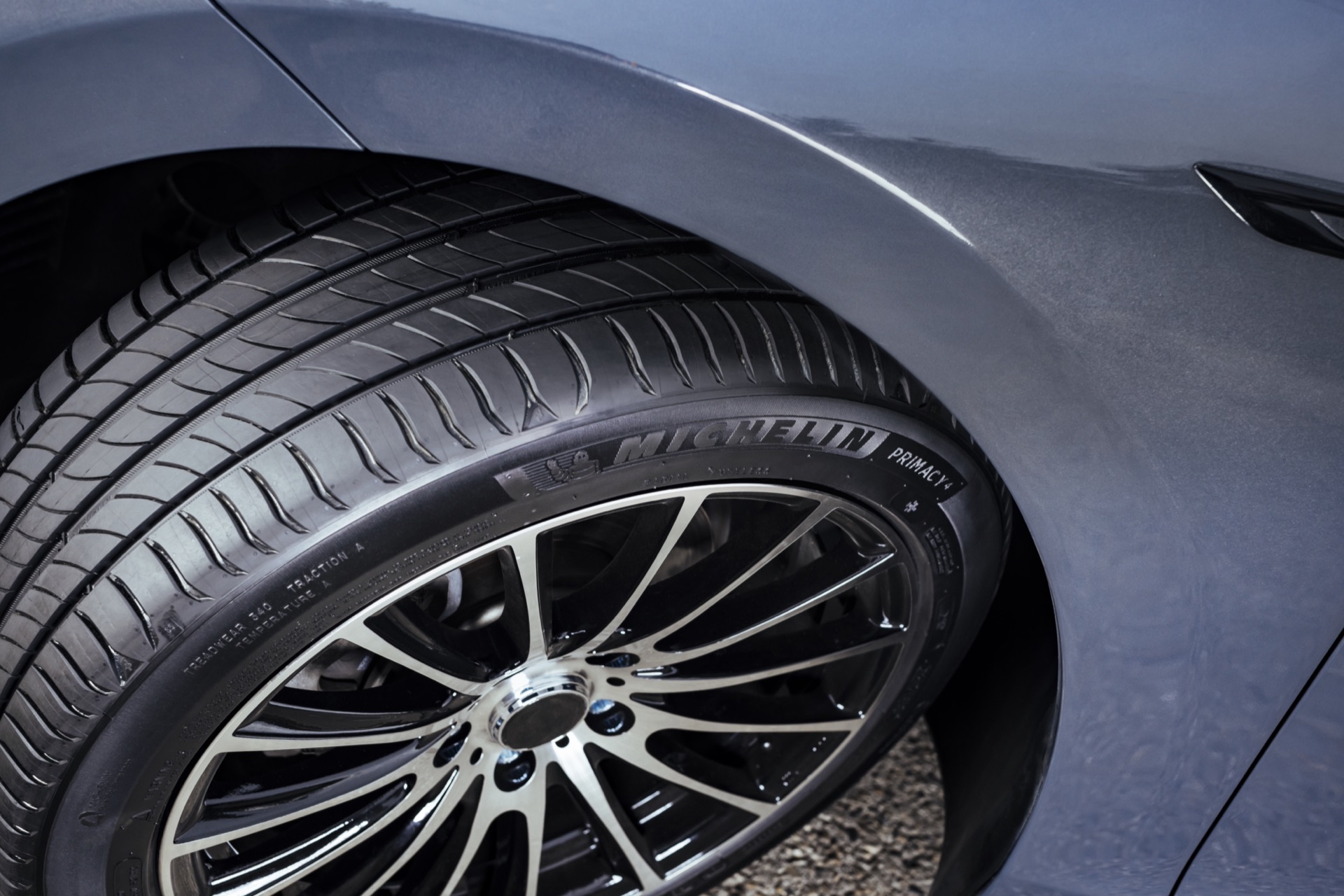
Many users are unaware of the meaning of the Treadwear marking that some new tyres may carry on their sidewall, which provides reference data on how the tyre will behave in terms of durability and wear.
Tyres carry much more information on their sidewalls than you might imagine. We normally know what the letters and numbers referring to the tyre’s dimensions or rim size mean. The three-peak mountain marking with the letters 3PMSF is also becoming better known, identifying winter-certified tyres suitable for driving on snow without chains. Other information we can read from a tyre’s sidewall includes the date of manufacture, the load index and the speed rating.
There is, however, a little-known marking that can be very useful: the treadwear index. It usually appears alongside two other indices, traction and temperature, and together they form part of the UTQG (Uniform Tire Quality Grading) system established by the NHTSA, the US agency responsible for road traffic safety (roughly the equivalent of the DGT in Spain), to classify tyres.
For this reason, some tyres sold in both the American and European markets, for example, already carry this marking as standard, which is mandatory in the United States. However, you won’t find it on every tyre sold in Europe, where new tyres carry their corresponding tyre label, which provides information on fuel efficiency, braking performance and noise.
What is a tyre’s treadwear index?
The treadwear index is an indicator that refers to a tyre’s lifespan. It is a relative index that gives users information about a tyre’s quality, allowing a comparative rating to be established through a numerical score obtained when the tyre passes a specific test under approval conditions. It therefore tells us how resistant a tyre is to wear.
Taking 100 as the standard reference figure, the treadwear index allows us to compare one tyre with another and assess which of the two offers greater wear resistance. Be aware, however, that this index does not equate to, nor give us an idea of, the mileage a tyre will achieve, which depends on many factors: type of vehicle, driving style, roads driven on, weather…
The treadwear index can range from 60 to over 600, with 100 used as the standard reference or average value. Above 100, the tyre has good wear resistance, the higher the number. In theory, a tyre with a treadwear index of 300 would wear out three times faster than one rated 600. It would therefore be correct to say that a tyre with a higher treadwear index will have a longer service life than a tyre from the same manufacturer (this is important, because the treadwear rating is assigned by the manufacturer based on test results) with a lower treadwear rating.
Traction and temperature indices
The other two indices that usually accompany the treadwear rating on the sidewall are traction and temperature, provided the tyre carries this marking under the UTQG system, which, let us remember, is mandatory only for new tyres in the United States.
The traction index, shown as “traction” on the sidewall, gives an idea of the tyre’s grip on the road. It does not use a numerical scale but a classification: AA for the best grip, A for optimal grip, B for medium grip, and C for acceptable grip. This index could be compared to the wet braking classification offered by the European tyre label, although the traction index, established many years before the European label, is determined through constant-speed braking tests on both asphalt and concrete, with the tyre mounted on a trailer axle, and also on wet surfaces.
As for the temperature index, it does NOT indicate a tyre’s ability to resist heat but, so to speak, its ability to dissipate it. While a tyre rolls, its temperature rises due to weight, speed, road surface type, outside temperature, etc. By isolating all these variables, the tyre’s design and rubber compounds will make its temperature rise differently. Laboratory tests allow this index to be determined, which indicates the speed at which a tyre would begin to deteriorate due to temperature, considering only its design and compounds. In this case there are three levels: A, B and C, according to the maximum speed before deterioration. In a way, we could compare this index to the tyre’s speed rating, required for approval in Europe.
Both the treadwear index and the traction or temperature indices, used for approving new tyres on the North American market, can be taken into consideration when buying or comparing new tyres on the European market, if these indices are included. However, some of the information they provide may be redundant with what we can obtain from the European label.
Related information of interest


 Peugeot E-208 GTi: a battery-powered toy that revives the spirit of the 1980s sports cars
 New Lexus ES: luxury grows and goes electric
 First contact with the Dacia Sandero Hybrid 155: power and efficiency from €19,890
Deja un comentario