EBRO s700 Hybrid Cars ECO Review SUV
Behind the wheel of the Ebro S700 HEV: 224 CV, ECO label and plenty of equipment to compete with the best-selling hybrid SUVs
 Antonio Roncero @roncero_antonio
22 April 2026
8 min.
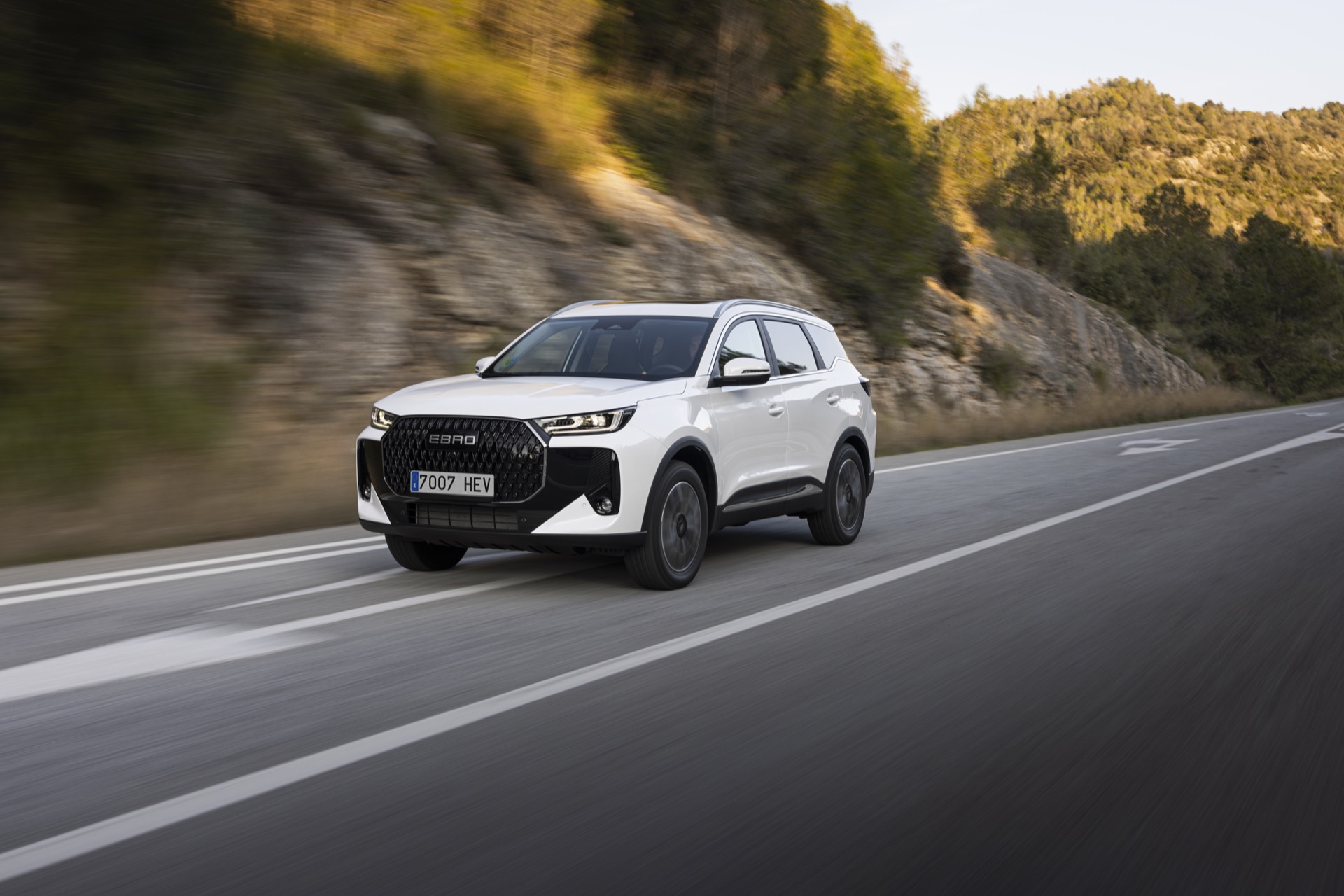
With 224 CV, an ECO label, a well-tuned full hybrid powertrain and an excellent value-for-money ratio, the S700 HEV is set to make life very difficult for the “heavyweights” of the segment.
Things are going well for Ebro. With more than 6,600 units registered in Spain in the first quarter of 2026 alone, and stabilised at around 2,000 cars a month in recent months, the “Spanish-Chinese” brand has climbed to 14th place in the overall SUV market. Currently, Ebro is already the fifth brand selling the most plug-in hybrid vehicles in our market, and the third if we limit it to PHEV SUV sales, behind only BYD and Mercedes-Benz. Specifically, the S700 PHEV leads the C-SUV PHEV segment, the S800 PHEV is among the five best-selling D-SUV PHEVs, and the S900 is second among luxury SUVs with plug-in hybrid technology.
The new S400, Ebro’s first HEV model – full hybrid – is doing quite well too: it ranks fifth in the B-SUV HEV ranking. And now the star of today arrives, with which Ebro fully enters one of the most competitive segments on the market, that of compact “no-plug” hybrid SUVs.
This is no coincidence. Conventional hybrid powertrains remain one of the best alternatives for most Spanish drivers, who don’t have a plug at home to take advantage of a PHEV. And the new S700 HEV has the ingredients of the perfect formula: low consumption and an ECO label, to which it adds an excellent price-to-product ratio. It is the third variant in the range and the one that closes the circle: petrol with a C label, PHEV with a ZERO label and now this HEV with an ECO label. One SUV with three answers for three types of customer.
In this way, the S700 is the first Ebro model to offer all three powertrain variants. As a data point, currently 33% of Ebro’s sales are vehicles with a ZERO label, 50% have an ECO label – thanks largely to the S400 HEV, which accounts for almost half of the brand’s sales – and only 17% are models with a C label.
Interior changes that are appreciated
There is little to add about the cabin that we haven’t already covered in previous tests of the S700, whether with the petrol or PHEV engine. But there are some very interesting details. In my view, and wisely so, Ebro has replaced the previous gear selector, which featured that crystal finish so popular in Asian markets, with a more conventional one wrapped in leather.
But the most important improvement inside is the new physical button panel for the climate controls, located just below the ventilation outlets. In a world dominated by screens – and it’s worth remembering here that the S700 has two 12.3-inch ones, one for the instrumentation and one touch screen for the multimedia system – being able to raise the temperature or change the air distribution without taking your eyes off the road to navigate menus is appreciated. Others should take note, however much the response we get when we suggest it is that voice control is there for that.
Another novelty that seems minor but which I consider very interesting is the possibility of assigning the energy recovery level controls to the favourites button on the steering wheel. Personally I prefer paddles, but at least it allows you to change the intensity of recovery without going through the screen.
Otherwise, from the interior I’m left with the seats, with a sporty bucket-style design that holds you well but doesn’t “squeeze” on long journeys. With the top-of-the-range Luxury trim, in addition to a synthetic leather upholstery that feels very good and has real presence, they add a ventilation function to the standard heating. You can cover many kilometres without them taking their toll.
The interior space is generous, as befits an SUV measuring 4.55 metres long with a 2.67-metre wheelbase. The Group’s T1X platform was designed from the outset with the cabin in mind, and it shows: the rear seats have a completely flat floor and the real width is always average or above average for the segment. The boot offers 369 litres up to the parcel shelf, 484 up to the roof, and expands to 1,269 litres with the seats folded down.
The hybrid system of the Ebro S700 HEV
Technically, the S700 HEV relies on a full hybrid powertrain that combines an efficient 1.5 TGDI turbo petrol engine with four cylinders and 105 kW, operating on the Miller cycle with two electric motors, one for propulsion and one acting as a generator. The combined power of the system is 225 CV, with 295 Nm of torque. The high-voltage battery has a capacity of 1.83 kWh.
In practice, the HEV system in the S700 seems to me clearly better resolved than that of the S400. The smaller sibling in the family suffered from a drivetrain management that didn’t quite convince me when you had to get out on the open road, although as an urban SUV it goes wonderfully. The S700 HEV doesn’t mind whether it’s country roads, city or motorway. The combustion engine works discreetly, comes in when needed with barely any noticeable intervention, and the transition between electric and hybrid mode is clean and almost imperceptible in most situations. Only at moments of maximum demand – a quick overtaking manoeuvre on a country road, a mountain pass – does it become more present, and even then it stays in a secondary role that never bothers.
The result on the road is balanced, quiet and with a smooth, agile response at any engine speed. It claims an acceleration from 0 to 100 km/h in 8.7 seconds and a top speed of 175 km/h. Real consumption during this first test drive, alternating between ECO and Sport modes, was around 6.5 l/100 km, a very good figure. With more relaxed driving and in ECO mode it won’t be difficult to get close to 6 l/100 km, nor to achieve the total range, which is around 900 km.
At the wheel: driving modes and regeneration
The S700 HEV offers two main driving modes selectable from the rotary dial on the centre console: Eco and Sport. Eco prioritises efficiency and limits the response of the powertrain; it is useful for city and relaxed country driving, although it can feel somewhat restrained for those accustomed to a more immediate response. Sport markedly increases throttle sensitivity and unlocks greater pushing power. In this mode the car is more responsive and, to a certain extent, even fun.
The regeneration system is capable of recovering large amounts of energy both on deceleration and under braking, thanks to an instantaneous power discharge from the battery of up to 85 kW for 10 seconds, one of the highest values in the sector. This improves performance in acceleration and overtaking, and helps keep the battery at a practically constant usable charge level. In other words: it won’t be easy to find yourself without the “assistance” of the electric motor and see the power or performance temporarily reduced.
As for the chassis, Ebro has made some adjustments to the suspension and steering of the S700 HEV compared with previous versions, and you can notice them. The body movements are better controlled and the steering has gained in precision and feel, which improves the driving experience while maintaining what customers ask of a family SUV: ride comfort and ease of driving.
Price and range
The S700 HEV range starts at 28,990 euros for the Comfort trim and rises to 31,490 euros in the Luxury version, prices with promotional campaigns and brand financing. The list prices without campaigns or discounts are 34,990 euros and 37,490 euros, respectively.
The Comfort trim already includes as standard the 12.3-inch dual screens, navigation, dual-zone climate control, keyless entry and start, full LED headlights, an 8-speaker Sony sound system, electric seat adjustment and heated seats, and a complete set of 24 ADAS systems. The Luxury adds Eco-Skin upholstery, seat ventilation, a 540º camera, a 50 W wireless charger, electric tailgate, panoramic sunroof and multicolour ambient lighting, among other details.
With the official prices in hand and the brand’s discount – excluding financing – the S700 HEV costs around 4,000 euros more than the petrol version with 147 CV and C label… and about 3,500 less than the plug-in hybrid. My recommendation? If you have a plug at home, don’t hesitate, go for the S700 PHEV. If you don’t have a plug, the HEV is worth it even if you don’t need the advantages granted by the ECO label, because it offers a far more pleasant driving experience and performance than the non-hybridised 1.6 TGDI, and consumption around 2.5 l/100 km lower.
Ebro S700 HEV – Image gallery
Technical specifications of this car


 Kia offers an electric range of 10 models, 50 versions and 400 possible combinations
 The seven finalists for the 2027 European Car of the Year (COTY) are exclusively electric
 Peugeot E-208 GTi: a battery-powered toy that revives the spirit of the 1980s sports cars
Deja un comentario