Test drive of the Mercedes-Benz EQA 250, five strengths and three weaknesses of the German electric SUV
 Diego G. Moreira
21 September 2022
5 min.
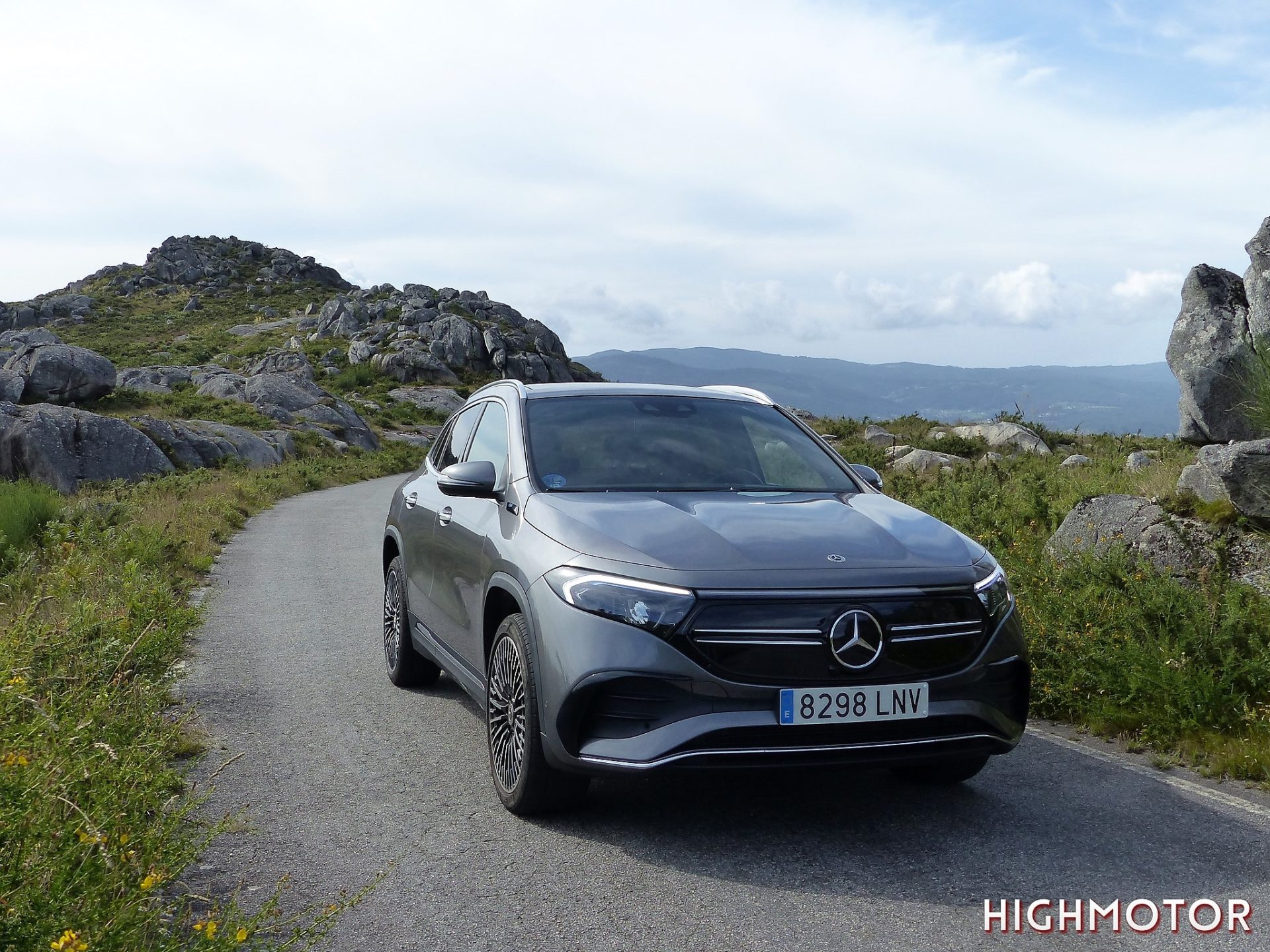
This is our analysis and road test of the Mercedes-Benz EQA, an electric car with 190 CV and a real-world range of 350 km. Its strengths and the less impressive aspects.
We got behind the wheel of one of the first electric cars from Mercedes-Benz, the EQA in its 250 version, that is, front-wheel drive with 190 CV of power. The entry-level electric model in the Mercedes-Benz range is a very interesting car for several reasons, and it has room for improvement in other areas that we will try to summarise in this article.
If you are considering the Mercedes-Benz EQA 250, keep reading to get an idea of what this German electric car offers.
SUV design with a quality interior
The EQA’s first strong point is its design. Its exterior differs from its sibling in the range, the GLA, through the rear lights that run across the entire tailgate and the fully enclosed grille. The most notable point, and a strength, is the interior.
The EQA offers a driving position similar to the rest of the A-Class range, with a avant-garde design (thanks to the twin instrument and infotainment screens), as well as air vents with integrated lighting and quality finishes that are more than adequate for its segment.
Precisely the interior design and the quality of the finishes (with some exceptions) are key points of this Mercedes-Benz EQA 250.
190 CV engine with strong performance
The EQA is available with several engines and with all-wheel drive, but the most balanced version if we want electric range is the 250, with a 190 CV motor and front-wheel drive.
This electric motor delivers 375 Nm of torque, making it particularly sporty and quick off the line when we select Sport mode.
Its 0 to 100 km/h in 8.9 seconds is not surprising, but the sensations it gives us when we need to overtake on a road, or simply drive more briskly, are: there the 190 CV feel very lively and press us back into the seat.
Dynamism behind the wheel
Another strong point of the EQA is its dynamism. Although its SUV design may be deceptive, its 235/45 R20 tyres with Pirelli P Zero rubber already give us an idea of its performance.
It has very composed handling and dynamically it is not afraid to tackle a mountain pass, thanks to the immediacy of the electric torque and a chassis that responds well, and it will make us enjoy driving.
Battery with charging up to 100 kW and sustained power
The Mercedes-Benz EQA’s battery has a capacity of 66.5 kWh, the same regardless of version and power chosen. It is not a battery with a surprising capacity, even more so when there are other vehicles on the market with 70-77 kWh batteries, but it is a battery that charges quickly.
On a standard charger of up to 22 kW it charges at 11 kW, but at a fast-charging point it can charge up to 100 kW, maintaining its power almost to 100%. In fact, one of its strong points is that few electric cars, once past 80% charge, still maintain outputs above 50 kW (up to 70 kW in our test).
At a 100 kW charger it takes 30 minutes to charge from 0 to 80%.
Reasonably complete equipment for 53,795 euros
On other models of the brand it is necessary to go through a huge list of extras to leave our car to our liking; in the case of the EQA, with just the Premium Pack (3,000 euros) we get a large array of assistance systems, a wireless phone charger, heated front seats, 64-colour ambient lighting, a reversing camera, among others.
That is, we can leave our Mercedes-Benz EQA very well equipped without the final bill rising exponentially.
The sportiness is noticeable and eats up kilometres
Among the points to improve is efficiency: the EQA is not the most economical in its segment. It is in line with other German electric cars, but below the South Korean competition. If we add to that some huge 20-inch wheels (which work very well dynamically), the end result is high consumption.
On the motorway it hovers around 22-23 kWh, while on country roads it is impossible to get below 18 kWh. All this leaves it with a real-world range of 230-250 km on the motorway and around 280-300 km on country roads.
Rear seats not very spacious
Another point to improve is rear-seat room: the batteries take up floor space in the rear seats and the bench sits too low, which reduces legroom comfort.
Nor does it have an outstanding boot, since its 340-litre capacity is, once again, the result of the space given over to the batteries.
Decent quality, but some materials could be improved
The interior of the Mercedes-Benz EQA 250 is very avant-garde: the twin screens offer a modern design and a lot of information, along with air vents with integrated LED lighting that change colour when the climate control temperature rises (red) or falls (blue).
All of this is very eye-catching, but there are certain parts of the finish (gear lever controls, window switches or lower parts of the dashboard) that do not have the quality we expect in a vehicle of this segment.
In summary, for being the brand’s first electric vehicle, the end result is very balanced. We have told you here about its strengths and its less impressive details so that you can quickly get an idea of everything the Mercedes-Benz EQA 250 offers.
Photos | Test team


 Kia offers an electric range of 10 models, 50 versions and 400 possible combinations
 The seven finalists for the 2027 European Car of the Year (COTY) are exclusively electric
 Peugeot E-208 GTi: a battery-powered toy that revives the spirit of the 1980s sports cars
Deja un comentario