From Madrid to Nürburgring: 2,000 kilometres to put the OMODA 9 SHS to the test
 Óscar Sanz
12 December 2025
6 min.
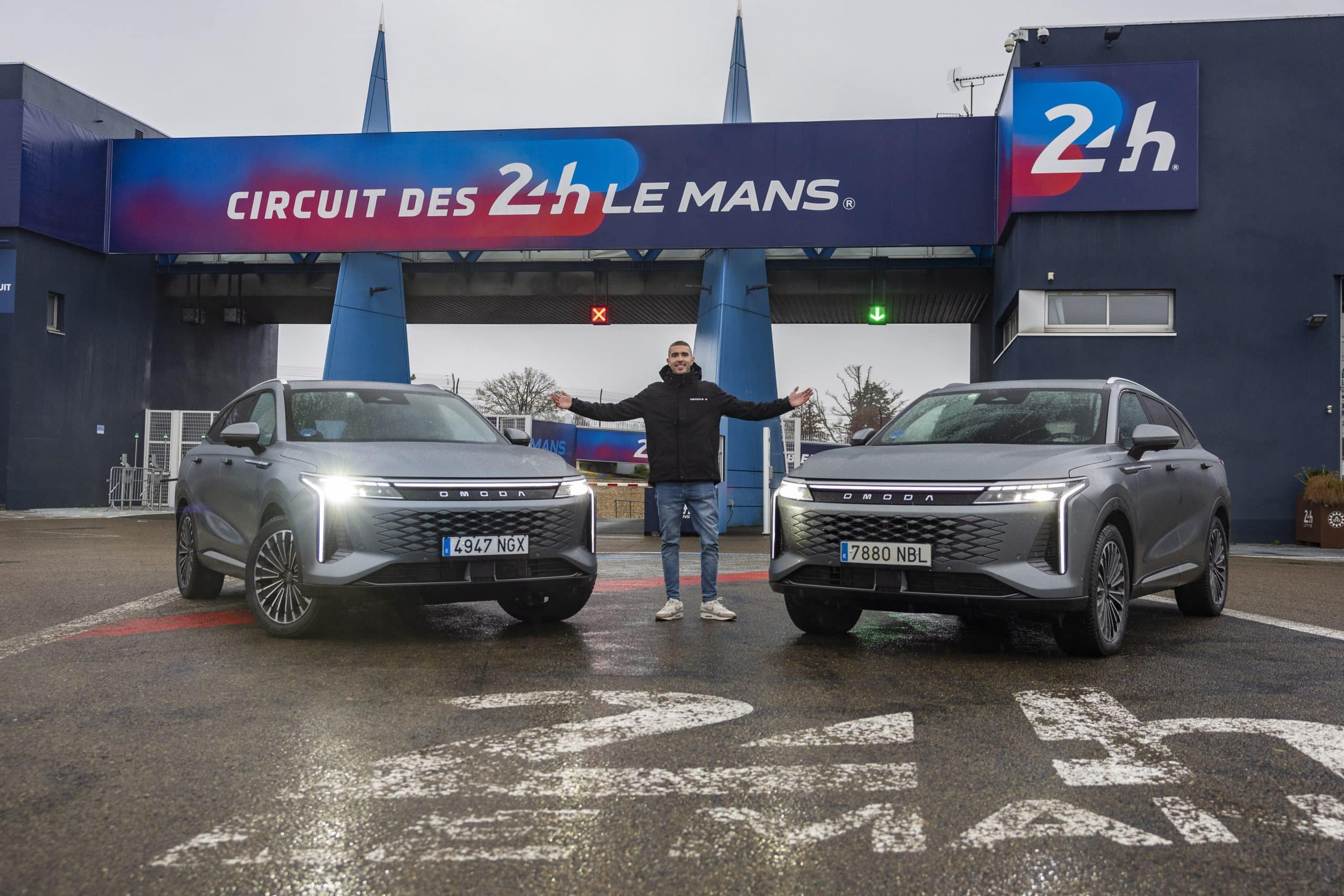
Nürburgring is rarely the end of a journey, but rather the beginning of a bigger one. There, on the Nordschleife, with wet asphalt, four degrees of temperature and one of the lowest grip levels of the year, the OMODA 9 SHS showed its most demanding side. It did so after having covered more than 2,000 kilometres from Madrid, crossing four countries and accumulating five days of continuous driving. That context is key to understanding what happened on the ‘Green Hell’.
The Super Hybrid Plug-in SUV from OMODA & JAECOO completed 20 laps of the German track in extreme conditions, testing its SHS system, AWD all-wheel drive and CDC electromagnetic suspension. The combined power of 395 kW (537 CV) was clearly felt, but always under control, even in critical areas such as the Karussell, Fuchsröhre or Pflanzgarten. The 3DHT transmission responded quickly and smoothly, while the electronic systems worked constantly to maintain stability on one of the most demanding circuits in the world.
Before the limit, many kilometres
What is relevant is that this performance at Nürburgring did not come from a cold start. The car had come from a real long-distance experience, with motorways, secondary roads, urban traffic and days of more than 600 kilometres behind the wheel. Four units of the OMODA 9 SHS, driven by journalists and content creators, had left Madrid five days earlier with a clear premise: to use the vehicle as any ordinary user would.
That real-world use translated into figures that are hard to ignore. The average consumption for the trip was 7.2 l/100 km, very close to the 7.0 l/100 km homologated with the battery depleted, four adults and a boot full of luggage. Remarkable figures for a car weighing over two tonnes and producing 537 CV. The best partial reading was 5.5 l/100 km, while the real-world range with a 70-litre tank came close to 1,000 kilometres. The combined range exceeded 1,100 km, with up to 145 kilometres in pure electric mode.
The OMODA 9 SHS uses a Super Hybrid Plug-in propulsion architecture based on four motors, one combustion and three electric. The thermal engine is a 1.5T GDI DHE producing 140 CV, while the electric system consists of two motors located on the front axle, with 100 CV and 120 CV respectively, and a third electric motor on the rear axle with 234 CV. This configuration enables advanced management of power and traction, with electric, hybrid or combined operation depending on driving conditions, and is the basis of the model’s AWD all-wheel drive, as well as its high responsiveness both on the road and in situations of high dynamic demand.
Even in Germany, on unrestricted stretches of autobahn, the OMODA 9 SHS reached its top speed of 187 km/h with stability and without consumption soaring disproportionately for a 537 CV SUV. Even in wet conditions. But also thanks to excellent tyres such as Michelin Cross Climate.
A car designed not to tire you out
One of the factors that most influenced the overall experience of the trip was comfort. The cabin of the OMODA 9 SHS proved to be designed for long distances. The double glazing and high structural rigidity notably reduce external noise, while the CDC electromagnetic suspension precisely filters out irregularities, expansion joints and poor road surfaces.
The Nappa leather seats, with ventilation, heating and massage, made all the difference after long days behind the wheel. The ergonomics of the driving position allowed a comfortable posture to be maintained for hours, and the technological equipment —24.6-inch panoramic display (two 12.3-inch screens), HUD, surround sound and a complete suite of driver assistants— made driving in unfamiliar environments, urban access roads and hotel car parks easier.
It is no coincidence that, after crossing several countries in a few days, the comments were repeated: getting out of the car without a sense of fatigue became a constant of the journey.
Between history, gastronomy and efficiency
The route was not limited to adding up kilometres. It passed through some of the most iconic sites of European motorsport. In San Sebastián, Basque gastronomy was combined with a visit to the Lasarte circuit, inaugurated in 1923 and host to ten Spanish Grands Prix. In Le Mans, lunch at L’Auberge des Hunaudières placed participants beside the most legendary straight of La Sarthe, where WEC prototypes once exceeded 400 km/h.
The visit to the original layout, to the Bugatti circuit and to the 24 Hours Museum provided historical context before continuing on to Reims. There, the Reims-Gueux circuit —venue of the 1950s Formula 1 races— offered a very different picture: restored grandstands, silent pit garages and the feeling of standing in an open-air museum.
Throughout that route, the OMODA 9 SHS did not need to charge its battery, which was the goal: to see under real conditions how efficient this model could be. That said, before entering the circuit, to make the most of its 537 CV of power, is when they truly used its DC fast-charging capacity of up to 65 kW, recovering from 30 to 80 % of the battery in just 25 minutes.
Technology that adapts to the terrain
The journey made it possible to observe how the SHS system automatically manages energy depending on the scenario. In town and on quiet stretches, the car ran for long periods in electric mode. On the motorway, the system alternated between series or parallel hybrid operation to optimise consumption and performance. At Nürburgring, the whole system worked to deliver constant thrust, immediate response and stability.
The M3X platform, with a low centre of gravity, generous track width and multi-link rear suspension, was decisive both on the road and on the circuit. Added to this are the safety and assistance systems —ABS, EBD, HBA, ESP, TCS, RSC— which acted progressively even in limit situations.
In the end, the route between Madrid and Nürburgring served to clearly define the OMODA 9 SHS. Not as an SUV focused solely on power, nor as a hybrid obsessed with consumption, but as a vehicle capable of combining real efficiency, high-level comfort and solid dynamic behaviour even on the most demanding circuit in the world.
More than 2,000 kilometres later, the message is clear: when a car survives the European test under real conditions and reaches the ‘Green Hell’ with nothing left to prove, it is because the journey has already done its work.
Technical specifications of this car


 Kia offers an electric range of 10 models, 50 versions and 400 possible combinations
 The seven finalists for the 2027 European Car of the Year (COTY) are exclusively electric
 Peugeot E-208 GTi: a battery-powered toy that revives the spirit of the 1980s sports cars
Deja un comentario