Rafale Renault Hybrid Cars ECO Tests SUV
Renault Rafale: we test the coupé SUV that wants -and can- compete with the premium ones
 Antonio Roncero @roncero_antonio
24 May 2024
9 min.
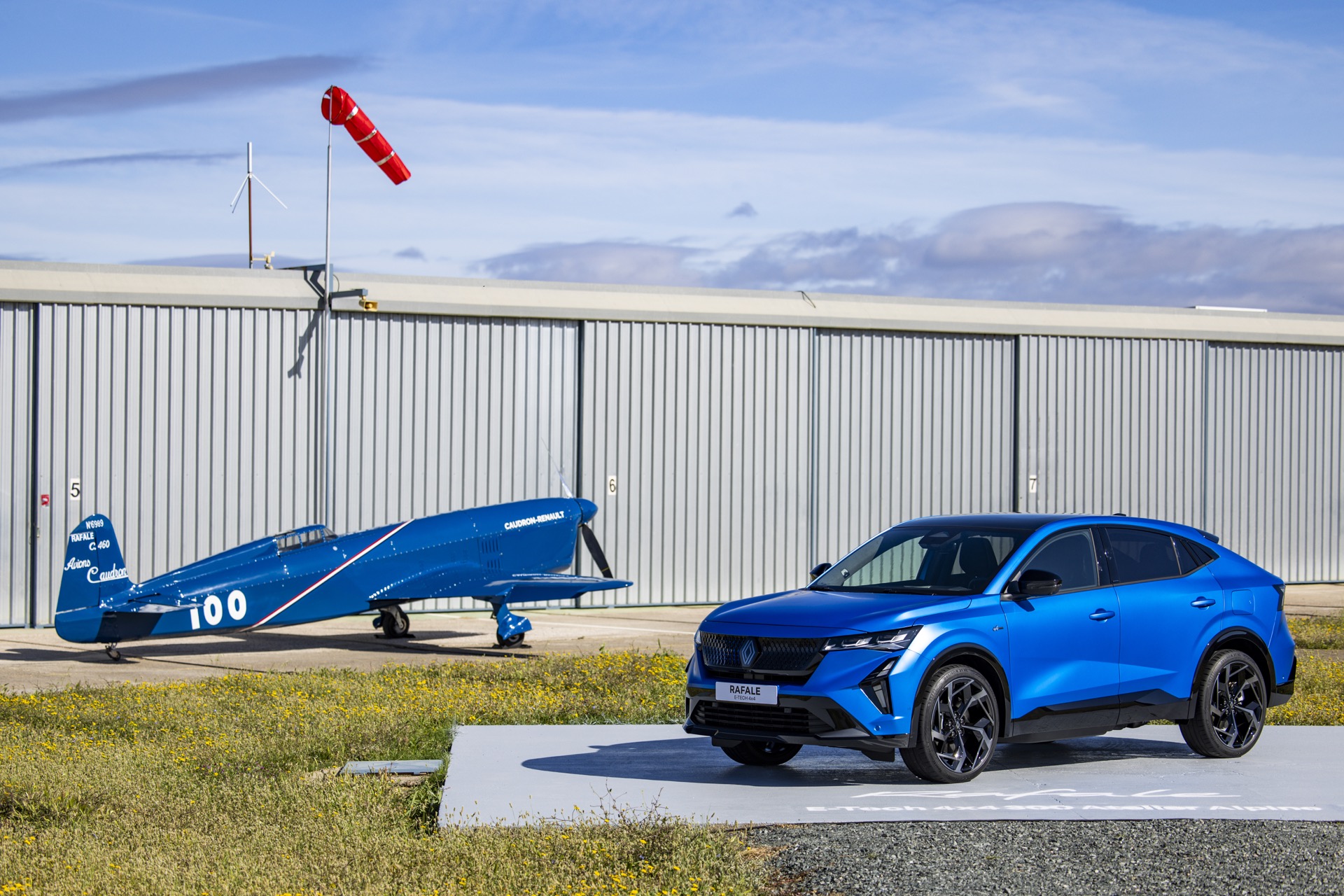
It is called Renault Rafale, and it is the third body version the French brand presents using the CMF-CD platform, after the Renault Austral and Espace, making up a very complete SUV range in this size and price segment: the Austral as a conventional SUV for all uses; the “stretched” version, the Espace, with a more family-oriented approach; and the Rafale, with its attractive coupé silhouette and a certain sporty focus.
We’ll see how long the competition takes to react, but we’re sure to start seeing SUV coupés sprouting up in this category like mushrooms. Because rivals to the Austral -and, to a lesser extent, to the Espace- there are plenty. But design alternatives to the Rafale that clearly identify as coupé SUVs are very few. If anything, the CUPRA Formentor, which doesn’t have such a markedly coupé silhouette but does have clear sporty connotations; and the Peugeot 408, which would be closer to what we could call a “crossover” than a coupé SUV.
The BMW X4 and the Audi Q5 Sportback are, though both play in another league: their price is much higher. But mind you, even costing almost 20,000 euros less, this Rafale has everything needed to become the “anti-premium” SUV: design, quality and a lot of technology. Let’s remember that by year-end the Rafale PHEV will be added to the range, with plug-in hybrid propulsion, 300 CV, 4×4 traction, predictive variable damping and four-wheel steering.
The price of the Renault Rafale: the “anti-premium” coupé SUV
One by one, I could practically repeat for the new Renault Rafale the six reasons why I told you after testing it that the Renault Austral is one of our favourite SUVs, which you can read here. But now that I’ve been able to drive the Rafale and get to know it better, I’ll go a bit deeper focusing on the differences between the Rafale and the Austral, which are many more than meet the eye. And to start, we have to talk about range and price.
The Rafale is available with the 200 CV E-TECH full hybrid engine and techno and esprit Alpine trims; that is, there are no MHEV versions nor is it offered in the entry-level evolution trim, which you can choose on the Austral, with a starting price from under 31,000 euros. The price of the Rafale E-TECH hybrid 200 CV in techno trim is 41,820 euros (discounts included), and 46,185 euros for the esprit Alpine. That’s about 4,000 euros more than the Austral with the same engine and trim. From a purely objective point of view, it’s a considerable difference. But if you ask me whether I would pay it, the answer is yes.
And since we’re talking about prices, I’m sure the esprit Alpine version, the sportiest one, will catch your eye. What you need to know here is that the 4,300-euro difference with the techno goes well beyond the decorative details that distinguish this version, such as the Alcantara and leather upholstery, the black exterior trim, the aluminium pedal covers or the specific interior trim.
The esprit Alpine includes as standard elements that are optional on the techno, such as the four-wheel steering (1,500 euros), the safety pack with blind-spot detection and rear traffic detection (380 euros), heated seats (500 euros) and the tailgate with automatic opening and closing (450 euros). It can also be equipped with options not offered on the techno, such as the head-up display, massage seats or the interesting driving & heating pack which, for 1,500 euros, includes matrix LED vision headlights, active driving assistant and intelligent adaptive cruise control.
An exterior and interior design with a lot of personality
Exteriorly the Rafale is a car that catches the eye, especially in some body colours, such as the two new ones for this model: satin pearl white and Alpine blue, and with the two-tone 20-inch alloy wheels, which are part of the standard trim. For the bodywork you can also choose between desire red, gloss black or slate grey.
At 4.71 metres long, the Rafale is as long as an Espace, with which it also shares the wheelbase; therefore, it is about 20 cm longer than an Austral. But it looks like neither of them. The front has its own design, with an eye-catching grille featuring small diamond-shaped elements and a very distinctive light signature with vertical lights below the main headlights simulating half of the brand logo. For the rear light clusters, Renault says it was inspired by the Chinese tangram puzzle. What’s striking is that they have micro-optical technology that handles the animations when lit, and they also offer a very distinctive visual effect while switched off.
Its coupé silhouette doesn’t stop the Rafale from remaining a practical car, as it doesn’t compromise access to the rear seats or the legroom or headroom, with more than notable habitability even in the PHEV version, which differs by having the floor one centimetre higher. Boot capacity is also very good, with 532 litres, even more than the Austral and the hybrid versions of the Espace.
The dashboard design is practically common with that of the Austral and Espace, with the characteristic dual screen of the OpenR system, a horizontal one behind the steering wheel of 12.3 inches, and a vertical one of 12 inches for the multimedia system. But there are many new details. For example, the sport seats are specific to the Rafale, and special materials are used for the decorative dashboard inserts: dyed natural cork in the techno, and natural slate in the esprit Alpine, with a very pleasant visual presence and feel that convey a sense of quality. The esprit Alpine versions incorporate an illuminated Alpine logo on the seatbacks, which changes colour depending on the selected driving mode.
Another novelty is the ingenious central rear armrest designed for multimedia activities, with USB ports and fold-out tablet holders. And although it’s not new to Renault, I was able to check the operation of the Solarbay panoramic roof debuted on the Scenic, with segments that turn opaque on demand. You can see more details about how it works in the following video, but I can vouch that I tried it, and it works wonderfully. It’s optional, and costs 1,500 euros, a price similar to that of a conventional sunroof.
https://www.youtube.com/watch?v=6t-K5zxe_o4
Otherwise, the multimedia system based on the Android Automotive operating system, which advances here one more generation, works just as well as ever, and I still think it’s one of the best on the market. The Google voice assistant even allows controlling the different opacity settings of the sunroof without using the corresponding button.
At the wheel of the Renault Rafale E-TECH Hybrid: sporty… with nuances
Responsiveness and agility are two of the priorities Renault put on the table so that the Rafale would stand out not only for its design but also when driven. To this end, compared with the Austral the track width has been increased by 40 mm, the suspensions have firmer tuning, and the standard tyres are 10 mm wider, keeping the profile: 245/45-R20. Another important detail is the brakes, with discs going from 320 to 350 mm on the front axle, and from 292 mm to 330 mm on the rear. The steering also has a specific calibration.
The Rafale version I was able to drive is the esprit Alpine, with the 4Control four-wheel steering as standard, which, as on the Austral, allows you to configure the degree of “agility” you want it to provide at different levels from the multimedia screen when selecting the individual mode among those available in the Multi-Sense system. Not knowing how a Rafale behaves with conventional steering, my recommendation for those who settle for the techno trim is to consider it: it’s one of the keys that make the Rafale stand out for its agility when the corners come, along with how flat it turns. On the downside, between the firmness of the suspension and the tyre choice, the Rafale does not reach the bump comfort of the Austral and Espace; but it can’t be called an uncomfortable car either.
As for the 200 CV E-TECH Hybrid propulsion system, little to add to what is already known. It stands out mainly for its pleasant use when driving at low speed, situations in which it can move for a large part of the time powered solely by the main 70 CV electric motor (it has a second 25 CV motor that acts as a generator and manages gearbox synchronisation) and by very low consumption: around 6.5 l/100 km combining road and motorway, and without shooting up even if you increase the pace.
https://youtu.be/-swSlmNruAI
As the two electric motors can add thrust to the 1.2 Turbo 130 CV petrol engine, throttle response is quick and the overall operation very smooth. However, when driving sportily, or tackling a very steep climb, that is, when you need to press the accelerator decisively, it is easy to completely drain the battery. Then you will suddenly notice how the available power clearly drops, until the road, or your driving, allows energy to be recovered again and the situation quickly returns to normal.
Clear interruptions or gaps in power delivery are also still noticeable which, as Renault confirmed to us, correspond to the moment when the four-speed Multimode gearbox shifts gears in the intermediate ratios under a demand for strong acceleration. The brand’s engineers told us they are still working on the software to gradually correct or at least smooth out this detail, which does not overshadow the good impression the Rafale leaves, unless you expect a decidedly performance-oriented feel at the wheel; but for that there is already the 300 CV Rafale PHEV.
Renault Rafale – Image gallery
Technical specifications of this car

 Peugeot E-208 GTi: a battery-powered toy that revives the spirit of the 1980s sports cars
 New Lexus ES: luxury grows and goes electric
 First contact with the Dacia Sandero Hybrid 155: power and efficiency from €19,890
Deja un comentario