2008 208 Peugeot Hybrid Cars ECO SUV Urban
I have tried the new Peugeot 208 and 2008 Hybrid, and I'm clear about it: forget the PureTech versions!
 Antonio Roncero @roncero_antonio
17 July 2024
9 min.
Peugeot continues to reap success with its range of 100% electric vehicles: the brand is the leader in Europe in the electric B segment with the e-208 and e-2008, and also holds the top spot among electric commercial vehicles. Furthermore, Peugeot’s electric range is one of the broadest, with up to 9 passenger cars (in addition to the aforementioned e-208 and e-2008, we must add the e-308 saloon and SW, the e-408, the new e-3008and e-5008, the e-Rifter and the e) and three light commercial vehicles (e-Partner, e-Expert and e-Boxer).
Peugeot’s offer of plug-in hybrid models is no less impressive. With this technology you can choose the 308 and 508 in both body variants, as well as the 3008 and 408. All of them, as with the electric models, carry the DGT CERO emissions label.
Where Peugeot “fell short” until recently was in its range of partially electrified models -without a plug- and ECO label. This has been addressed with the arrival of Hybrid 48V technology, which debuted on the 5008 and is now also available for the 308 saloon and SW, 3008 and 408, joined now by the new 208 and 2008. We have precisely tested the city car and the small SUV with this new mild hybridisation technology, which brings many advantages we will now examine in detail… and which allows me to make an initial statement that may sound categorical, though I will also try to explain myself: if you are going to buy a Peugeot, forget the Puretech engines without hybridisation and switch to these Hybrid versions!
This technology is by no means new to the market, though it is for Peugeot. Well, in fact, for the Stellantis Group, as it is being progressively incorporated across many of its models. Recently we discussed it after driving the Opel Corsa Hybrid, and also on the occasion of the presentation of the Jeep Avenger Hybrid.
Peugeot’s Hybrid 48V technology
Although the Hybrid designation is used, in the case of Peugeot (and all Stellantis models incorporating this technology) we are not dealing with a conventional hybrid car, such as the popular models from Toyota, the E-TECH Hybrid from Renault, or the hybrid versions from Kia and Hyundai. In fact, many brands offer both technologies in their ranges, mild hybridisation and “full hybrid”, as conventional hybrids are also known to distinguish them from MHEV or mild hybrids. But not all mild hybrid systems are the same.
Here you can read more on the subject. But, basically, what you need to know about mild hybridisation is that it is a simpler -and therefore cheaper- technology than a full hybrid with a self-recharging high-voltage battery system; it reduces consumption and improves performance and driving enjoyment compared with the equivalent engine without this technology; and, like hybrids, it also allows you to obtain the DGT ECO label. We summed it up this way when the two protagonists of today were presented: “They are cheaper than a hybrid and also carry the ECO label: the new Peugeot 208 and 2008 MHEV arrive“. Now, moreover, we have driven them.
The starting point of these Hybrid versions is the evolution of the 1.2 Pure Tech three-cylinder petrol engine, called EB GEN 3. And it is no minor evolution. To begin with, the timing drive has been redesigned, now by chain, instead of the belt that has caused so many headaches for many users of the original engine… and for Stellantis itself. Although the brand insists that the change was not due to reliability issues, and that the non-hybrid Pure Tech versions will keep the timing belt. What can I say, the belt-to-chain change alone already scores many points for me when it comes to paying more for these Hybrid versions. Furthermore, this GEN3 engine features Miller combustion cycle, variable geometry turbo and VTT variable valve timing.
The second key element in this system is the E-DCT dual-clutch gearbox. Between the engine and the gearbox an electric motor is installed, connected to the crankshaft via a coupling clutch. The remaining elements are a second belt-driven electric motor that acts as generator and starter motor for the combustion engine. The system is completed by a 48-volt battery with a gross capacity of just under 1 kWh (just over 0.5 kWh net).
The difference from other simpler MHEV systems, in which the generator acting as starter motor can add extra energy to the combustion engine but cannot move the vehicle on its own, is that in this case, although only in very specific situations, 100% electric driving is possible, thanks to the additional electric motor located between the combustion engine and the gearbox. For example, when pulling away and covering the first kilometres smoothly in electric mode. But also when parking, or in the continuous stop-start situations found in traffic jams. Up to 50% of urban journeys can be made in electric mode, according to Peugeot. Naturally, another advantage of the system is that it allows coasting when the driver lifts off the accelerator.
Translated into figures, again according to the brand, all this means a fuel saving of around 0.8 l/100 km on the road and up to 1.6 l/100 km in the city, comparing the 100 hp Hybrid engine with the equivalent PureTech. And greater still, up to 1.2 and 2.4 l/100 km respectively, if the comparison is between the 136 hp Hybrid and the non-hybridised version with the same power and the EAT8 torque converter automatic gearbox.
Behind the wheel of the Peugeot 208 and 2008 Hybrid
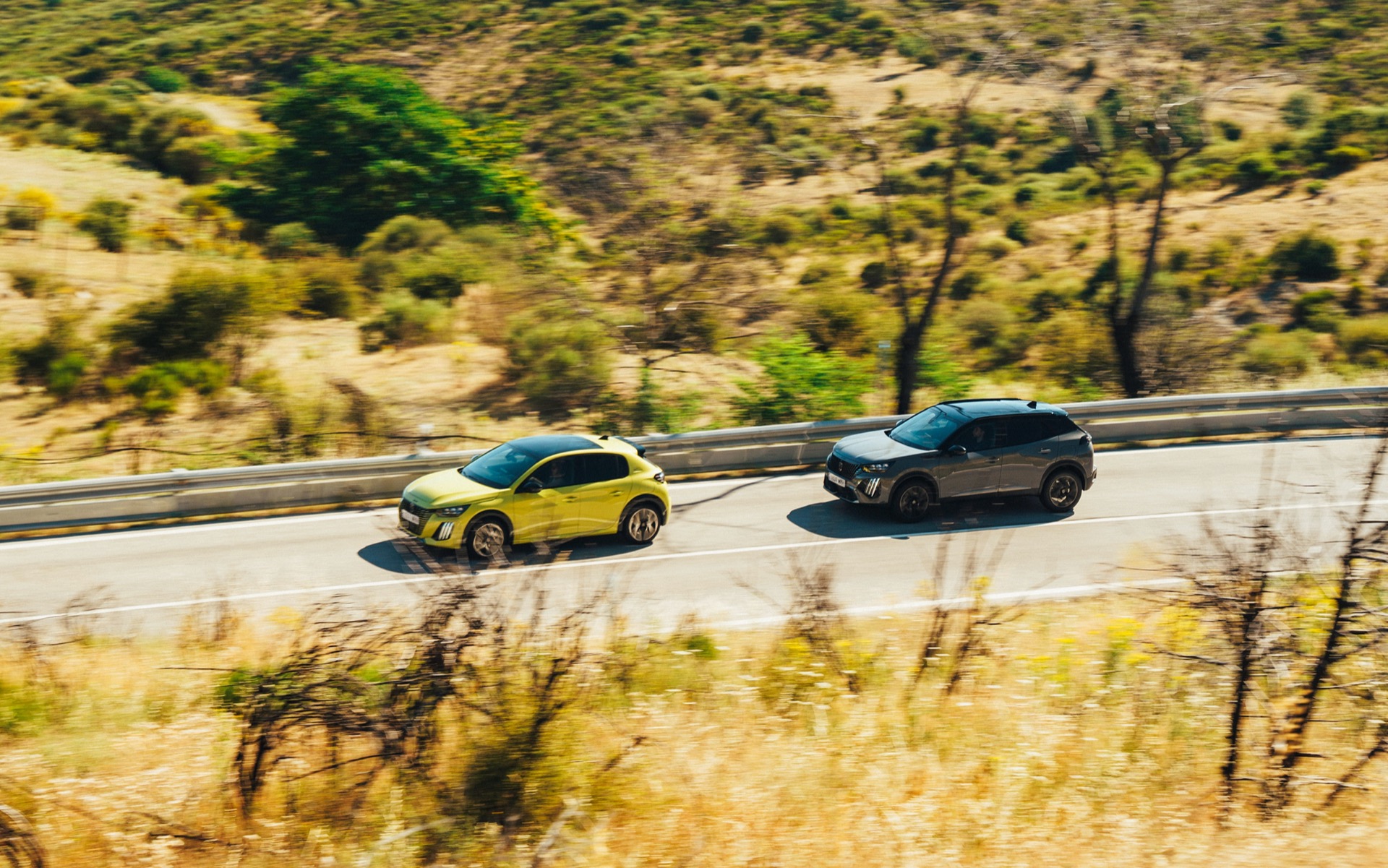
The theoretical advantages are noticeable in practice as soon as you pull away in either of the two available Hybrid versions, with 100 hp or 136 hp. For the 208 both are offered, although the 136 hp is only associated with the GT trim, while for the 2008 the most powerful is reserved.
The 100 hp is more than sufficient for the small city car which, in addition to the significant consumption reduction mentioned above, noticeably improves throttle response and driving enjoyment compared with the 100 hp PureTech. I would even venture that it accelerates much better than the official figures suggest, which indicate a gain of barely 0.3 seconds in 0-100 km/h, and 0.2 seconds over 1,000 metres from a standing start. Without doubt, a magnificent engine for a car like the Peugeot 208. It is true that, if we take the interesting Allure versions as reference, it represents an additional outlay of almost €2,700. But look at everything you get in return: dual-clutch automatic gearbox -which alone almost justifies it-, a car that consumes less and performs better, the DGT ECO label… and the “peace of mind” of a chain-driven timing system.
And if you are torn between the 100 hp and 136 hp Hybrid, the choice is easy. The most powerful Hybrid engine in the 208 range is only offered with the top trim and a sportier approach, the GT. It costs €1,000 more than the 100 hp Hybrid, but the difference in performance is large enough to make the outlay worthwhile, especially in a version with the GT badge: the 136 Hybrid is about two seconds quicker both in acceleration measurements and in in-gear overtaking from 80 to 120 km/h, the manoeuvre most similar to an overtake on a main road.
For the 2008, only the most powerful Hybrid is offered, with 136 hp, although the non-hybridised Pure Tech 100 hp with manual gearbox remains in the range, which in my view falls a little short for this car. The 100 hp Hybrid would indeed be a very reasonable entry version, with that additional push from the hybridisation; but, at least for now, there are no plans. The Pure Tech 130 hp with the EAT8 automatic gearbox also remains in the range, though I doubt it will last long: with equal equipment, the price premium of the 136 hp Hybrid, which benefits from exemption from registration tax, does not even reach €800. And once again the Hybrid is quicker, consumes less, adds the advantages of the ECO label… and, I insist, has a timing chain. Under these conditions, I would not buy a 2008 with the Pure Tech 130 hp EAT8 engine over the Hybrid, unless there is a major incentive in the form of a substantial discount.
During a test drive through the roads of the Madrid mountains at the wheel of the Peugeot 2008 we were able to verify how well the mild hybrid system works, as well as the dual-clutch gearbox, which you can operate manually using the paddles on the steering wheel. Smoothness, immediate throttle response -the electric motor adds up to 12 hp of extra push when you accelerate hard-, very low consumption in ECO and Normal modes -real average of 5.7 l/100 km- and more than sufficient performance to move with the agility a well-tuned chassis allows when you switch to SPORT mode.
Peugeot 208 and 2008 – Image gallery
Technical specifications of the cars in this article

 Peugeot E-208 GTi: a battery-powered toy that revives the spirit of the 1980s sports cars
 New Lexus ES: luxury grows and goes electric
 First contact with the Dacia Sandero Hybrid 155: power and efficiency from €19,890
Deja un comentario