C-HR Toyota Hybrid Cars Crossovers ECO Tests
Real-world consumption test: Toyota C-HR Plug-In Hybrid, a plug-in hybrid with plenty of appeal
 Antonio Roncero @roncero_antonio
8 August 2025
10 min.
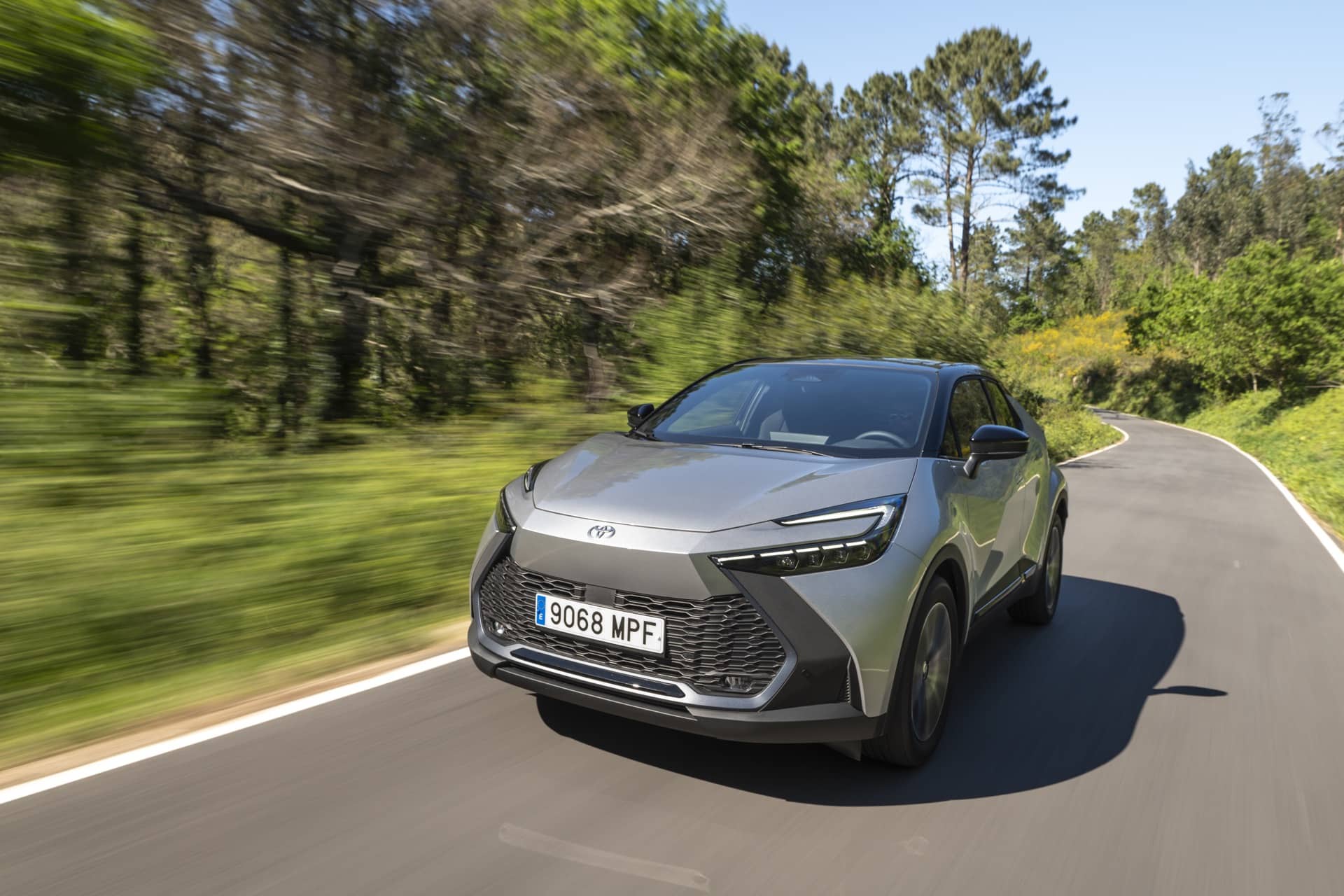
I really liked the Toyota C-HR Plug-In Hybrid when I had the chance to drive it at its first national press presentation back in April 2024. Since then, several things have happened that make it worth revisiting this interesting model. For example, Toyota has introduced changes to the C-HR range that affect pricing and positioning, both for the HEV and the PHEV versions, and I can tell you now that they will surprise you.
What’s more, new vehicles of real calibre have arrived and ended the dominance the C-HR PHEV held as the best-selling plug-in hybrid in our market. Just to mention one, there’s the new MG HS, which led PHEV sales in June. Or the BYD Seal U DM-i, which has already overtaken the C-HR in the sales ranking for the cumulative total to July 2025. Not to forget the updated Ford Kuga PHEV or the newcomers Jaecoo 7 PHEV and Ebro S700 and S800 PHEV, which are attracting more and more buyers.
And since I’ve also been able to live with the C-HR plug-in hybrid for a few days to carry out a more in-depth test, now is the time to update my driving impressions, review the model’s key points and, above all, tell you about one of the car’s most interesting aspects: its real-world electric range and its everyday consumption. Let’s get into it.
Toyota currently has three models among the five best-selling conventional (non-plug-in) hybrids in our market. And none of them is the C-HR, which was always there when the plug-in hybrid wasn’t on sale. They are the Corolla, the Yaris Cross and the Yaris.
That’s no surprise. We went into this topic in depth at the time (you’ll find the link a little further on), but I don’t want to miss the chance to stress why the Toyota C-HR plug-in hybrid (from now on I’ll refer to this version as PHEV) is a much better buy than the conventional non-plug-in hybrid (HEV). Even more so now, with the price repositioning Toyota has carried out. In fact, it surprises me that the HEV version still sells… You’ll understand right away.
C-HR plug-in hybrid: far better than a self-charging hybrid
When the C-HR PHEV launched, Toyota priced it about 4,500 euros above the C-HR HEV with the same equipment, not counting purchase grants under the MOVES plan. Now, the C-HR HEV comparable to the PHEV in terms of equipment is the 200H version with GR Sport trim, and they cost the same: 38,250 euros list price!
Remember that with the PHEV you can benefit from the MOVES Plan, with a grant of 2,500 euros as long as its electric range doesn’t exceed 90 km, plus another 2,000 euros if you scrap an old car. So the PHEV costs 2,500 euros less than the HEV (5,000 euros less if you scrap a car), although it’s fair to mention that the 200H GR Sport comes with four-wheel drive as standard.
It’s also true that Toyota offers a C-HR HEV from 30,750 euros, but that’s the 140H in Active trim. If we look at the Advance version, the better buy in terms of price-to-equipment ratio, it starts at 31,500 euros. That’s 1,000 euros less than the entry-level C-HR PHEV in the same trim if you take advantage of MOVES. There’s no contest…
I’m not trying to convince you to switch to plugging in. But without going into too much detail, just note this at first glance, in addition to the price considerations. Compared with the HEV versions, the C-HR PHEV gives you:
- A much faster and more powerful car (83 CV more than the 140H and 26 CV more than the 200H)
- A more advanced generation of hybrid transaxle, resulting in greater efficiency and less noise
- A specific suspension (dampers with rebound control) that makes the car feel better to drive
- More powerful brakes, more underbody insulation and a heat pump as standard.
Add to this the advantages of the DGT’s ZERO label and, as if that weren’t enough, the savings from using the car in electric mode day to day, which by my reckoning can be estimated at around 500 euros a year for a driver covering 15,000 km annually. In short, and very directly, let me tell you that if you buy a C-HR HEV instead of the PHEV version, you’re making a mistake. And you know it…
Consumption of the Toyota C-HR PHEV with and without battery charge
This is where we get into a particularly interesting aspect. Not just comparing the C-HR’s hybrid versions, but when weighing up this Toyota against any other hybrid alternative on the market… even if you don’t have a plug at home. Because the C-HR PHEV uses very little even when its battery is flat.
Let’s start with the electric side. The battery capacity is 13.6 kWh, which allows an officially homologated WLTP range of 66 km in the combined cycle, and getting close to 100 km/h in the urban cycle, according to official data. These figures are starting to look short next to the trend we’re seeing in new plug-in hybrids, with larger batteries and ranges around 100 km. But the truth is the C-HR gives you plenty of flexibility.
During the test I found it very easy to always exceed 50 km of real electric range on mainly interurban routes, using ECO mode, which is enough to keep pace with traffic in everyday driving. If you mostly use it in town, you can cover at least around 80 km before the battery runs completely flat, depending on traffic and, above all, outside temperature. As you know, in very cold weather electric range always drops a little.
Another option instead of staying in full electric mode, which is where the car starts by default, is to select hybrid mode. With a full battery you can cover around 150 km at a very low average consumption, around 2.5 l/100 km.
And what happens once the battery is completely empty? The C-HR PHEV switches to hybrid mode and, surprisingly, despite its higher power and greater weight, it consumes almost the same as the HEV version, which is… very little. Together with the Ford Kuga PHEV, it is the plug-in hybrid of all those I’ve tested that consumes the least when running in hybrid mode with a flat battery. How much? Averages around 5.5–6 l/100 km in mixed driving and around 7.5 l/100 km on the motorway, again using ECO mode, which gives you plenty of flexibility, and driving the way you need to drive a hybrid to keep consumption low: anticipatively, but without being overly fixated on the accelerator and, of course, without switching off the climate control.
If you’ve read between the lines, you’ll already have worked out that you can buy and run a C-HR PHEV even if you don’t have a plug at home and can’t take daily advantage of the consumption savings that charging it every day makes possible. In that case you use it like a conventional hybrid, only worrying about refuelling, and you take advantage of occasional charging whenever it’s convenient, for example while you do the shopping at a shopping centre.
Only in this respect is it a pity that it doesn’t accept fast charging. But given how the car is set up, the onboard 6.6 kWh charger is sufficient: it charges the battery in about 2 hours from a 32-amp socket. I’ve been charging it from an ordinary domestic socket, with no modifications, at around 2.4 kW, so leaving it plugged in overnight is enough to start the day with the battery always full.
To finish this chapter: if you forget it’s a hybrid, select Sport mode and head out on your favourite twisty road, where the C-HR handles surprisingly well despite never feeling like a sports car or having more than 200 CV. Consumption doesn’t shoot up either, and the figure will hardly reach double digits.
On the road with the Toyota C-HR Plug-In Hybrid
Otherwise, I have to say I really liked the C-HR. It’s one of those cars that, once you’re clear about its limitations (mainly the rear seats, which are tight on space, and the small boot), wins you over more and more the more kilometres you cover.
Nor does it have a multimedia system on a par with the best, with ever-larger screens and more intuitive operating systems, although Toyota has improved this area a lot compared with earlier generations. The C-HR makes do with a 12.3-inch screen for the instrument cluster which doesn’t have a high resolution but offers a great deal of information, and another of the same size with the Smart Connect+ system for infotainment, which requires some adaptation but does the job. The wireless connection with Apple CarPlay worked very well for me, and I like having conventional controls for the climate system without having to go through the screen.
On the move there is a smoothness and refinement of operation, to which the prominent role of the electric motor contributes a great deal, with an instantly responsive throttle and good acoustic insulation. You can tell that Toyota has paid particular attention to this area.
Overall, the feeling at the wheel is of a very pleasant car, even for long journeys, secure and well planted on the road — the weight of the battery lowers the centre of gravity, and you can feel it — one that doesn’t fall apart over bumps and doesn’t feel clumsy when the bends come. Total range isn’t very large for a plug-in hybrid, because the fuel tank is small: just 43 litres.
That said, don’t expect the sensations of a GTI, even though the spec sheet says it has 223 CV. Not because it fails to deliver them, but because of how the transmission works, clearly focused on efficiency and comfort. To gain more control over the propulsion system and be able to have a bit of fun, at least with the regenerative braking retention, without having to limit yourself to the “D” and “B” positions of the transmission, it would be helpful to have paddle shifters on the steering wheel. There are three levels of retention available, but you can only select them by going into a menu from the steering-wheel controls with the car stationary.
Toyota C-HR | Image gallery
Technical specifications of this car


 Kia offers an electric range of 10 models, 50 versions and 400 possible combinations
 The seven finalists for the 2027 European Car of the Year (COTY) are exclusively electric
 Peugeot E-208 GTi: a battery-powered toy that revives the spirit of the 1980s sports cars
Deja un comentario