Model 3 Tesla Sedans Electric Cars
Test drive of the Model 3: is the cheapest Tesla also the BEST of them all?
 Óscar Sanz
5 December 2025
8 min.
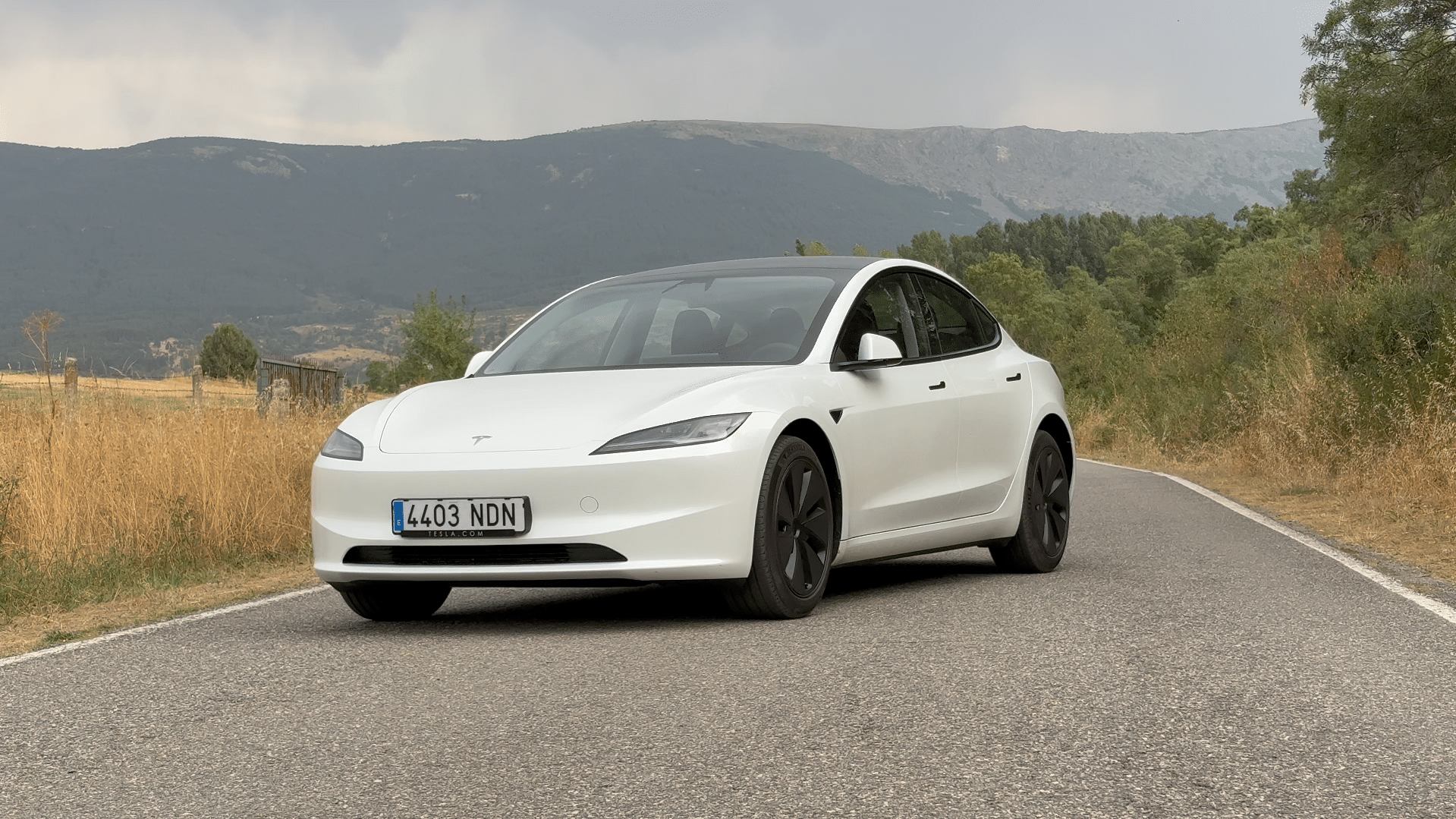
They say perfection doesn’t exist… but some never stop trying. In 2017, Tesla broke the mould with the Model 3. It was fast, efficient and more affordable than any other electric car from its brand. Now, seven years later, comes its most refined evolution. Quieter. More comfortable. More efficient. This is the new rear-wheel-drive Tesla Model 3, and today we’re going to find out whether, in an increasingly competitive market, it’s still the king… or whether its crown has been taken away.
https://youtu.be/ia-8_eRdyjM
You’ll recognise it at a glance from the outside, but everything is more polished. The lines are cleaner, with sharper headlights and aerodynamics fine-tuned to the millimetre, which allow it to achieve a drag coefficient of 0.219, still a benchmark figure that few can match. It’s not a radical redesign, but it’s enough to convey the feeling of a mature product. On top of that come two new colours: Ultra Red and Stealth Grey.
What hasn’t changed compared with what we knew until now are its dimensions: it measures 4,720 mm in length, 1,441 mm in height and 1,850 mm in width, with a wheelbase of 2,875 mm. Along the side, however, we don’t see major changes; the most notable elements are the blind-spot camera located on the B-pillar, the door handles flush with the bodywork and the wheels, which, by the way, are plastic, 18 inches, and also available in 19″, although the latter cuts the range by up to 40 km.
The rear lights change their light signature and are now integrated directly into the boot lid to improve fit and aerodynamics. Under the front bonnet it hides a practical “frunk” of 88 litres, perfect for storing charging cables or a small piece of luggage. And at the back, the main space offers 425 litres
, with a wide opening and usable shapes, more than enough for family trips and roomier than other models in the segment such as the BYD Seal or the Hyundai Ioniq 6.
A simple yet sophisticated interior
And what matters is inside: more sound insulation, a suspension optimised to smooth out potholes and an interior with better-quality materials and a touch of ambient lighting that makes it cosier and more appealing. The cabin has been completely redesigned with materials that convey a better visual and tactile impression, which was one of the car’s weak points. Real aluminium, new textiles and a level of finish you can feel to the touch.
The front seats are now ventilated and heated, and the rear seats also get heating as standard. The centre console is new, with an aluminium finish; there is now more storage space and it includes wireless charging for two phones. In addition, it has a front USB-C port and two rear ones with 65 W of power, more than enough to quickly charge even a laptop. The 15.4″ central screen keeps its size but has reduced bezels to gain usable area, and the interface is now more customisable.
All the data appears on it, since we don’t have instrumentation behind the steering wheel, from speed to opening the glovebox, adjusting the mirrors, the steering wheel or even checking the range. What we do miss, though, is that Tesla still hasn’t integrated compatibility with Android Auto and Apple CarPlay. In the rear seats, the headroom and space are very remarkable. The panoramic roof eliminates the C-pillar and gives an incredible sense of openness. For the first time, there is an 8″ screen to control the climate, ventilation and access streaming entertainment.
A motor perfect for any situation
Under the bonnet — or rather, under the floor — it hides a 283-horsepower motor, rear-wheel drive and a battery that allows it to cover up to 513 kilometres on the WLTP cycle. In real life, on the road, that figure drops to around 325 km if you maintain travel speeds. There is, however, another rear-wheel-drive version available, the Model 3 Long Range with all-wheel drive, which weighs 1,828 kg, about 100 kg more than the version we’re testing, and reaches a range of 629 kilometres; that one, admittedly, costs €10,000 more. Charging is one of its strong points: it can go from 10 to 80% in just over 25 minutes at a fast charger. And if you’re in a hurry, using the Tesla Supercharger network is, today, one of the most comfortable experiences any electric car offers. The Model 3 can charge up to 282 km in just 15 minutes at one of the 12,000 Supercharger locations across Europe, which deliver 250 kW of power.
Driving sensations
For this test we drove a Madrid–Segovia and Segovia–Madrid route, charging our model at one of Tesla’s Supercharger stations, where we managed to charge our unit to the maximum in just 15 minutes and where, over 135 kilometres of driving, the car lost 40% of its range. It is homologated at a consumption of 13.2 kWh/100 km on the WLTP cycle, although in our test, with mixed city and motorway use, we recorded consumption of 14 kWh/100 km.
As for driving, Tesla opts for simplicity: there’s nothing to switch on or handbrake to engage; you simply sit down, fasten your seatbelt and drive. The levers have been eliminated, replaced by controls on the steering wheel and haptic controls for the indicators. To select gear, we have to go either to the top-left corner of the multimedia screen and drag the car symbol, or to touch buttons located on the roof; it’s not the most comfortable, but it doesn’t take away from practicality. After all, you only have to select “D” or, when manoeuvring, “R”.
The sensation on the road is one of greater refinement. There is no noise, the comfort is remarkable, thanks to a new acoustic glass all around the perimeter, new seals and improvements to the suspension. The result: 30% less wind noise, 20% less rolling noise and 25% less impact noise. The steering loses a little immediacy compared with the previous model, but the suspension and chassis rigidity have achieved a better balance; it remains agile through bends, but is now more relaxed and comfortable for long journeys. With its 283 hp motor and rear-wheel drive, it accelerates from 0 to 100 in about 5.2 seconds and reaches 201 km/h. The WLTP range is 513 km, although on realistic roads it hovers around 325 km. More than enough for long journeys, although it really shines on urban routes.
If I have to find a drawback in its dynamics — apart from the fact that it has lost a little agility — it would be that we can’t play with energy recuperation. There is only one regeneration mode, the default one, and there is no possibility of increasing, decreasing or deactivating it, and I can assure you it is even a little abrupt in some situations. In town it is very comfortable, and the one-pedal driving is one of the best inventions of the electric car, but on the open road we didn’t like it because, for example, it makes you lose momentum on downhill slopes unless you keep a very close eye on the accelerator so as not to lift off completely and the regeneration isn’t at its maximum.
Compared with its rivals, the ones most likely to challenge it are the Hyundai Ioniq 6 or the BYD Seal
, two very similar models, but in terms of value for money, the Tesla Model 3 remains the undisputed king. And I’m not saying this, the numbers are. Compared with the Seal, the Tesla is more efficient and the whole charging ecosystem works better. The dynamic sensations of the Ioniq 6 are closer, but the price of the most basic version of the Ioniq 6 is €10,000 more than this one, although it has more range.
A very competitive price… which keeps it as a best seller
And now the important part, the prices. The range starts with the rear-wheel-drive version, which offers up to 554 km of WLTP range at a price of €40,000. Next comes the Long Range rear-wheel drive, which reaches 702 km and costs €45,000§h70§. And at the top, the Long Range all-wheel drive, with 678 km and a price of €49,000. Which one would I buy? Well, with the entry-level version of the range you already get a superb saloon for everyday use and for tackling long journeys without range anxiety.
Technical specifications of this car


 Peugeot E-208 GTi: a battery-powered toy that revives the spirit of the 1980s sports cars
 New Lexus ES: luxury grows and goes electric
 First contact with the Dacia Sandero Hybrid 155: power and efficiency from €19,890
Deja un comentario